

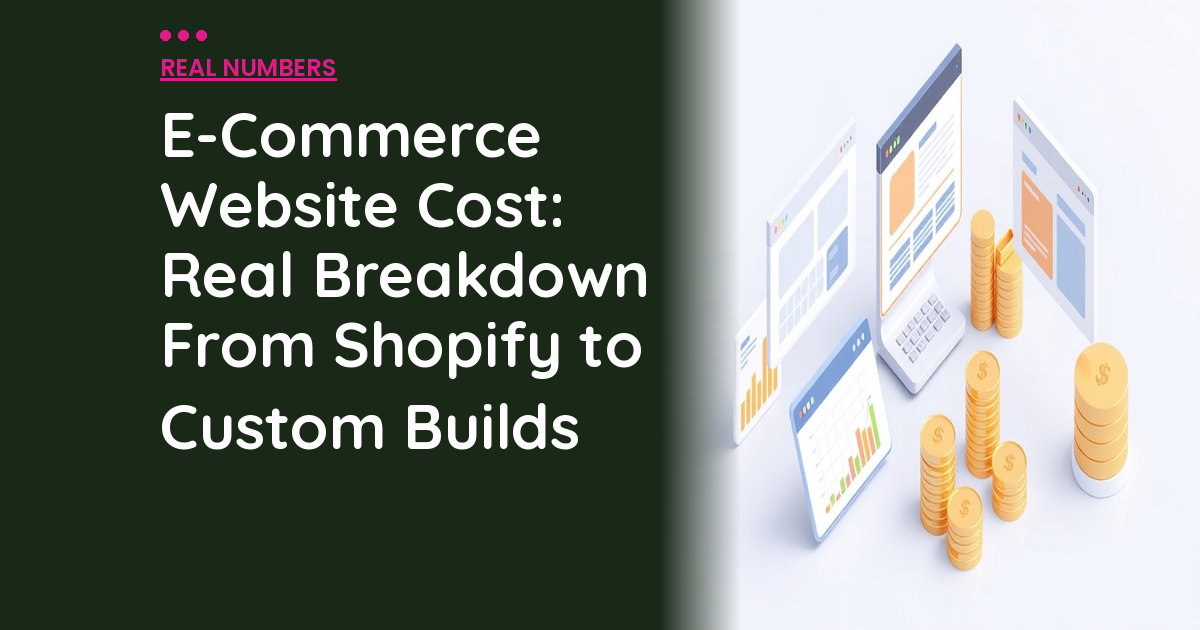
E-Commerce Website Cost: Real Breakdown From Shopify to Custom Builds
The Real Cost of an E-Commerce Website in 2025
If you Google “how much does an ecommerce website cost,” you’ll get answers ranging from $500 to $500,000. Super helpful, right?
📋 Table of Contents
After 12+ years building e-commerce sites for our 400+ clients served, from simple WooCommerce shops to complex custom platforms, I can tell you the real answer depends on exactly three things: what platform you choose, how custom you need it, and who builds it. Everything else is just noise.
Let me break down the actual costs so you can make an informed decision instead of getting blindsided by a quote that’s 3x what you expected.
The Three E-Commerce Platform Tiers
Every e-commerce website falls into one of three categories. Understanding which one you need is the first step to knowing what you’ll spend. I’ve built sites in all three tiers, and the difference in complexity and cost is massive.

Tier 1: DIY Platforms (Shopify, Squarespace, Wix)
These are template-based, hosted platforms where the technology is handled for you. You pick a theme, customize it, add your products, and go. It’s the fast food of e-commerce development.
Monthly platform fees run $29 to $399 for Shopify, or $27 to $49 for Squarespace. Themes cost anywhere from free to $350 as a one-time purchase. Apps and plugins are where the costs spiral, they start free but you’ll easily spend $100 to $500 per month once you add inventory management, email marketing, reviews, and analytics tools. Setup time is 1 to 4 weeks if you’re doing it yourself, or 2 to 6 weeks if you hire someone to do it properly.
Pro tip: Don’t get app-happy on Shopify. Every app you add slows down your site and increases your monthly bills. Start with the basics and add functionality only when you actually need it, not when you think you might need it someday.
Total first-year cost for DIY is typically $500 to $3,000. If you hire professionals to set it up right, you’re looking at $3,000 to $15,000.
Tier 2: Self-Hosted Platforms (WooCommerce, Magento)
These give you more control but require hosting, security, and technical maintenance. WooCommerce runs on WordPress, which means maximum flexibility but also maximum responsibility. When something breaks at 2am, it’s your problem to fix.
Hosting costs range from $30 to $300 per month depending on your traffic volume. Themes run $60 to $200 as a one-time purchase. Plugins can cost anywhere from free to $1,000 per year for the premium ones you actually need. SSL certificates used to cost $200 per year, but most decent hosts include them free now. Professional development and setup will run you $5,000 to $30,000, and the whole project typically takes 4 to 12 weeks to complete properly.
Total first-year cost with professional development is $8,000 to $35,000.
Tier 3: Custom-Built E-Commerce
This is for businesses with specific requirements that off-the-shelf solutions can’t handle. Custom product configurators, complex pricing logic, multi-vendor marketplaces, or integrations with legacy ERP systems. It’s expensive because it’s basically building a car from scratch instead of buying one off the lot.
Development costs start at $25,000 and can easily hit $250,000 or more for enterprise builds. Hosting runs $100 to $2,000 per month for servers that can handle the custom code. Maintenance is $1,000 to $5,000 per month because you need developers on retainer to fix things when they break. Setup time is 3 to 12 months, and that’s if everything goes according to plan.
Total first-year cost ranges from $40,000 to $300,000 and up.
Free Template
The Ultimate Task Delegation Template
Stop guessing what to hand off. This template shows you exactly what to delegate, how to brief it, and how to QA the results.
Get the Free Template →
Platform Comparison: What Each One Actually Gets You
Let me give you the no-BS comparison based on hundreds of e-commerce projects I’ve overseen. Starting costs for Shopify run $500 to $5,000, WooCommerce is $5,000 to $20,000, and custom builds start at $25,000 and go up to $250,000. Monthly ongoing costs are $79 to $500 for Shopify, $50 to $500 for WooCommerce, and $500 to $5,000 for custom builds.
Shopify is very easy to manage but limits your customization options to moderate levels. You get good SEO control but pay 0.5 to 2% transaction fees unless you use Shopify Payments. It scales well up to 7-figure businesses and works best for quick launches with simple product catalogs.
WooCommerce requires moderate technical skills but gives you high customization freedom. SEO control is excellent, and you only pay payment processor fees with no platform transaction fees. It scales to 8-figure businesses and works best for content-heavy stores or existing WordPress sites.
Custom builds require dedicated developers but offer unlimited customization and scalability. You get excellent SEO control and only pay payment processor fees. These work best for complex business requirements that standard platforms can’t handle.
Hidden Costs Nobody Tells You About
The sticker price of an e-commerce website is never the full picture. Here’s what catches people off guard every single time.
Payment Processing Fees
Every transaction costs 2.4 to 3.5% plus 30 cents. On $100,000 in annual sales, that’s $2,700 to $3,800 just in payment fees. It’s not optional, it’s not negotiable, and most people forget to factor it into their pricing until they see their first monthly statement.
App and Plugin Bloat
Shopify apps are a money pit disguised as convenience. The average Shopify store uses 6 to 7 apps, and at $10 to $100 each per month, you’re looking at $60 to $700 monthly on top of your Shopify subscription. WooCommerce plugins are cheaper upfront but you’ll still spend $200 to $500 per year on the premium ones you actually need.
Product Photography
Your e-commerce site is only as good as your product images, and professional photography costs real money. Basic product shots run $25 to $75 per product. Lifestyle photos with models and staging cost $100 to $300 per product. If you have 50 products, you’re looking at $1,250 to $15,000 for photography alone. And you’ll need to update these photos regularly as products change.
Ongoing Maintenance
Websites break. Plugins need updates. Security patches need applying. For a WooCommerce site, budget $100 to $500 per month for ongoing maintenance, or things will start failing at the worst possible times. Shopify handles most of this for you, but you’ll still need to manage app updates and theme tweaks as your business evolves.
Watch out: Maintenance isn’t optional just because your site is “finished.” Ignoring updates is like never changing the oil in your car. Everything works fine until it doesn’t, and then you’re looking at a complete rebuild instead of simple upkeep.
Content Creation
Product descriptions, category pages, blog content for SEO. Someone has to write all of this, and if you want it done well, it costs money. Budget $50 to $200 per product description for professional copywriting. Blog posts that actually drive traffic cost $500 to $2,000 each. Most businesses underestimate this by a factor of three.
Design Updates and Seasonal Refreshes
Your homepage needs seasonal banners, promotional graphics, email templates, and social media assets. This is ongoing work that never stops. Working with a flat-rate design team can keep these costs predictable instead of getting nickel-and-dimed every time you need a banner updated.
We cover this in more detail in best superside alternatives in 2025: enterprise design without enterprise pricing.
What Should You Actually Spend?
Based on business size and goals, here’s my honest recommendation after seeing hundreds of launches succeed and fail.
Just Starting Out (Under $100K Revenue)
Go with Shopify Basic at $39 per month. Pick a clean theme, focus on getting products listed and traffic flowing. Don’t overthink it. You can always upgrade later when you have actual revenue data to guide your decisions. Budget $500 to $3,000 to launch properly.
Growing Business ($100K to $500K Revenue)
Shopify or WooCommerce with professional setup makes sense here. Invest in custom design, proper product pages, and conversion optimization. This is where professional help pays for itself because the cost of poor conversion rates exceeds the cost of doing it right. Budget $5,000 to $20,000 to build, plus $500 to $2,000 monthly for ongoing optimization and maintenance.
Established Business ($500K to $5M Revenue)
WooCommerce or Shopify Plus with full customization becomes worth the investment. You need custom functionality, integrations with your ERP and inventory systems, and a design that’s uniquely yours. Your website is a core business asset at this stage. Budget $15,000 to $50,000 to build, plus $1,000 to $5,000 monthly for ongoing development and optimization.
Companies that invest appropriately in their e-commerce platform see 85% higher conversion rates compared to those using basic setups beyond their intended scale.
Enterprise ($5M+ Revenue)
Custom or Shopify Plus with heavy customization is the only path forward. At this level, your e-commerce platform directly impacts millions in revenue. Invest accordingly. Budget $50,000 to $300,000 or more to build, plus $3,000 to $10,000 monthly for ongoing development and optimization.
How to Save Money Without Cutting Corners
There are smart ways to reduce your e-commerce website costs without ending up with a garbage site that converts poorly.
Start with a Template, Customize Later
Don’t go custom from day one. Pick a quality theme, customize the colors, fonts, and layout to match your brand, then launch. Once you have revenue data and understand how customers actually use your site, you’ll know exactly where to invest in custom development. I’ve seen too many companies spend $50,000 on features their customers never use.
Use an Outsourced Development Team
Instead of hiring a full-time developer at $80,000 to $120,000 per year, outsource your WordPress and e-commerce development to a skilled team. You get senior-level work at a fraction of the cost, plus the flexibility to scale up or down based on your project needs. At DeskTeam360, we handle Shopify and WooCommerce builds for clients who need ongoing development support without the overhead of a full-time hire.
Prioritize What Actually Drives Revenue
Spend money on fast loading speed because every second of delay costs 7% in conversions. Invest in mobile responsiveness since 60% of e-commerce traffic is mobile now. Get clear product photography that shows exactly what customers are buying. Simplify your checkout process to reduce abandonment. Add trust signals like reviews, security badges, and clear return policies.
Don’t spend money on fancy animations that slow your site down. Avoid features you might use “someday” until someday actually arrives. Skip custom functionality before you’ve validated your business model with actual paying customers.
Timeline: How Long Does an E-Commerce Site Actually Take?
Shopify template setup takes 1 to 2 weeks for basic customization and product upload. Shopify custom design takes 3 to 6 weeks for custom theme development, full branding, and complete setup. WooCommerce builds take 4 to 8 weeks for custom design plus development. Complex WooCommerce projects with custom functionality and integrations take 8 to 16 weeks. Full custom builds take 3 to 12 months for enterprise-level projects.
Add 2 to 4 weeks for content creation, including product descriptions and photography, on top of these timelines. Most delays happen because clients underestimate how long it takes to write good product descriptions and gather quality images.
For industry research and benchmarks, check out G2 Reviews.
Choosing the Right Platform for Your Situation
Let me simplify the decision process based on what I’ve seen work for hundreds of clients over the years.
Choose Shopify when you want to launch quickly with minimal technical overhead. Your product catalog is straightforward with standard sizes, colors, and variants. You don’t need heavy content marketing baked into your store. You want hosted security and PCI compliance handled for you. And you’re comfortable with monthly platform fees plus transaction fees for the convenience.
Choose WooCommerce when you already have a WordPress site with significant content and traffic. You want maximum customization without platform restrictions. You need complex product configurations or custom pricing logic. SEO and content marketing are core to your growth strategy. And you want to own your platform completely without ongoing transaction fees.
Choose custom development only when off-the-shelf solutions literally can’t handle your requirements. You have unique business logic that requires custom development work. You’re doing $5 million or more in online revenue and need enterprise scalability. Or you need to integrate with complex backend systems that don’t have standard connectors.
Most businesses under $1 million in online revenue should stick with Shopify or WooCommerce. If someone tells you that you need a custom build at that stage, get a second opinion. They might just be trying to bill more hours.
The ROI Framework: What E-Commerce Should Cost Relative to Revenue
Here’s the framework I use with clients to determine if their e-commerce investment makes financial sense.
Your year one investment should be recoverable within 6 to 12 months of launch. If your e-commerce build costs $15,000 and you expect $200,000 in online revenue with 30% margins, you’re looking at $60,000 in gross profit. The build pays for itself in the first quarter.
But if your build costs $50,000 and you expect $100,000 in first-year revenue with 20% margins, you’re looking at $20,000 in gross profit against $50,000 in costs. That math doesn’t work until year three, and a lot can change in three years. Technology changes, market conditions shift, and your business model might evolve completely.
This is why I always tell people to start lean, validate the concept, then invest in optimization and custom features once you have revenue data backing the decisions. Get a professional but modest store live, prove that customers will actually buy from you online, and then pour money into conversion optimization based on real user behavior data.
The Bottom Line on E-Commerce Investment
Your e-commerce website is an investment, not an expense. A well-built store that converts at 2 to 3% pays for itself many times over through increased sales and customer lifetime value. A cheap store that converts at 0.5% costs you more in lost sales than you saved on development. The opportunity cost of poor conversion rates is massive and compounds every month.
Invest appropriately for your current stage. Don’t overspend on features you don’t need yet, but don’t cheap out on the fundamentals that directly impact revenue like site speed, design quality, user experience, and ongoing optimization support.
If you need help building or maintaining your e-commerce site without the traditional agency price tag, our guide on how to outsource web design shows you how flat-rate teams deliver professional results at predictable monthly costs. For businesses looking to optimize their existing store, our website maintenance cost guide breaks down what ongoing support should actually cost. And if you’re considering whether to build in-house or outsource, check out our analysis of outsourcing WordPress development versus hiring full-time developers.
Free 5-Minute Video
See How DeskTeam360 Works in Under 5 Minutes
Watch the short video and see exactly how we handle design, development, and marketing implementation — so you don't have to.
Watch the Video →