


How to Create a Customer Referral Program That Drives Growth
Your Best Customers Are Your Best Salespeople
Figuring out how to create a customer referral program doesn’t have to be complicated. Here’s something I’ve learned after 12+ years of running agencies: your happiest customers are sitting on a goldmine of referrals, and they’re just waiting for you to ask. But most businesses never do. They hope satisfied clients will magically start recommending them to friends. Sometimes it happens. Usually it doesn’t.
📋 Table of Contents
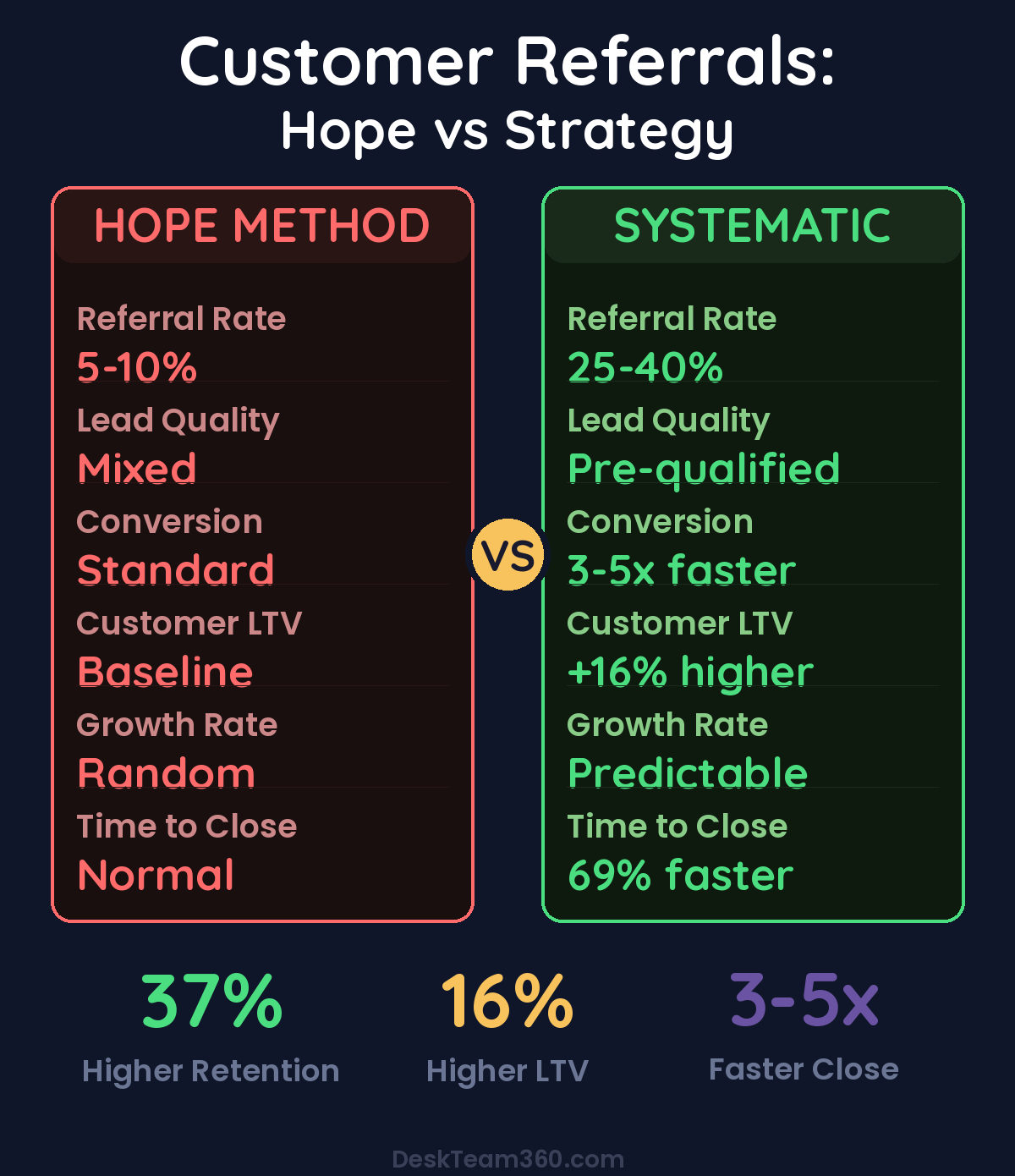
That’s leaving serious money on the table. Referred customers close 3-5x faster than cold leads, have 37% higher retention rates, and spend 16% more over their lifetime. This isn’t theory from a business book. This is data from Wharton School of Business research, and I’ve seen it play out across hundreds of our clients.
The difference between hoping for referrals and systematically generating them is a proper referral program. You create the structure, the incentive, and the process that turns your happiest customers into your most effective sales team. And when it’s done right, it becomes one of the most cost-effective growth channels you’ll ever build.
This guide walks through everything you need to create a referral program that actually drives growth, from choosing the right incentive structure to building the landing pages, email sequences, and tracking systems that make it work.
Why Referral Programs Outperform Everything Else
Referral programs aren’t just another marketing channel. They tap into three psychological forces that make them uniquely powerful.
First, there’s built-in trust. When a friend recommends a business, you skip the entire “are these people legit?” phase of the buying process. The referrer has essentially pre-sold you before you even land on the website. That’s why referred leads convert at 3-5x the rate of leads from paid advertising. They’re not evaluating whether to trust you, they’re evaluating whether your service fits their needs.
Second, there’s quality filtering. Your customers naturally refer people who look like themselves. If you serve a particular industry or business size, referrals tend to be pre-qualified because they’re in the same circles as your existing clients. A marketing agency’s client base refers other marketing agencies. A manufacturing consultant’s contacts are mostly in manufacturing. The targeting happens automatically.
Third, there’s reciprocity and social currency. People enjoy helping friends find good services. When they recommend something great, it reflects well on them. A referral program doesn’t create this behavior, it just makes it easier and adds a tangible reward on top of the social benefit that already exists.
Free Tool
How Much Is Freelancer Management Really Costing You?
Most agency owners have never done this math. Plug in a few numbers and see your real cost in 2 minutes.
Calculate Your Hidden Costs →
The Four Referral Program Structures That Actually Work
Not all referral programs are built the same. The right structure depends on your business model, price point, and customer relationships. Here’s what I’ve seen work across different types of businesses.
One-Sided Rewards: Referrer Gets Something, New Customer Doesn’t
This is the simplest structure. Your existing customer receives a reward when their referral becomes a customer. The new customer gets your normal offering with no extra incentive. This works best for high-value services where the new customer doesn’t need an extra push to make the decision. If you’re selling $2,000/month consulting services, a good referral is already motivated by the recommendation itself.
The reward could be a $50 credit toward their next invoice, a gift card, or straight cash. The pros are that it’s simpler to manage and clearly motivates your existing customers to refer. The downside is there’s less motivation for the referred person to act quickly or choose you over alternatives they might be considering.
Two-Sided Rewards: Both Get Something
This is the most common structure and typically the most effective. Both the referrer and the new customer receive a reward. It creates a win-win-win situation where everyone benefits, and it gives the referrer something positive to offer their friend beyond just the recommendation.
The classic example is “Give $25, Get $25” where both parties receive an account credit. This works well for most B2B services and subscription businesses because it motivates both parties to complete the process. The referrer feels good about giving their friend a deal, and the new customer has an extra reason to move forward instead of procrastinating.
Pro tip: Make the rewards equal. If the referrer gets $50 and the new customer gets $10, it feels lopsided. Equal rewards create a sense of fairness that makes people more comfortable participating in the program.
Tiered Rewards: More Referrals Equal Better Rewards
This structure gamifies the referral process by increasing rewards based on the number of successful referrals. For example: 1 referral gets you a $50 credit, 3 referrals get you a free month of service, and 5 referrals get you an exclusive gift or upgrade.
Tiered programs work best for businesses with high referral potential per customer. If your typical client knows dozens of potential referrals, a tiered system encourages them to think beyond just one or two obvious connections. The gamification aspect can turn your most satisfied customers into active referral machines.
The downside is complexity. Tiered programs are harder to explain, harder to track, and harder to communicate clearly. But when they work, they identify your biggest advocates and motivate repeat referral behavior.
Community or Charitable Rewards
Instead of rewarding individuals, each referral triggers a donation to a cause or contributes to a community goal. Examples include “Every referral plants 10 trees” or “We donate $25 to [local charity] for each qualified referral.”
This approach works especially well for mission-driven businesses, B-corps, and community-focused brands. It aligns with values-driven customers who care more about impact than personal rewards. The downside is that it provides less direct personal motivation for some customers, so it typically generates fewer referrals than cash-based programs.
How to Choose the Right Incentive Without Killing Your Margins
The incentive needs to be valuable enough to motivate action but sustainable enough to not destroy your profitability. Here’s how to think through the options.
Cash and account credits are the most universally motivating. For service businesses, a credit toward their next invoice is often the sweet spot because it rewards them while keeping the value within your ecosystem. It feels like a discount on something they were already going to buy.
Physical rewards like branded merchandise, gift baskets, or tech gadgets can create more excitement than a credit, but they’re harder to scale and not everyone values the same things. A $100 gift card is universally understood. A $100 piece of branded apparel might excite some people and feel like junk to others.
Service upgrades can be cost-effective because the marginal cost to you is often low while the perceived value to the customer is high. Offering a free month of premium features, an additional service, or extended support can feel like a bigger reward than its actual cost to deliver.
Calculate your referral budget using your customer acquisition cost. If you spend $200 on average to acquire a customer through paid ads, you can afford a $100-150 referral reward and still come out ahead because referred customers typically have higher lifetime value and lower support costs.
The formula I use is: Referral reward ≤ (Average Customer LTV × Profit Margin) − Fulfillment Cost. This ensures the program is profitable even accounting for the operational overhead of managing rewards.
Building Your Referral Program Assets
A referral program needs actual assets, not just a verbal ask during client calls. You need web pages, email templates, social graphics, and tracking systems. Here’s what to build.
The Referral Landing Page
This is the hub of your program and it needs to be dead simple. If someone can’t understand your program in 10 seconds, they won’t participate. Include a clear headline like “Refer a Friend, Get Rewarded,” a 3-step visual explanation showing how it works, exact details of what both parties receive, the referral mechanism itself (unique link, form, or code), and terms and conditions that clearly state when rewards are paid and who qualifies.
Make the page clean, visual, and scannable. Nobody wants to read paragraphs of text to understand a referral program. Use icons, bold text, and plenty of white space. For more landing page design best practices, check out our guide on creating effective landing pages that actually convert visitors.
Email Templates for Every Stage
You need multiple email templates to handle different parts of the referral process. Start with a program announcement email that introduces the referral program to your existing customers. Write a referral invitation email that your customers can easily forward to their contacts. Create a referral received confirmation that says “We got your referral! Here’s what happens next.” Build a reward notification email for when the referral converts. And set up reminder emails for periodic nudges to customers who haven’t referred anyone yet.
These emails should feel personal and conversational, not corporate and salesy. Your customers are doing you a favor by referring people. The tone should reflect appreciation, not aggressive sales pressure.
Social Sharing Assets
Make it easy for customers to share on social media by providing pre-written social posts they can copy or share with one click, branded graphics sized for each platform, and a short URL or referral code that’s easy to share verbally in conversations.
Most people won’t create social posts from scratch about your referral program, but many will share something you’ve already written if it’s easy and doesn’t sound overly promotional.
Watch out for generic social posts. “Check out this great service!” posts get ignored. Write posts that explain the specific benefit: “Just saved $200 on my monthly marketing costs with [your service]. If you’re looking to cut expenses while improving results, you should check them out.”
The Email Sequence That Actually Drives Referral Action
Don’t just announce your program once and forget about it. A strategic email sequence keeps referrals flowing over time by staying top of mind without being annoying.
Start with the program launch email on day zero. Use a subject line like “You’re going to love this — refer a friend, get [reward].” Announce the program clearly, explain the reward structure, include the unique referral link prominently, and use a strong CTA like “Start Referring Now.”
Send a social proof follow-up email on day seven with the subject “[X] customers have already referred friends — here’s what they’re saying.” Share early results or testimonials from people who have already participated, remind them of the reward, and re-share the referral link. This creates FOMO and shows that real people are actually using the program.
Day 21 gets the direct ask email: “Know someone who’d benefit from [your service]?” Use a personal tone that feels like you’re asking a friend for help rather than pushing a sales program. Keep the explanation brief since they’ve already seen it twice. Make the referral link prominent and easy to find.
Day 45 creates urgency with a milestone or deadline email. Subject lines like “Last chance to earn [bonus reward]” or “We’re 10 referrals away from our goal” motivate action from people who have been thinking about referring but haven’t done it yet. Temporarily increase the reward if possible to create genuine urgency.
After the initial sequence, send quarterly reminder emails as part of your regular newsletter or as standalone messages. The goal is to keep the program visible without turning into spam.
How to Track and Measure Success
If you can’t measure your referral program, you can’t improve it. Track these key metrics weekly for the first month, then monthly after that.
Referral rate measures the percentage of your customers who make at least one referral. This tells you if your program incentives are compelling enough to motivate action. Conversion rate tracks the percentage of referred leads who become customers. This shows whether your referrals are high quality and whether you’re handling them properly. Cost per acquisition for referrals should be lower than your other channels once you factor in higher lifetime value.
Time to conversion measures how quickly referred leads close compared to other channels. Referred leads should convert faster because they start with more trust. Lifetime value of referred customers should be higher than other acquisition channels. Top referrer tracking helps you identify your biggest advocates so you can nurture those relationships.
Companies with formal referral programs see 69% faster sales cycles for referred leads compared to cold prospects.
For tracking, use unique referral links for each customer — this is the simplest and most reliable method. Referral codes entered at signup or checkout work well for e-commerce. Dedicated referral software like ReferralCandy or Ambassador automates the entire process but adds monthly costs. Tag referred leads in your CRM with the referral source so you can track their full customer journey. UTM-tagged links let you track referral traffic in Google Analytics alongside your other marketing channels.
The Step-by-Step Launch Plan
Here’s the exact timeline I recommend for launching a referral program without overwhelming your team or confusing your customers.
Phase 1 is foundation building in weeks 1-2. Define your program structure, choose your incentive and calculate the budget based on your customer acquisition costs, write clear terms and conditions that cover edge cases, and set up your tracking system whether that’s referral software, CRM tags, or manual tracking.
Phase 2 is asset creation in weeks 2-3. Design and build the referral landing page that clearly explains the program, create all the email templates you’ll need for the sequence, design social sharing graphics for different platforms, and build your tracking and reporting dashboard so you can monitor performance from day one.
Phase 3 is a soft launch in week 3-4. Start with your best customers first — the top 20% who are most likely to refer and most forgiving of any bugs. Collect feedback on the experience and fix any tracking or usability issues you discover. Gather early testimonials that you can use in the full launch. This phase helps you identify problems before they reach your entire customer base.
Phase 4 is the full launch in week 4 and beyond. Roll out to your entire customer base, start the email sequence, add referral prompts to your regular customer touchpoints like invoices and support emails, and monitor metrics weekly for the first month to catch any issues early.
Common Mistakes That Kill Referral Programs
I’ve seen the same mistakes destroy referral programs across dozens of businesses. Here’s how to avoid each one.
Making it too complicated is the number one killer. If your program takes more than three sentences to explain, simplify it. “Refer a friend with your unique link. When they become a customer, you both get $50.” Done. Don’t add tiers, conditions, and fine print that confuse people and create barriers to participation.
Choosing the wrong incentive size destroys programs from both directions. An incentive that’s too small won’t motivate anyone to take action. A $5 reward for referring a $2,000/month client feels insulting. But an incentive that’s too large attracts gaming and fraud while making the program unsustainable. A $500 reward for a $50/month subscription will bankrupt you.
Not promoting the program consistently is another silent killer. You launch it, send one email, and never mention it again. Referral programs need ongoing promotion in emails, on your website, in client conversations, and in your product interface. If people forget it exists, it might as well not exist.
Slow reward fulfillment kills the positive feelings that drive referrals. If someone refers a friend and has to wait 90 days for their reward, the emotional connection between the action and the reward is gone. Fulfill rewards as quickly as possible — ideally within a few days of the referral converting to a customer.
For industry benchmarks and research, see Neil Patel.
For industry research and benchmarks, check out Think with Google.
Pro tip: Have a dedicated process for handling referred leads so they don’t fall through the cracks. A referral isn’t a closed deal, it’s a warm lead that still needs proper follow-up. Train your sales team to mention the referral source in their initial outreach.
Real Examples of Programs That Actually Work
Let’s look at three referral programs that generated massive growth, and what made them successful.
Dropbox’s referral program is legendary for good reason. Both the referrer and the new user received 500MB of extra storage space. It grew signups by 60% and was responsible for 35% of all new registrations at its peak. The key insight was that the reward was directly tied to using the product more. More storage meant more files, which meant more engagement and higher retention.
Tesla’s referral program created competition among advocates with escalating rewards — free Supercharging miles for one referral, exclusive event invitations for multiple referrals, and even free vehicles for top referrers. It generated massive word-of-mouth for a product that had zero traditional advertising budget. The exclusivity and status aspects motivated people who already had plenty of money.
Morning Brew grew from 100,000 to 1.5 million newsletter subscribers in 18 months using a milestone-based referral program. Subscribers unlocked rewards at specific milestones — 1 referral for premium content access, 3 referrals for a branded mug, 5 referrals for a t-shirt, and higher levels for exclusive merchandise. The gamification turned referrals into a challenge rather than just a transaction.
The common thread across all three is clear rewards, simple mechanics, and consistent promotion. None of them were complicated to understand, but all of them were systematically promoted and continuously optimized.
Technical Implementation: What You Actually Need to Build
Here’s the complete checklist of everything you need to launch a referral program that actually works.
Your referral landing page needs a clear program explanation that someone can understand in 10 seconds, a unique referral link generation system, and prominent placement of terms and conditions. The page should be mobile-optimized since many people will share referral links through text messages and social media apps.
Email templates include a program announcement for existing customers, a referral invitation that customers can forward to friends, a referral confirmation for when someone clicks their link, a reward notification for successful conversions, and quarterly reminder emails to keep the program active.
Social media assets include sharing graphics sized for Instagram, Facebook, LinkedIn, and Twitter, plus pre-written post templates that don’t sound like corporate marketing. In-product or in-email referral prompts should appear at natural moments like after successful project completion or in monthly newsletters.
Your tracking dashboard should show referral rate by customer segment, conversion rate of referred leads, cost per acquisition through referrals, and individual customer referral activity so you can identify and appreciate your top referrers.
Finally, you need an internal process for handling referred leads that includes faster response times, personalized outreach that mentions the referral source, and proper attribution in your CRM so you can track the full customer journey.
This is a significant amount of design and development work, especially if you want it done right the first time. Which is exactly why many of our clients at DeskTeam360 ask us to handle the technical implementation while they focus on the strategy and customer relationships.
Build Your Referral Program Assets Without the Headache
You design the strategy. We build everything else.
At DeskTeam360, we create the landing pages, email templates, social media graphics, and tracking systems that make referral programs work. From the initial program design to the automated email sequences, our team handles the technical execution while you focus on your customers and growing your business.
We’ve built referral programs for professional services, SaaS companies, and e-commerce businesses. We understand the technical requirements and the design elements that drive participation. And we know how to implement tracking systems that give you the data you need to optimize performance over time.
Need help with other parts of your marketing system? Our guide on creating sales funnels covers how to build complete marketing systems that work together. We also handle email marketing automation and website optimization to support your referral program with strong supporting systems.
Stop leaving referrals to chance. Build a system that turns your happiest customers into your most effective sales team.
Free 5-Minute Video
See How DeskTeam360 Works in Under 5 Minutes
Watch the short video and see exactly how we handle design, development, and marketing implementation — so you don't have to.
Watch the Video →