




Outsource Marketing for Course Creators: What to Delegate at Every Revenue Stage
Most Course Creators Delegate Marketing Too Late (And Pay For It)
When you outsource marketing for course creators, you’re making a strategic move. You’ve built an amazing course. Your students love it, leave great reviews, and transform their lives with your content. But you’re spending 40+ hours a week on marketing instead of creating more courses, and your revenue is stuck in the same range month after month.
📋 Table of Contents
I see this constantly with course creators. They nail the product but burn out on the marketing grind before they can scale. They try to do everything themselves because “no one understands my audience like I do.” Meanwhile, their competitors who delegate smart are pulling ahead.
Here’s the truth: marketing delegation isn’t about losing control, it’s about getting control back. The course creators hitting six and seven figures aren’t superhuman marketers. They’re just better at knowing what to keep, what to delegate, and when to do it.
I’ve worked with 400+ clients across every industry, including dozens of course creators. There’s a predictable pattern to successful delegation that matches your revenue growth. Get the timing wrong and you either waste money too early or plateau too long. Get it right and you scale faster than you thought possible.
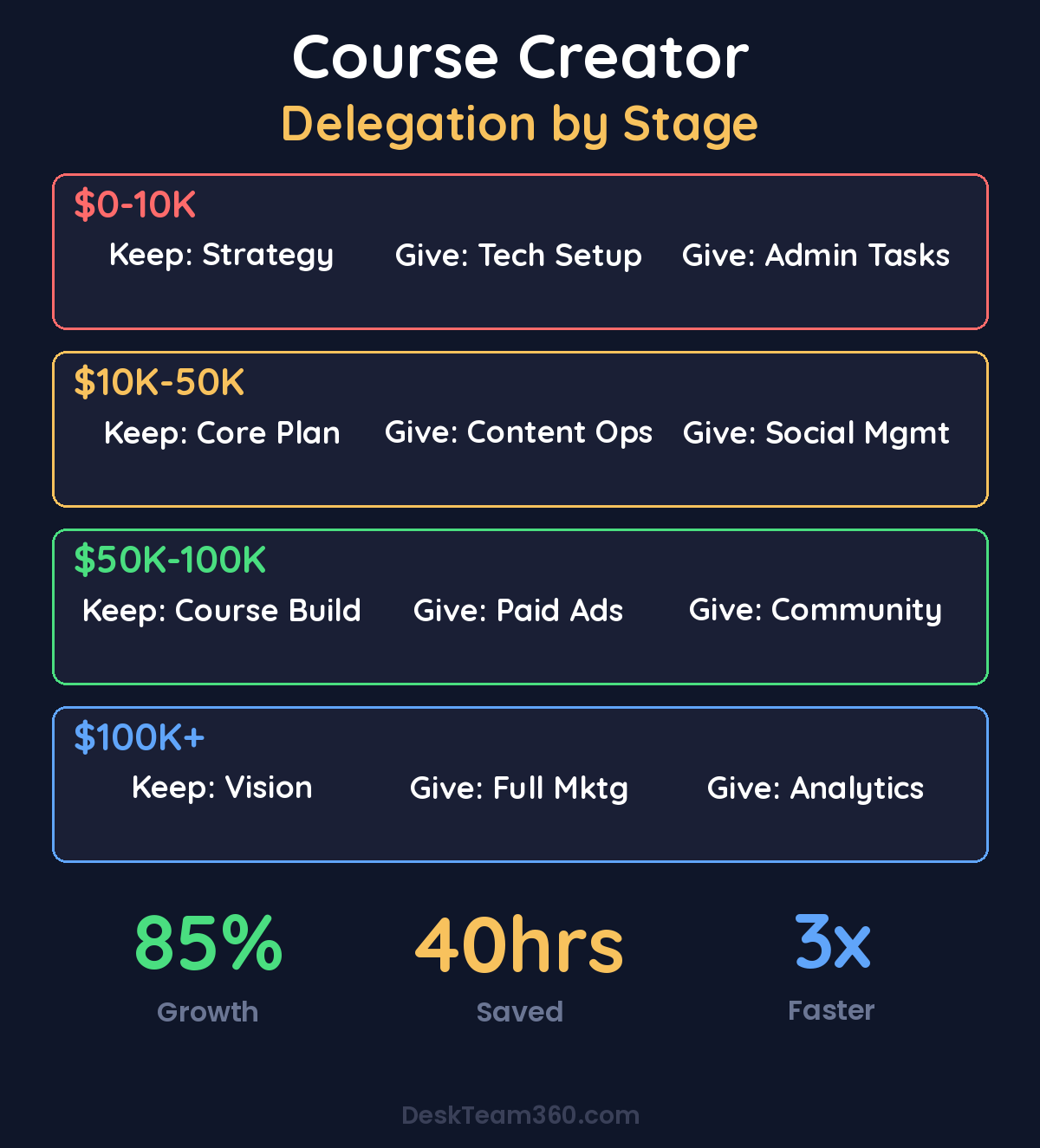
The $0-$10K Stage: Foundation Marketing You Can’t Delegate Yet
If you’re making less than $10K monthly recurring from your courses, you’re still in the foundation phase. Your audience doesn’t know you exist yet. Your messaging isn’t dialed in. You don’t know which marketing channels actually convert for your specific niche.
At this stage, trying to delegate core marketing is like outsourcing your dating profile to someone who’s never met you. The person creating your content needs to understand your voice, your audience’s pain points, and your unique perspective. That person is you.
What to Keep In-House at $0-$10K
Content creation stays with you. Blog posts, course curriculum development, email newsletters, social media captions, video scripts. This isn’t busy work, it’s audience research. Every piece of content you create teaches you something about what resonates and what doesn’t.
Customer conversations can’t be delegated. Sales calls, support emails, student feedback, community engagement. These interactions shape your messaging and reveal new course opportunities. No VA can extract those insights for you.
Strategic decisions remain yours. Which platforms to focus on, what content topics to cover, when to launch new courses, how to price your offers. You’re still figuring out what works for your specific market.
What You Can (And Should) Delegate at $0-$10K
Technical setup and maintenance don’t require your genius. WordPress management, email platform setup, landing page creation, basic graphic design, course platform administration. These tasks eat time but don’t directly impact your messaging or strategy.
Pro tip: Start with one technical VA at 10-15 hours per week for $8-12/hour. Have them handle course uploads, email sequences setup, basic graphics, and website maintenance. This alone saves you 15+ hours weekly to focus on content and sales conversations.
Administrative work should go immediately. Calendar management, customer support for basic questions (refunds, login issues), social media scheduling (you write, they post), and email list management. I’ve seen too many course creators answer “how do I reset my password” emails personally when they could be creating content.
Free Template
The Ultimate Task Delegation Template
Stop guessing what to hand off. This template shows you exactly what to delegate, how to brief it, and how to QA the results.
Get the Free Template →
The $10K-$50K Stage: Scale Your Content Machine
Once you hit consistent $10K months, your messaging is working. You know who your audience is and what they respond to. Now it’s time to amplify what’s working instead of experimenting with new approaches.
This is the stage where most course creators make their first major delegation mistake: they try to hand over strategy too early. Don’t delegate what to say, delegate how much you can say it.
Content Production Scales Here
You’ve probably identified 3-4 core topics that your audience loves. Maybe it’s “productivity for entrepreneurs,” “Instagram marketing for coaches,” or “meal prep for busy parents.” Whatever your niche, you know what converts.
Now you can delegate content amplification. Have a content team take one long-form piece (your weekly blog post or YouTube video) and turn it into 10+ pieces of social content, email newsletters, course module updates, and lead magnets.
Content multiplication works like this: You create one 45-minute video training. Your team creates a blog post summary, 8 social media posts, 3 email sequences, one lead magnet PDF, and 2 podcast episodes from that single piece of content. Your voice and expertise, their execution.
We break this down further in marketing implementation for online service providers: a practical guide.
What to Delegate at $10K-$50K
Content repurposing becomes your biggest leverage point. Hire a content manager who can take your core content and adapt it across platforms. YouTube videos become blog posts, blog posts become email sequences, webinars become course modules.
Email marketing execution should move off your plate. You still write the main newsletters, but someone else handles the welcome sequences, abandoned cart emails, re-engagement campaigns, and promotional sequences. Understanding how to create FAQ pages becomes important here as your support volume grows.
Social media management expands beyond just scheduling. Your team should be responding to comments, engaging with other accounts in your niche, and identifying trending topics for content ideas. You provide the voice and approval, they handle the daily execution.
Paid advertising research and setup can be delegated, but you keep control of the budgets and creative approval. A good ads manager will test audiences, optimize campaigns, and present data, but you’re still making the strategic calls about spending and messaging.
What Still Stays With You
Course creation and core content strategy remain yours. No one else can develop your curriculum or decide what courses to create next. Your audience insights and teaching style are your competitive advantage.
High-value customer interactions stay personal. Sales calls for premium courses, partnerships with other creators, speaking opportunities, podcast interviews. These relationships determine your long-term growth trajectory.
The $50K-$100K Stage: Build Your Marketing Department
Congratulations, you’ve built a real business. At $50K+ monthly, you’re not just selling courses, you’re running a media company with educational products. Your delegation strategy needs to match that reality.
This stage is where course creators either build a real team or plateau forever. The ones who plateau keep trying to manage everything personally. The ones who scale build systems that run without them.
Delegation Gets Strategic
You’re not just handing off tasks anymore, you’re building specialized roles. Content manager, ads manager, email marketing specialist, community manager, customer success coordinator. Each person owns entire functions instead of just helping with yours.
Your content manager should be developing content calendars, identifying trending topics, and managing your editorial schedule across platforms. You approve themes and provide expert insights, they handle research, writing, and publishing.
Advanced Delegation at $50K-$100K
Paid advertising becomes fully managed. Your ads team should be testing new audiences, creating new creative angles, managing campaign budgets, and scaling what works. You review performance weekly and approve major strategy shifts, but they handle daily optimization.
Partnership and affiliate outreach can be systemized. Someone else can research potential partners, manage affiliate relationships, coordinate joint ventures, and handle speaking opportunity inquiries. You focus on the high-value relationships while they manage the pipeline.
Customer success and community management require dedicated attention. As your student base grows, personal touch points matter more, not less. A community manager who knows your teaching style can provide excellent support while you focus on new course development.
Email marketing becomes sophisticated with dedicated specialists. Your email team should be running complex automation sequences, testing subject lines and send times, managing segmentation strategies, and developing nurture campaigns for different customer types.
Watch out: Don’t delegate customer feedback analysis at this stage. The insights from student success stories, complaints, and feature requests directly inform your next course topics. Keep this information flowing to you, even if someone else categorizes and summarizes it.
For a deeper dive, see our guide on deskteam360 vs design pickle: the best design pickle alternative for full-service marketing.
The $100K+ Stage: Scale Through Systems, Not Hours
Once you’re consistently hitting six figures monthly, you’ve proven your market fit. Your courses work, your marketing works, your audience trusts you. Now the challenge becomes scaling without breaking what you’ve built.
Most course creators who reach this level assume they can just hire more people doing the same things. That’s not scale, that’s just bigger overhead. Real scale comes from systems that multiply your expertise without multiplying your time.
Executive-Level Delegation
At this stage, you’re delegating entire business functions. Marketing director, content director, customer success director. These aren’t assistants helping with your work, they’re specialists running departments.
Your marketing director should be developing quarterly strategies, managing budget allocation across channels, hiring and managing specialists, and presenting performance data for your strategic decisions. You’re involved in quarterly planning, not daily execution.
Content strategy becomes predictable and scalable. Your content director manages editorial calendars, coordinates with subject matter experts, oversees video production, and ensures consistent brand voice across all channels. New content gets produced whether you’re working or on vacation.
What You Can Never Delegate
Even at this level, certain functions must stay with you. Course curriculum development remains your domain. Your expertise and teaching methodology are why students choose you over competitors. You can delegate course production, but not course strategy.
Vision and strategic direction can’t be outsourced. Where should your business expand? What new markets should you enter? Which partnerships align with your brand? These decisions shape your long-term success and require your unique perspective.
High-level relationship building stays personal. Speaking at major conferences, partnering with industry leaders, appearing on top podcasts. Your personal brand and expertise are the business’s most valuable assets.
Course creators who delegate strategically see 85% higher revenue growth than those who try to manage everything personally beyond the $50K monthly mark.
The Hidden Costs of Delegating Too Late
I’ve seen brilliant course creators plateau for years because they couldn’t let go of tasks that should have been delegated long ago. They’re making $75K monthly but working 70-hour weeks because they’re still personally managing their Facebook ads and writing every email.
The opportunity cost is enormous. Every hour you spend on tasks that could be delegated is an hour not spent developing new courses, building strategic partnerships, or planning business expansion. Your expertise is finite. Your team’s execution capacity isn’t.
Revenue plateau becomes inevitable when you’re the bottleneck in every marketing function. You can’t scale personal attention across thousands of students. You can’t personally respond to every social media comment. You can’t personally optimize every ad campaign. Successful website optimization requires constant testing and iteration that demands dedicated focus.
Delegation Frameworks That Actually Work
The course creators who delegate successfully follow predictable patterns. They don’t just hand off tasks randomly, they transfer complete functions with clear success metrics.
Start with the 80/20 rule for each function. What 20% of email marketing activities drive 80% of your results? Keep that 20%, delegate the rest. What 20% of social media work generates 80% of your engagement? You handle strategy and high-value posts, your team manages everything else.
Document your processes before delegating them. Not just “manage our Facebook ads” but “here’s how I identify winning audiences, here’s how I write ad copy that converts, here’s how I scale campaigns without wasting budget.” Your delegation is only as good as your documentation.
Pro tip: Record yourself doing each task you plan to delegate. Loom recordings of your actual process work better than written instructions. Your team can see exactly how you think through decisions, not just what the final outputs should look like.
For industry research and benchmarks, check out Clutch.co.
We covered this in detail in our post about ai marketing tools: the complete guide for 2026.
Measuring Delegation Success
Successful delegation isn’t just about freeing up your time, it’s about maintaining or improving results while reducing your direct involvement. Track these metrics at every delegation stage.
Time savings should be measurable. If you delegate email marketing but still spend 10 hours weekly reviewing and editing everything, the delegation failed. Good delegation should cut your time investment by 70-90% while maintaining quality.
Revenue impact matters more than cost savings. Yes, you’re paying team members, but your newly freed time should generate more revenue than the delegation costs. If you save $2,000 monthly on delegation but only generate an extra $1,500 in revenue, rethink your approach.
Quality metrics must be tracked. Open rates for delegated email campaigns, conversion rates for delegated ad campaigns, engagement rates for delegated social content. Delegation that saves time but hurts performance is moving backward, not forward.
Common Delegation Mistakes Course Creators Make
The biggest mistake I see is delegating strategy before nailing execution. You can’t outsource your marketing strategy until you know what works. Get to $10K monthly first, then start delegating the tactical work while keeping strategic control.
Delegating too many functions simultaneously overwhelms your management capacity. Add one new delegation every 30-60 days, not five at once. Your team needs time to learn your standards, and you need time to develop effective management systems.
Watch out: Don’t delegate customer-facing functions to team members who don’t understand your audience. A generic VA responding to student questions with corporate-speak can damage relationships that took months to build. Cultural fit matters as much as skill set.
Perfectionism kills effective delegation. Your team won’t do things exactly like you would, and that’s okay. If their work achieves 85% of your results with 10% of your time investment, that’s a win. You can always optimize later, but you can’t get your time back.
Building Your Course Creator Marketing Team
The most successful course creators build teams that amplify their strengths rather than replacing them entirely. You remain the expert, the voice, and the strategist. Your team becomes your execution engine.
Your first hire should solve your biggest time drain. For most course creators, that’s either technical tasks (if you hate the tech side) or content production (if you love creating but hate the repetitive marketing work). Don’t hire based on what seems most important, hire based on what saves you the most time immediately.
Effective team building requires systems for knowledge transfer. Our approach to measuring marketing ROI helps course creators track which delegation investments actually pay off. When you can demonstrate that your $3,000 monthly team investment generates $8,000 in additional revenue, scaling becomes an obvious choice.
Quality control systems prevent delegation disasters. Weekly team reviews, monthly performance analysis, quarterly strategy sessions. Your team needs feedback loops just like your courses do. The course creators who delegate successfully treat team management like curriculum development: structured, measured, and continuously improved.
Your Next Steps
Successful delegation isn’t about finding the perfect team members, it’s about building the right systems at the right time. Start where you are, with what you can afford, focusing on your biggest time drains first.
At DeskTeam360, we’ve helped course creators at every stage build their marketing teams strategically. From technical VAs at the $10K stage to full marketing departments at the $100K+ level, we handle the recruitment, training, and management so you can focus on what you do best: teaching and creating.
Stop letting marketing tasks consume the time you should be spending on course development and strategic growth. The right delegation strategy doesn’t just save time, it accelerates revenue growth while giving you back the creative freedom that made you start teaching in the first place.
Free 5-Minute Video
See How DeskTeam360 Works in Under 5 Minutes
Watch the short video and see exactly how we handle design, development, and marketing implementation — so you don't have to.
Watch the Video →