



Outsource Pitch Deck Design: Investor and Sales Decks That Win
When you outsource pitch deck design, you free up your team to focus on what moves the needle.
📋 Table of Contents
Why Your Pitch Deck Design Is Killing Your Chances
I watched a brilliant founder blow a $2M Series A pitch last month. The product was solid. The market opportunity was massive. The team had the right experience. And yet, three investors passed within the first five slides.
Why? The pitch deck looked like it was assembled during a late-night PowerPoint panic session. Misaligned text boxes, inconsistent fonts, and charts that were impossible to read from ten feet away. By slide four, you could see investors checking their phones.
Here’s the thing about pitch decks that most founders miss. Investors see 3,000+ decks per year. Most of them look identical because they’re built from the same Canva templates. A professional design doesn’t just make your deck pretty, it makes it memorable. And when you’re competing for attention from people who have fifteen-second attention spans, memorable wins.
I’ve been helping companies create presentation materials for 12+ years, and the difference between decks that get meetings and decks that get ignored is almost always about visual storytelling. Your content might be brilliant, but if the design doesn’t support it, that brilliance gets lost.
The Three Types of Pitch Decks That Actually Matter
Not all pitch decks serve the same purpose, and their design needs reflect that reality.
Investor Decks: Get the Meeting, Not the Check
Your fundraising deck has one job: generate enough interest that investors want a follow-up meeting. That’s it. You’re not closing the deal in 15 slides, you’re opening the conversation.
The structure is predictable because it works. Problem, solution, market size, business model, traction, team, competition, financials, and the ask. But the execution separates winners from losers. Data visualization matters enormously here. A chart showing hockey-stick growth communicates instantly what three paragraphs of text cannot.
I’ve seen founders spend weeks perfecting their pitch narrative and then slap those words into a basic slide template. That’s backwards thinking. The visual story should amplify your verbal story, not distract from it.
Sales Decks: Close the Deal
These are customized for each prospect and designed to move them through your sales process. The focus shifts from “why us” to “why now” and “what happens next.” Social proof carries the weight here. Case studies, client logos, and specific results matter more than vision statements.
The design needs flexibility because you’re adapting content for each prospect. But that doesn’t mean inconsistent. Professional sales decks maintain visual consistency while allowing content variations.
Conference Decks: Support Your Story
Designed for large audiences where slides support spoken content rather than standing alone. Minimal text, large visuals, and the design amplifies your stage presence instead of competing with it.
If outsource pitch deck design is on your radar, this guide is for you. When you outsource pitch deck design, you’re making a strategic move. Each deck type requires different visual approaches. A data-heavy investor deck that works in a conference room will fail completely on a conference stage. Design your deck for its intended environment, not just its content.
Free Template
The Ultimate Task Delegation Template
Stop guessing what to hand off. This template shows you exactly what to delegate, how to brief it, and how to QA the results.
Get the Free Template →
What Makes Pitch Deck Design Actually Work
After reviewing hundreds of decks across every industry, the patterns are clear. Great pitch deck design follows principles that most template-builders completely ignore.
Visual hierarchy guides attention exactly where you want it. Every slide should have a clear focal point that draws the eye first, then supporting elements that provide context. When everything on a slide competes for attention equally, nothing gets attention. Professional designers achieve this through strategic font sizes, color contrast, and white space that creates breathing room around key information.
Data becomes a story instead of a spreadsheet. Raw numbers are meaningless to someone seeing them for the first time. Revenue growth becomes an ascending chart with clear milestones. Market size becomes a visual comparison that makes the opportunity tangible. Customer acquisition becomes a timeline with inflection points highlighted. The goal isn’t making data pretty, it’s making data instantly understandable.
Brand consistency signals professionalism. Your deck should look like it belongs to your company. Colors, fonts, and visual style should remain consistent throughout. This seems basic, but most DIY decks have different formatting on every slide. Mixed font sizes, colors that don’t quite match, and inconsistent spacing that makes everything feel amateur.
Minimal text forces clarity. The worst decks are the ones where presenters read paragraphs off slides. Effective slides contain one key message per slide, short headlines that capture the essence, and bullet points with five to eight words each. The detail lives in your spoken narrative, not on the screen.
Pro tip: If you can’t summarize a slide’s message in one sentence, split it into two slides. Complexity is the enemy of comprehension.
DIY Versus Professional Design: The Real Cost Analysis
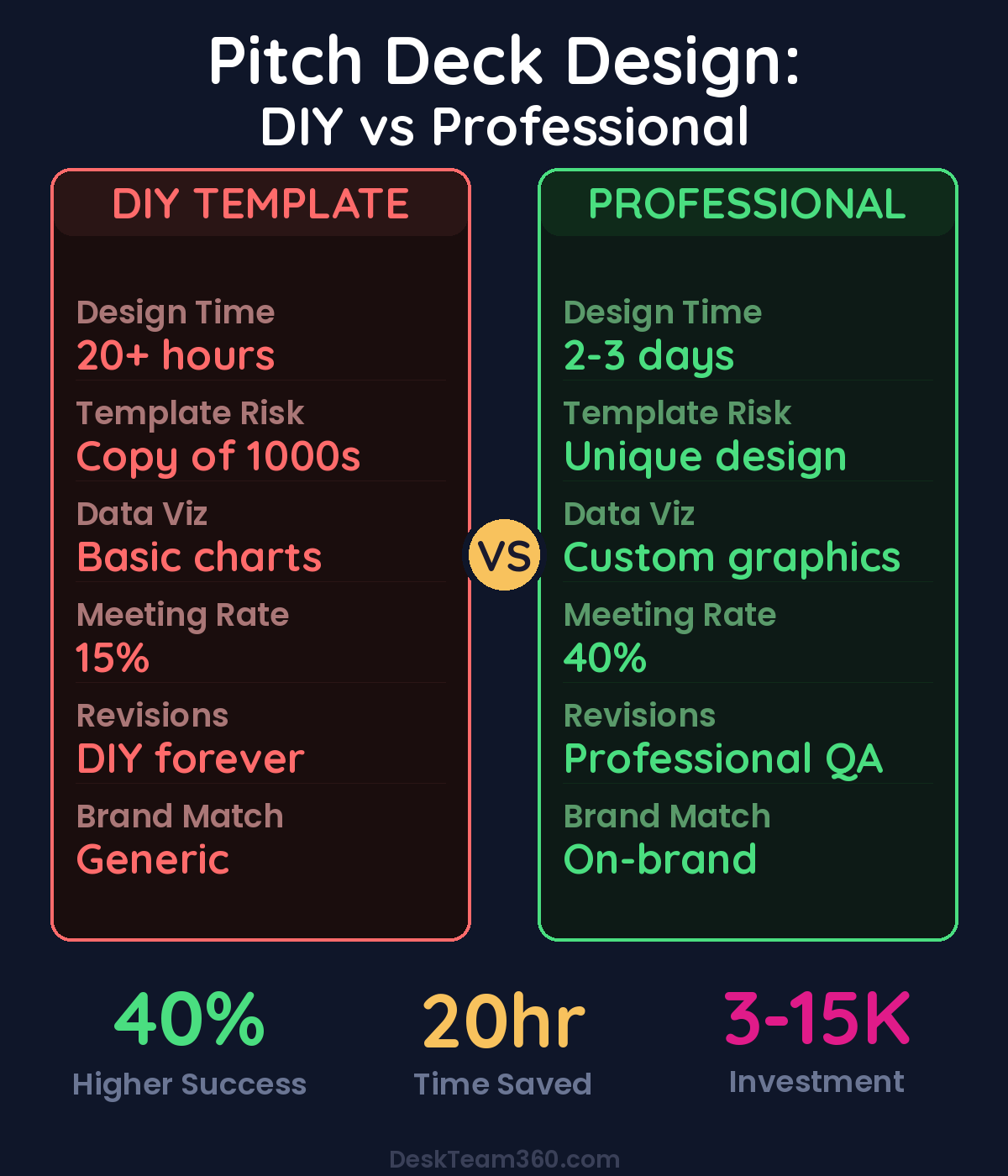
Tools like Canva and PowerPoint offer thousands of pitch deck templates. For very early-stage startups pitching friends and family, they’re adequate. But for anything beyond that? The limitations become expensive.
Template fatigue is real. Investors have seen the same Canva designs hundreds of times. When your deck looks identical to every other startup’s deck, you’re not memorable. You’re forgettable.
Data visualization becomes impossible. Complex charts and custom graphics are difficult or impossible in template-based tools. You end up with generic bar charts when what you need is custom visualizations that tell your specific story.
Formatting consistency requires constant vigilance. Without design expertise, slides end up with misaligned elements, inconsistent spacing, and clashing styles that scream “amateur.” Every hour you spend wrestling with text alignment is an hour not spent on your business.
The time cost is brutal. Founders spending 20+ hours fighting with slide layouts are founders not talking to customers, building products, or closing deals. Your hourly value is almost certainly higher than what professional design costs.
Where Smart Companies Outsource Pitch Deck Design
You have three real options, and each fits different situations.
Specialized pitch deck agencies focus exclusively on fundraising presentations. They understand investor expectations, know what works in fundraising contexts, and can deliver polished decks quickly. The downside? Cost runs $3,000 to $15,000+ per deck, and ongoing updates require new projects. If you’re raising significant capital and need to stand out from thousands of competing decks, the investment makes sense.
Design subscription services provide dedicated design teams at flat monthly rates. You get your pitch deck designed alongside all your other creative needs including marketing materials, website graphics, and social content. Cost-effective especially if you have ongoing design requirements, unlimited revisions, and quick turnaround times. The deck grows with your business without additional project costs.
Freelance designers offer the widest price range but quality varies enormously. Vetting takes time, revision limits create constraints, and designer availability becomes unpredictable during busy periods. You might find exceptional talent, but it requires significant upfront research. Our comparison guide on presentation design outsourcing breaks down the specific tradeoffs.
Startups using professional deck design see 40% higher meeting conversion rates compared to template-based presentations.
Related: 10 Best Unlimited Graphic Design Services for 2026 (Honest Rankings).
For industry benchmarks and research, see Clutch.co.
What Professional Pitch Deck Design Actually Costs
Investment ranges reflect quality, complexity, and service level.
Basic freelancers charge $500 to $2,000 for standard ten to fifteen slide decks. Experienced freelancers with specialized pitch deck experience run $2,000 to $5,000 for custom design with data visualization. Specialized agencies command $5,000 to $15,000+ for full-service decks with strategy input and multiple revision rounds. Design subscriptions include deck design within monthly plans that typically run $500 to $2,000 monthly alongside other creative work.
The right investment depends on what’s at stake. If you’re raising a $5M Series A, spending $5,000 on a deck that helps close the round is insignificant cost. If you’re bootstrapped and pitching early clients, a design subscription that covers your deck plus all other design needs delivers better value. Understanding marketing ROI measurement applies directly to design investments.
How to Work With Pitch Deck Designers
Success depends on preparation before you engage any designer.
Provide written content for every slide. Not polished scripts, but key messages, data points, and talking points for each section. Raw data and numbers for revenue figures, growth metrics, market size data, and customer numbers because designers need this information to create accurate visualizations. Brand assets including logo files, brand colors with hex codes, fonts, and existing style guidelines. Reference decks with two or three examples of designs you admire because “I like this style” communicates infinitely more than verbal descriptions.
Target audience context matters because design approaches differ for VCs versus angel investors versus enterprise buyers. If you need help structuring this information, our guide on brand style guides provides the foundation for consistent visual identity.
Watch out: Design by committee kills projects. Having five people provide conflicting feedback creates endless revision cycles. Designate one decision-maker and stick to that structure throughout the process.
The design process follows predictable stages. Discovery and briefing to discuss goals, audience, content, and visual direction. Concept development where designers create two or three slide concepts showing potential visual directions. Direction approval where you choose a path and provide specific feedback. Full deck design in the approved style across all slides. Revision rounds, typically two to three, to refine details and adjust data visualizations. Final delivery includes source files in PowerPoint, Keynote, or Google Slides formats plus PDF versions and custom assets.
Mistakes That Torpedo Pitch Deck Projects
I’ve watched the same mistakes derail deck projects repeatedly. Sending incomplete content with placeholder text like “we’ll fill in numbers later” creates redesign cycles that waste time and money. Changing fundamental content after design completion means restarting significant portions of the work. Ignoring designer expertise when they recommend cutting text or restructuring slides, because they’ve designed hundreds of decks and understand what works visually.
The worst mistake? Rushing the process. Professional design takes time. Planning two weeks minimum for initial design and one week for revisions prevents panic-driven compromises that hurt the final product.
Pitch Deck Design Details That Make the Difference
Small details separate amateur decks from professional presentations. The 10/20/30 rule still holds: ten slides, twenty minutes, thirty-point minimum font size. Guy Kawasaki’s formula works because it forces clarity and readability. Design for the leave-behind because your deck gets forwarded without your narration. Every slide must communicate its key message independently.
One message per slide prevents confusion and maintains focus. Show traction visually because charts communicate growth patterns instantly while paragraphs of numbers get ignored. Professional team photos matter more than founders realize. Inconsistent headshots signal disorganization. End with a clear ask and state exactly how much you’re raising plus what milestones it funds. Test on a projector because colors, contrast, and readability change dramatically on large screens and projectors compared to laptop displays.
Keep Your Deck Current
Pitch decks aren’t one-and-done documents. Numbers change, traction grows, stories evolve. Plan monthly updates during active fundraising periods.
This advantage makes design subscriptions particularly valuable over project-based pricing. Updating decks with new metrics or refining slides based on investor feedback becomes just another task in your queue without additional costs, contracts, or delays. When your Q3 numbers crush projections, you want that reflected in your deck immediately, not after negotiating a new freelancer contract.
Building comprehensive brand systems helps maintain consistency across updates. Our guide on FAQ page creation demonstrates the systematic thinking that applies to any content that gets updated regularly.
Design Your Way to Better Outcomes
Your pitch deck is too important to leave to PowerPoint templates and good intentions. Whether you’re raising your first round, closing enterprise deals, or presenting at major conferences, professional design elevates your message and commands attention in rooms full of people who’ve seen everything before.
The math is simple. If better design increases your meeting conversion rate by even 10%, the ROI on professional design pays for itself immediately. If it helps you close funding faster or at better terms, the investment becomes insignificant compared to the outcome.
At DeskTeam360, we handle pitch decks alongside all your other creative production needs. Marketing materials, website design, social content, and presentation design under one flat-rate plan that scales with your business. You focus on winning the room while we handle making sure your message looks the part.
Free 5-Minute Video
See How DeskTeam360 Works in Under 5 Minutes
Watch the short video and see exactly how we handle design, development, and marketing implementation — so you don't have to.
Watch the Video →