


How to Outsource Business Card and Stationery Design
Business Cards Still Matter More Than You Think
When you outsource business card design, you’re making a strategic move. Every year, some startup founder declares business cards “dead.” And every year, billions of business cards get printed, handed out, and actually kept by the people who matter to your business.
📋 Table of Contents
Here’s what I’ve learned managing 400+ clients over 12+ years: a great business card does something a LinkedIn connection can’t. It creates a moment. It sits on someone’s desk for weeks. It gets passed to a colleague with “call this person, they were sharp.” But a terrible business card? Flimsy stock, blurry logo, email address that screams side hustle? That creates the opposite impression and undoes every minute of good conversation you just had.
Your business card is your brand ambassador working after you leave the room. Your letterhead shows up in every proposal, every invoice, every piece of formal communication you send. Your stationery either signals that you’re the kind of company worth taking seriously, or it doesn’t.
This is how you outsource professional business card and stationery design without getting amateur results that waste your money and damage your reputation.
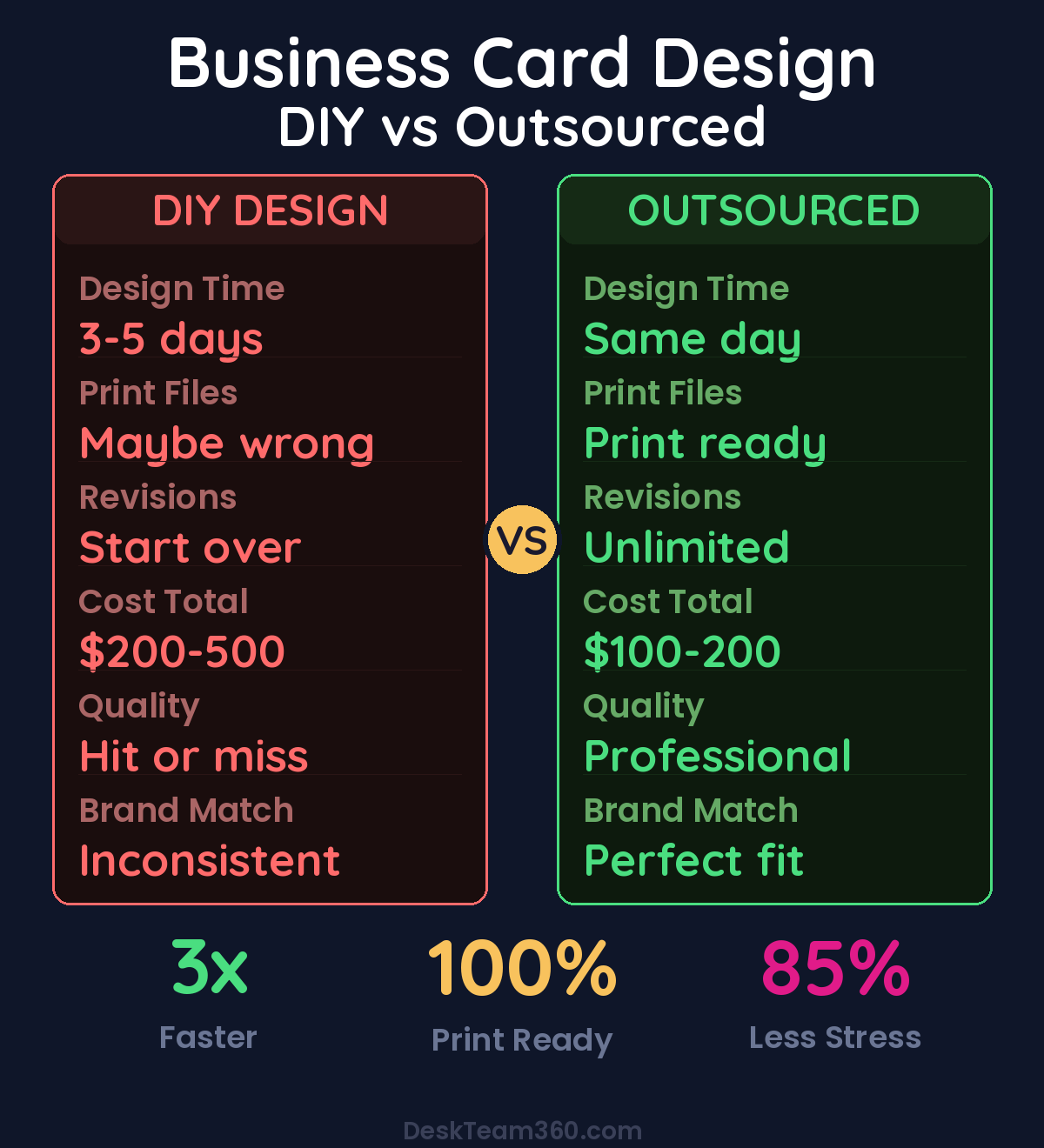
Why DIY Business Cards Are Usually Garbage
I’ve seen Microsoft Word business cards. I’ve seen Canva templates stretched beyond recognition. I’ve seen cards with three different fonts, clip art borders, and Gmail addresses in Comic Sans. They’re all terrible, and they all send the same message: “I don’t take myself seriously enough to invest in looking professional.”
Professional stationery design isn’t hard because the concept is complicated. It’s hard because print design has technical requirements that will ruin your cards if you get them wrong. CMYK color mode instead of RGB. 300 DPI resolution instead of screen resolution. Bleed and safe zones. Outlined fonts so they don’t turn into boxes when printed. Typography that’s actually readable at 3.5 by 2 inches.
Watch out: Most design templates you find online are built for screens, not print. They look fine on your monitor and terrible when printed. The colors are wrong, the resolution is too low, and text that seemed readable becomes microscopic on the actual card.
This is exactly why you outsource to someone who knows the difference between designing for screens and designing for print. Unless you want to learn about bleeds and CMYK conversion, hire someone who already has.
Free Tool
How Much Is Freelancer Management Really Costing You?
Most agency owners have never done this math. Plug in a few numbers and see your real cost in 2 minutes.
Calculate Your Hidden Costs →
What Actually Goes Into Professional Stationery
A complete stationery package isn’t just a business card. It’s a system of pieces that work together to reinforce your brand every time someone sees your name.
Business Cards That Don’t Suck
Standard US business cards are 3.5 by 2 inches. Sounds simple until you try to fit everything important into that tiny space without making it look cluttered.
What belongs on your card: your name and actual title, company name with logo, one phone number (your direct line, not the main office number that routes through three people), email address, website, and your physical address if location matters to your business. Maybe one social media handle if you actually use it for business.
What doesn’t belong: fax numbers unless you’re still living in 1995, multiple phone numbers that confuse people about which one to call, every social platform you’ve ever touched, and QR codes that just link to your homepage. QR codes on business cards are like putting a button that says “visit our website” on your business card. It’s redundant.
Letterhead That Looks Professional
Your letterhead appears on proposals, contracts, formal letters, and any document that represents your company officially. It needs to look like it came from a company worth doing business with.
A good letterhead includes your logo, usually in the header, company name and tagline if you have one, physical address, phone and email, website URL, and subtle design elements that match your brand colors and style. The key word is subtle. Letterhead is background. It shouldn’t compete with whatever you’re writing about.
I’ve seen letterheads that look like ransom notes. Fifteen different fonts, rainbow colors, clipart that hasn’t been acceptable since Windows 95. Your letterhead should make people focus on your message, not wonder what design disaster they’re looking at.
Envelopes and Supporting Materials
Your envelopes should match your letterhead. Same logo placement, same colors, same fonts. When someone gets a letter from you, everything should feel like it came from the same professional company.
Standard business envelope is a #10 envelope, which measures 4.125 by 9.5 inches. There are other sizes for different purposes, but that’s what you‘ll use 90% of the time.
Depending on your business, you might also need note cards for handwritten thank-you notes, presentation folders for proposals and sales materials, and digital templates that match your print stationery for documents that never get printed.
The Hidden Technical Requirements
This is where most DIY stationery fails, and it’s exactly why you hire someone who understands print production.
Your designer needs to deliver files that printers can actually use. That means print-ready PDFs with proper bleed and crop marks, CMYK color mode (not RGB, which is for screens), 300 DPI resolution minimum, 0.125-inch bleed on all sides, safe zones that keep important text away from trim edges, and fonts that are outlined so they display correctly regardless of what fonts the printer has installed.
Get any of these wrong and you’re reprinting. Reprinting costs money and wastes time. It’s much cheaper to hire someone who gets it right the first time.
File Formats That Actually Work
Your final files should be print-ready PDFs. Not JPEGs. Not PNGs. Not Word documents. PDFs with all fonts embedded, all images at print resolution, and all the technical specs that make printers happy.
You should also get source files. Vector formats like AI or EPS for your logo, so it can be resized to any size without losing quality. High-resolution PNGs as backup. And editable source files so you can make changes later without starting over.
How to Hire a Stationery Designer Who Gets It
Prepare Your Brand Assets First
Before you submit any design request, gather everything your designer needs. Logo files in vector format if you have them, or the highest resolution version you have if you don’t. Brand colors with exact values in HEX, RGB, and CMYK. Don’t make your designer guess what “kind of blue” you want. Brand fonts with license information. And all the text content that needs to appear on each piece.
If you don’t have formal brand guidelines yet, provide examples of designs you like and explain what appeals to you about each one. “I like how clean this looks” is more helpful than “make it pop.”
Pro tip: Create a simple brand guidelines document before ordering stationery. Include your exact colors, fonts, logo usage rules, and tone of voice. This ensures every piece of marketing material you create afterward stays consistent with your stationery design.
Write a Design Brief That Actually Helps
A good design brief tells your designer exactly what you need and eliminates most of the back-and-forth revisions that waste everyone’s time.
Include what pieces you need. Business cards only, or the full set with letterhead and envelopes. Style direction based on your industry and preferences. Modern and minimalist, classic and traditional, bold and creative. Print specifications like card stock weight, finish (matte, gloss, uncoated), and any special treatments like foil stamping or embossing.
Show examples of stationery designs you like and explain what you like about each one. Equally important, show examples of what you don’t want and explain why. “This looks too busy” or “These colors don’t work for our industry” gives your designer clear boundaries.
The Review Process That Prevents Disasters
When you get your design proofs, check everything twice. Every phone number, every email address, every URL. A typo on a thousand printed business cards is expensive to fix.
Print the design at actual size, both on screen and on paper. What looks great on a 27-inch monitor might be completely unreadable at business card size. Check contrast to make sure text is readable against the background. Light text on light backgrounds fails in real-world lighting conditions.
Verify that the files are actually print-ready. CMYK color mode, 300 DPI resolution, proper bleed, outlined fonts. If you’re not sure what these mean, ask your designer to confirm each one specifically.
Business Card Trends Worth Considering
Most business card trends are garbage, but a few are worth knowing about.
Minimalist Design
Clean, uncluttered cards with plenty of white space never go out of style. One color accent, one font family, essential information only. This approach works for virtually every industry and ages better than trendy designs.
Premium Stock and Finishes
The physical feel of your card matters as much as how it looks. Cotton stock has a soft, textured feel that signals quality. Thick cardstock (16 point or heavier) feels more substantial than thin, flimsy cards. Soft-touch laminate creates a matte coating with a velvety feel that people remember.
Special finishes like foil stamping (metallic gold, silver, or copper on specific elements), spot UV (glossy coating on select parts of a matte card), or embossing (raised elements that add texture) cost more but create memorable cards. They’re worth considering if your business relies heavily on in-person networking and first impressions.
Premium business cards cost 2-3x more but get kept by recipients 40% longer than basic cards, according to printing industry data.
Vertical Orientation
While horizontal cards are traditional, vertical cards stand out in a stack simply because they’re different. They work especially well if you have a tall logo or minimal contact information.
Digital Stationery: The Modern Reality
Physical stationery isn’t the complete picture anymore. You need digital versions that match your print materials.
Digital business cards shared via QR code, NFC tap, or link are becoming standard in tech and startup circles. Your digital card should match your physical card’s design and branding. Services like HiHello, Popl, and Blinq provide platforms for this.
Your email signature gets seen more often than your business card. Design it to match your stationery. Same fonts and colors, small logo (not a banner), essential contact information only, and HTML format that renders consistently across email clients.
Create digital letterhead templates for Word and Google Docs that match your print letterhead. This ensures every document your team creates is on-brand, even when it’s never printed. Match your invoice and proposal templates to your stationery design too. When a prospect receives a branded proposal that matches the business card you handed them last week, it reinforces professionalism and brand consistency.
Print Ordering Without Getting Ripped Off
Online vs Local vs Specialty Printers
Online printers like Moo, Vistaprint, and PrintPlace are cost-effective for standard jobs and deliver good quality for basic cards and stationery. Local print shops cost more but offer better service for premium finishes, exact color matching, and rush jobs. Specialty printers handle foil stamping, letterpress, embossing, and luxury paper stocks. They’re significantly more expensive, but the quality difference is obvious.
For most small businesses, online printers handle 90% of stationery needs perfectly well. Save the specialty printers for when you need something truly premium.
Quantity Strategy
Order 250 to 500 business cards per person. Ordering more reduces the per-card cost, but you don’t want 2,000 cards with an old phone number when you move offices. For letterhead, 250 to 500 sheets covers most small businesses for a year or two. Consider how often you actually print letters versus using digital letterhead templates.
Match your envelope quantity to your letterhead unless you do heavy direct mail campaigns.
Proofing Saves Money
Always request a proof before the full print run. Digital proofs cost nothing. Physical proofs cost $20 to $50 but can save you from a $500 reprint when you discover the colors are wrong or text is misaligned.
Check color accuracy against your brand colors. Verify text accuracy (every character, every number). Confirm alignment and spacing. Make sure nothing important will get cut off during trimming.
For industry benchmarks and research, see HBR on Outsourcing.
For industry research and benchmarks, check out Clutch.co.
Industry-Specific Considerations
Your industry shapes expectations for your stationery design.
Professional services like law, accounting, and consulting need conservative designs, premium stock, and traditional layouts. Include professional credentials where relevant (Esq., CPA, etc.). Consider embossing or foil stamping for added prestige.
Creative industries like design, marketing, and photography can push boundaries. Your card becomes a portfolio sample. Show what you’re capable of with unique shapes, bold colors, or innovative finishes.
Real estate professionals typically include professional headshots on business cards (industry standard). Premium quality is expected since real estate is a high-value, relationship-based business. Include license numbers where required by local regulations.
Technology and startup companies favor clean, modern, minimalist designs. Skip physical addresses if you’re fully remote. Consider NFC-enabled cards for a tech-forward impression.
Your stationery should fit your industry’s professional standards. A creative agency can get away with fluorescent orange business cards. A law firm cannot. Understanding your industry’s visual language ensures your stationery helps instead of hurts your business development efforts.
Managing Stationery for Growing Teams
When your business has multiple employees, your stationery system needs to scale without breaking the bank or losing consistency.
Create master templates that accommodate any name and title while maintaining design consistency. Many printers offer variable data printing, which means they can print different names on each card in a single print run. This is much more cost-effective than ordering separate batches for each person.
If different departments need variations (different contact information or sub-brands), design them within the same visual system. Develop a standard process for ordering cards when new employees join. Include stationery specifications in your brand guidelines so new hires understand what’s expected.
The Real Cost of Professional Stationery Design
Typical pricing for stationery design services varies widely based on complexity and the designer’s experience.
Business card design only ranges from $100 to $500 from a freelancer, or $200 to $1,000+ from an agency. A full stationery set (business card, letterhead, and envelope) costs $300 to $1,500 from a freelancer, or $500 to $3,000+ from an agency. Extended sets that include presentation folders, invoice templates, and email signatures run $500 to $2,500 from a freelancer, or $1,000 to $5,000+ from an agency.
The wide price range reflects differences in designer experience, project complexity, and how much back-and-forth revision is included. A $100 business card design probably includes one round of revisions and basic print files. A $1,000 business card design includes multiple concepts, unlimited revisions, premium stock recommendations, and complete print production management.
Or you can use a design subscription service where stationery design is included alongside all your other design needs without per-project pricing. This works especially well for growing businesses that need stationery for multiple team members plus ongoing design support for other marketing materials.
Your Stationery Creates First Impressions
Your business card gets handed out in the first thirty seconds of meeting someone. Your letterhead appears on every proposal and contract. Your stationery either reinforces that you’re a professional operation worth taking seriously, or it raises questions about whether you care about quality and attention to detail.
Professional stationery design isn’t about vanity. It’s about removing barriers to doing business. When someone receives a beautifully designed proposal on matching letterhead after getting your well-crafted business card, everything feels intentional and trustworthy. When the business card is obviously homemade and the letterhead looks like a different company designed it, people wonder what else you’re cutting corners on.
Getting professional stationery designed correctly, once, pays for itself in the credibility and trust it builds over hundreds of interactions. DIY stationery that looks amateur costs you opportunities you never know you lost.
Free 5-Minute Video
See How DeskTeam360 Works in Under 5 Minutes
Watch the short video and see exactly how we handle design, development, and marketing implementation — so you don't have to.
Watch the Video →