



How to Outsource Book Cover Design: A Guide for Self-Published Authors
Why Your Book Cover Can Make or Break Your Sales
When you outsource book cover design, you’re making a strategic move. Here’s a hard truth every self-published author needs to accept: your book cover is more important than your actual book.
📋 Table of Contents
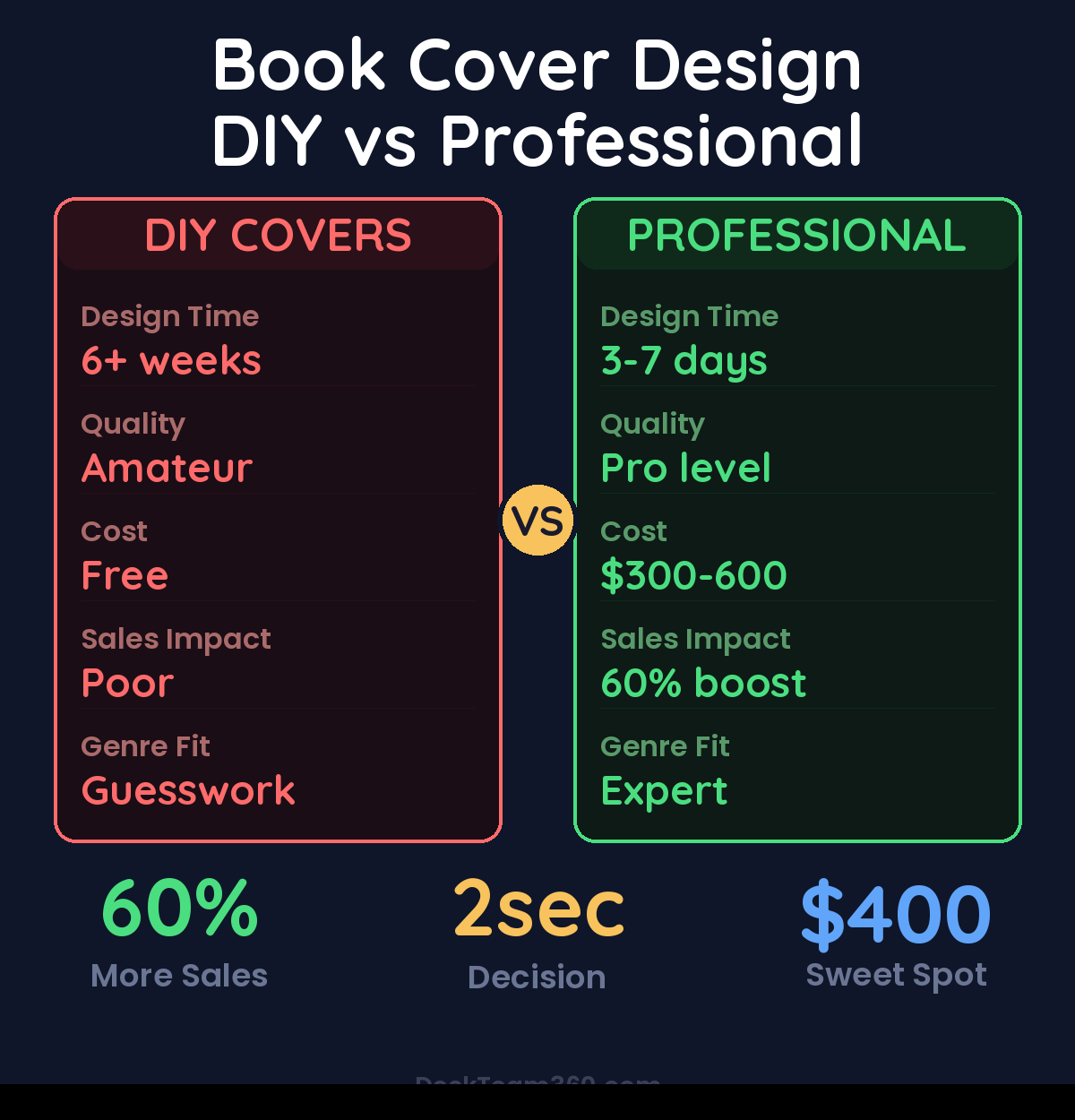
I know that stings. You’ve spent months crafting every sentence, perfecting every plot point, editing until your eyes bleed. But none of that matters if your cover looks like it was designed by a middle schooler in Microsoft Paint. Amazon shoppers make their buying decision in 2-3 seconds based on your cover thumbnail. That’s it.
I’ve watched authors with brilliant manuscripts sell 12 copies because their cover screamed “amateur hour.” I’ve also seen mediocre books hit bestseller lists because they nailed the visual first impression. The cover isn’t just packaging, it’s your entire marketing campaign compressed into 120×193 pixels.
You have two options: spend the next six months learning graphic design (spoiler: you won’t get good enough), or outsource to professionals who do this for a living. Here’s exactly how to find, hire, and work with book cover designers without getting ripped off.
The Five Types of Book Cover Designers
Not all designers are created equal. The book cover world has five distinct tiers, and picking the wrong one will either bankrupt you or deliver garbage.
Tier 1: The Freelance Platforms ($50-200)
Fiverr, Upwork, 99Designs. You’ll find hundreds of designers offering book covers for $50-200. Some are surprisingly good, most are terrible. The challenge is separating wheat from chaff when you’re looking at 847 portfolios.
What works here: designers with 500+ reviews and 4.8+ ratings, portfolios showing your exact genre, clear communication in English, and willingness to provide 3-5 concept options. What doesn’t: anyone promising 24-hour delivery, using obvious stock photos as examples, or asking for payment upfront before showing concepts.
Watch out: Many platform designers use pre-made templates and just swap out the text. You might end up with the same cover as three other authors. Always ask if the design will be 100% original to you.
Tier 2: Specialized Book Cover Services ($300-600)
Companies like SelfPubBookCovers, BookCoverZone, and The Book Cover Designer focus exclusively on books. They understand genre conventions, Amazon optimization, and thumbnail readability. This is the sweet spot for most self-published authors.
You get genre expertise, proven track records, and covers that actually sell books. The process is streamlined, they include print-ready files, and most offer unlimited revisions until you’re happy.
Tier 3: Established Cover Artists ($700-1,500)
These are the designers behind bestselling traditionally published books. Names like Dane Low, Jennifer Quinlan, and Najla Qamber. Their waiting lists are 2-4 months, but the quality is extraordinary.
If you’re launching a series or have a significant marketing budget, this tier delivers covers that compete directly with Big Five publishers. The investment pays off in credibility and sales conversion.
Tier 4: Big Agency Custom Work ($1,500-5,000)
Design agencies that handle major publisher accounts. Only makes sense if you’re launching with serious marketing spend or targeting traditional bookstore placement. Most self-published authors should skip this tier entirely.
Tier 5: Celebrity Cover Artists ($5,000+)
The people behind Stephen King and John Grisham covers. Unless you’re already a bestselling author or have corporate backing, this is vanity spending, not business investment.
Pro tip: Start with Tier 2 for your first book. If it takes off and you’re planning a series, upgrade to Tier 3 for consistent branding across multiple titles. You can always redesign later if success justifies it.
Free Tool
How Much Is Freelancer Management Really Costing You?
Most agency owners have never done this math. Plug in a few numbers and see your real cost in 2 minutes.
Calculate Your Hidden Costs →
The Brief That Gets You Great Covers
Most authors write terrible briefs and wonder why they get terrible covers. Your designer isn’t a mind reader. The more specific you are upfront, the better your results will be.
Essential Information
Start with the basics: exact genre and subgenre (not just “fiction” but “contemporary romance” or “grimdark fantasy”), target audience demographics, book’s tone and mood, and whether this is standalone or part of a series.
Include your book’s unique selling proposition in one sentence. What makes it different from the 50 other thrillers published this month? That differentiation should show up in the cover concept.
Visual References
Find 5-10 covers in your genre that you love. Don’t worry about copyright, you’re not asking for copies, you’re showing style preferences. Say “I like the moody lighting in this one” or “the typography treatment here really works.”
Also find 3-5 covers you hate and explain why. “This feels too busy” or “the colors are wrong for my target audience.” Negative examples are often more helpful than positive ones.
Technical Requirements
Specify all the formats you need: Kindle Direct Publishing (300 DPI, JPEG), print-ready spine (depends on page count), audiobook cover (3000×3000 pixels), and any promotional sizes for social media or ads.
Red Flags That Scream “Run Away”
You’ll encounter plenty of designers who seem legit until you dig deeper. Here’s how to spot trouble before you waste money.
They won’t show you concepts first. Any legitimate designer should provide 2-3 rough concepts before you commit to full payment. If they demand 100% upfront, that’s a red flag.
Their portfolio doesn’t match your genre. A designer who specializes in children’s books probably shouldn’t design your psychological thriller. Genre conventions exist for good reasons.
They promise unrealistic timelines. Good design takes time. Anyone offering finished covers in 24-48 hours is either using templates or cutting corners on quality.
They can’t explain their design choices. When you ask “why did you choose this font?” they should have a real answer about readability, genre expectations, and target audience preferences. “It looked cool” isn’t design thinking.
They don’t ask about your marketing strategy. Cover design and marketing are connected. A designer who doesn’t ask about your target audience, comp titles, or promotional plans isn’t thinking strategically about your book’s success.
The Revision Process That Actually Works
Even great designers rarely nail it on the first try. How you handle revisions determines whether you end up with a cover you love or one you settle for.
Be Specific About Changes
Don’t say “make it more exciting.” Say “the current version feels too calm for a thriller, can we try darker colors and more dynamic composition?” Give actionable feedback that addresses specific elements: typography, color palette, imagery, layout, or mood.
Reference other covers when describing changes. “Can we try a font more like this example?” is infinitely more useful than “the font doesn’t feel right.”
Test With Your Target Audience
Before finalizing, show the cover to 10-15 people in your target demographic. Don’t ask if they like it, ask “what genre do you think this book is?” and “would you click on this cover while browsing?” Their answers tell you if the cover is working as marketing.
The genre test never lies. If readers consistently misidentify your genre based on the cover, you have a marketing problem that will kill sales before anyone reads page one. Fix it now or pay for it later in poor conversion rates.
For a deeper dive, see our guide on responsive web design best practices: the complete guide.
Budgeting: What Different Price Points Actually Buy You
Understanding what you get at each price point prevents both overpaying and false economy decisions that cost you sales.
Under $100: Template modifications or very basic custom work. You’ll get a functional cover, but it won’t stand out in a crowded marketplace. Fine for testing concepts or very niche markets with low competition.
$200-400: Solid custom work from experienced freelancers. This range delivers professional quality that competes effectively on Amazon. Most self-published authors should start here.
$500-800: Premium custom work with multiple concepts, detailed revisions, and genre expertise. The cover becomes a real marketing asset that drives discoverability and conversion.
$1000+: Exceptional work from established professionals. The cover quality matches traditionally published books and justifies higher price points. Worth it for series or when you’re investing seriously in marketing.
Authors who spend $400+ on covers sell 60% more copies in their first year compared to those using sub-$200 designs.
Working With Designers Like a Pro
The best covers come from collaborative relationships where author and designer work as a team. Here’s how to be the kind of client that designers do their best work for.
Communicate your timeline upfront. If you need the cover by a specific date for launch, tell them immediately. Rushing a designer at the last minute guarantees subpar results.
Be responsive during the process. When they send concepts, respond within 24-48 hours with detailed feedback. Delayed responses stretch projects out for weeks and frustrate everyone involved.
Trust their genre expertise. If they suggest changes based on market conventions, listen carefully. They’ve designed hundreds of covers and understand what actually sells books vs. what looks pretty.
Pay promptly and leave reviews. Good designers are in high demand. Treat them well and they’ll prioritize your future projects and refer other quality professionals when they’re booked.
The Hidden Costs Nobody Talks About
The quoted design fee is just the beginning. Factor these additional costs into your budget planning.
If you’re printing books, you’ll need spine design based on exact page count. That’s usually $50-150 extra if not included in the original quote. Marketing materials like bookmarks, postcards, or social media graphics can add $100-300 to the total project cost.
Series planning is crucial but often overlooked. If this is book one of five, you need consistent branding across all covers. That might mean paying extra upfront for series templates or redesigning early books later when the series grows.
Format optimization for different platforms sometimes requires adjustments. What works on Amazon might need tweaking for Barnes & Noble, Apple Books, or international markets.
For industry research and benchmarks, check out Clutch.co.
Platform-Specific Optimization
Different sales platforms have different technical requirements and visual conventions. A cover optimized for one platform might underperform on another.
Amazon KDP prioritizes thumbnail readability and genre recognition. Covers that work here have bold, simple designs with large, clear typography. Busy covers with multiple elements get lost in search results.
Apple Books tends toward more artistic, sophisticated designs. Their audience expects covers that look like they belong in physical bookstores. More detailed artwork often performs better here than on Amazon.
Print bookstores require covers that work both as thumbnails and full-size shelf displays. The design needs impact from across a store aisle while remaining readable in online search results.
Smart authors create primary covers optimized for their main sales channel, then make minor adjustments for secondary platforms. Understanding how different marketing channels work helps you optimize accordingly.
Series Branding Strategy
If you’re planning multiple books, approach cover design as a cohesive branding system, not individual projects.
Establish visual elements that remain consistent across all books: color palette, typography style, layout structure, and graphic elements. These create instant recognition when readers see book two or three.
Plan for variation within consistency. Each cover needs to feel unique while clearly belonging to the same family. This might mean changing the main image while keeping typography and layout identical, or using the same color scheme with different compositions.
Testing and Iteration
Your cover’s job isn’t finished when the designer delivers files. Smart authors test performance and optimize based on real sales data.
A/B testing different covers is easier than most authors realize. Upload one version, track sales for 30 days, then upload an alternative and compare performance. Amazon allows cover changes without affecting reviews or ranking.
Monitor genre trends quarterly. Cover styles evolve, and what worked two years ago might look dated today. Successful authors refresh covers every 18-24 months to maintain competitive positioning.
Track metrics beyond just sales: click-through rates on ads, conversion from page views to purchases, and reader feedback about cover expectations vs. book content. These insights guide future cover decisions.
Launch Your Professional Cover Today
Your book deserves a cover that matches its quality and helps it find its audience. Professional cover design isn’t an expense, it’s marketing infrastructure that drives sales for the entire life of your book.
At DeskTeam360, we work with authors who need comprehensive marketing support, from cover design coordination to launch strategy and ongoing promotion. Our team handles the research, vendor management, and optimization so you can focus on writing your next book.
Quality book marketing requires the same systematic approach that we bring to business operations. Let us handle the implementation while you concentrate on creating great content.
Free 5-Minute Video
See How DeskTeam360 Works in Under 5 Minutes
Watch the short video and see exactly how we handle design, development, and marketing implementation — so you don't have to.
Watch the Video →