


Should You Outsource Email Marketing? What I Learned After 200+ Campaigns
The ActiveCampaign Disaster That Changed Everything
When you outsource email marketing, you’re making a strategic move. Let me tell you about the time I accidentally sent 12,000 emails with the subject line “TEST — DO NOT SEND.”
📋 Table of Contents
It was 3am on a Tuesday. I’d been wrestling with ActiveCampaign for six hours, trying to set up an automation sequence for one of our biggest clients. The email looked perfect. The trigger logic made sense. I was exhausted, but one more click and I’d be done.
I clicked what I thought was “save draft.”
It wasn’t.
By the time I realized what happened, 12,000 people had received a test email with placeholder copy like “[INSERT BENEFIT HERE]” and “Click this button that doesn’t go anywhere yet.” The client’s unsubscribe rate that day was 4.2%. Industry average is 0.26%.
That email disaster cost the client about 500 subscribers and nearly cost me the account. More importantly, it taught me something: email marketing isn’t a side hustle. It’s not something you squeeze between client calls and lunch breaks. It requires dedicated expertise, or you end up like me at 3am, destroying subscriber lists with test emails.
Watch out: Email marketing looks simple until something goes wrong. One mistimed automation or broken link can damage your sender reputation for months. The technical side alone requires someone who lives in these platforms daily.
After 200+ email campaigns across dozens of clients, I’ve figured out exactly when to outsource email marketing and when to keep it in house. Here’s what I wish someone had told me before my 3am disaster.
When Outsourcing Email Marketing Makes Sense
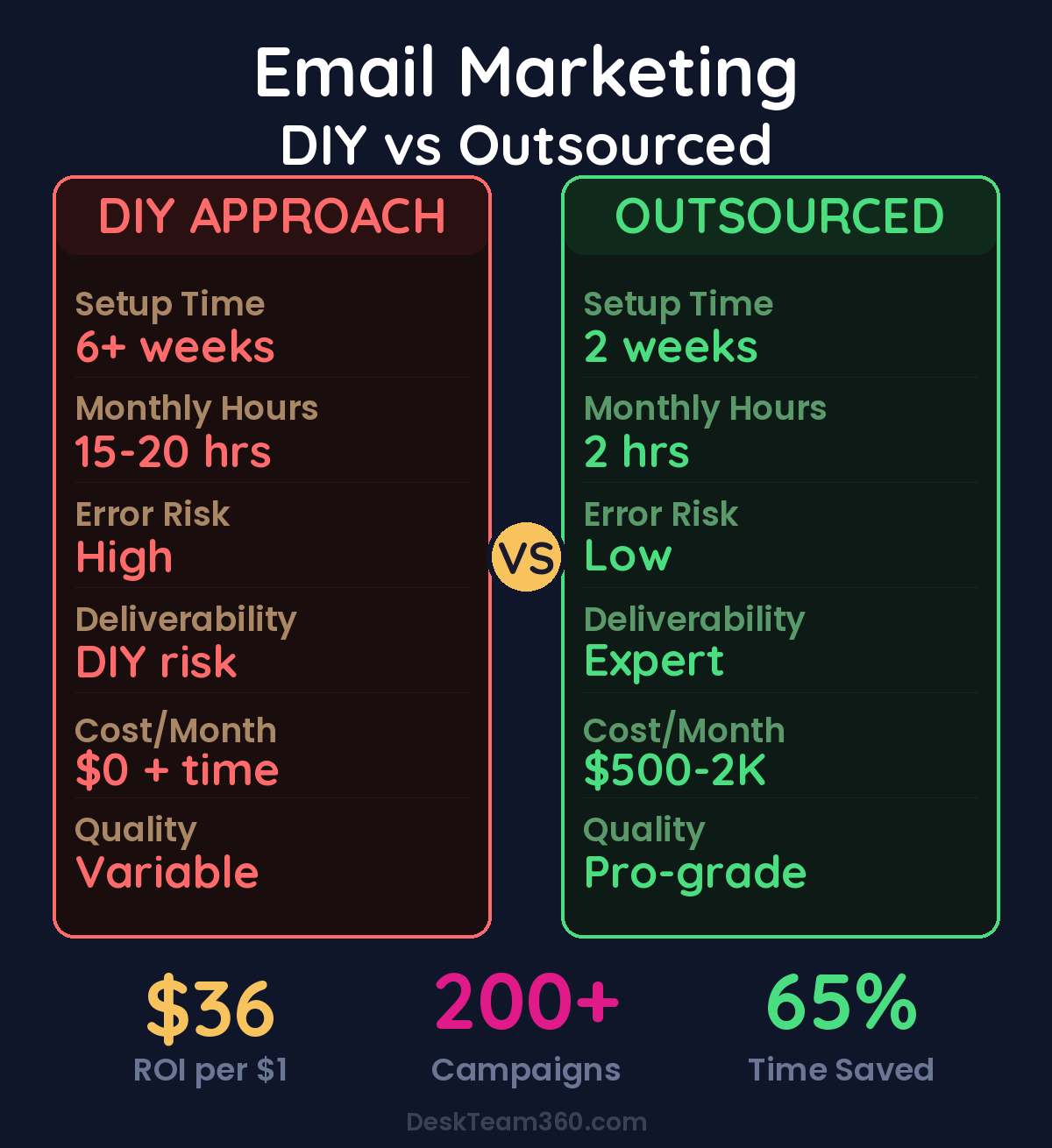
You should outsource email marketing when you’re spending more than five hours per week on it. Do the math. At $100-$200 per hour (your effective rate as a business owner), five hours weekly on email costs you $2,000-$4,000 monthly in opportunity cost. That buys a lot of professional email management.
Your list size matters too. Once you’re above 5,000 subscribers, mistakes get expensive fast. Small lists forgive errors. Large lists amplify them. My 12,000-subscriber disaster would’ve been a minor hiccup with 500 subscribers. At scale, you need someone managing email campaigns daily, not someone learning as they go.
The complexity factor is huge. Email marketing today isn’t just writing newsletters. It’s automation sequences, behavioral triggers, list segmentation, deliverability monitoring, A/B testing, and integration management. That’s a full skill set, not a checklist item. According to HubSpot’s latest data, email generates $36 for every $1 spent, but only when executed properly. Bad email marketing generates unsubscribes and spam complaints.
You definitely need outside help if you don’t have a dedicated email person on your team. Email marketing requires strategy, copywriting, design skills, automation logic, list management, and technical troubleshooting. Expecting your marketing coordinator to master all of this while handling other responsibilities is unrealistic.
For a deeper dive, see our guide on what is white label marketing? the complete guide for agencies.
Free Tool
How Much Is Freelancer Management Really Costing You?
Most agency owners have never done this math. Plug in a few numbers and see your real cost in 2 minutes.
Calculate Your Hidden Costs →
When to Keep Email Marketing In House
Keep email marketing internal when your emails are deeply personal and voice-dependent. If you’re a personal brand where every email sounds like you texted it from your phone, outsourcing the writing might dilute that authenticity. But you can still outsource the technical setup, design, and automation while writing the copy yourself.
Your list size plays a role here too. If you’re under 1,000 subscribers and still figuring out what resonates, don’t pay someone to optimize something unproven yet. Test your messaging first, find what works, then outsource the scaling.
Control freaks should probably keep email in house, at least initially. If you need to approve every subject line and can’t delegate messaging decisions, outsourcing will create bottlenecks that defeat the purpose. Work on your delegation skills first. Our guide on effective task delegation covers the fundamentals.
What Parts of Email Marketing to Outsource
You don’t have to outsource everything. I break it into three categories based on what I’ve learned from dozens of implementations.
Outsource the technical stuff immediately: email template design and HTML coding, CRM setup and automation building, list segmentation and tagging architecture, deliverability monitoring and reputation management, A/B testing setup and analysis, and analytics dashboards and reporting. This is the stuff that breaks at 3am and costs you subscribers when done wrong.
Consider outsourcing the strategic work: copywriting for sequences and campaigns, content calendars and campaign planning, lead magnet creation and funnel design, and competitor analysis and industry research. These require skill but not necessarily your specific voice and knowledge.
Usually keep the brand stuff in house: voice and messaging direction, personal stories and anecdotes (though you can provide these as raw material), major strategic decisions like which segments to prioritize, and product launch messaging that requires deep company knowledge.
Pro tip: Start by outsourcing just the technical implementation. You write the emails, they build the automations and handle the setup. This gives you quality control over messaging while eliminating the 3am technical disasters.
At DeskTeam360, we handle the technical and design side for our clients. CRM setup, template creation, automation building, list management, and deliverability monitoring. The client provides strategy and approves copy, but we handle everything that requires platform expertise. It’s the best of both worlds.
The Real Cost of Email Marketing Outsourcing
Let me give you actual numbers, not the vague ranges you find in most articles.
Freelance email specialists charge $50-$150 per hour. For ongoing management, that’s typically 10-15 hours monthly, or $500-$2,250 per month. Quality varies wildly. I’ve hired three freelance email marketers over the years. One was excellent, one was average, and one set up an automation that sent the same email 47 times to the same people in one day.
Email marketing agencies run $2,000-$8,000 monthly. This gets you strategy, copy, design, setup, and management from a team. The premium comes with premium overhead though. Account managers, strategists, designers, and developers all billing against your retainer adds up fast.
Full-service subscription teams (like DeskTeam360) include email marketing as part of your flat monthly rate. Email template design, automation building, and CRM setup alongside your other design and development work. No separate email vendor to manage.
Don’t forget platform costs. As of 2026, you’re looking at Mailchimp ($13-$350/month based on list size), ActiveCampaign ($49-$386/month), GoHighLevel ($97-$497/month but includes CRM and funnels), or HubSpot ($800-$3,600/month for Marketing Hub). The platform choice impacts both monthly costs and the expertise required to manage it effectively.
Email marketing delivers $36 return for every $1 invested, but only when executed properly by experienced hands.
How to Find the Right Email Marketing Partner
After too many bad hires, I’ve learned what to look for. Platform expertise matters more than general marketing experience. If you use GoHighLevel, don’t hire someone who only knows Mailchimp. The platforms have completely different automation logic, tagging systems, and integration capabilities. Ask specifically which platforms they work with daily, not which ones they’ve “used before.”
Deliverability knowledge separates pros from amateurs. Anyone can report open rates and click rates. The real question is their track record with sender reputation. Have they ever gotten a client blacklisted? Do they know how to warm up new domains? Can they troubleshoot delivery issues? If these questions get blank stares, keep looking.
Test before committing. Don’t sign a six-month retainer without seeing actual work. Have them build one automation or design one template. Evaluate quality, communication, and turnaround time before going all in. Most email disasters happen when you skip the trial period and assume competence.
Look for a full-service approach when possible. Email doesn’t exist in a vacuum. Your emails need landing pages, graphics, maybe video content. If your email person can’t coordinate with your design team (or isn’t part of an integrated team), you’ll spend half your time being the middleman between vendors.
The coordination overhead is why I built DeskTeam360 as a full-service team rather than specialized email-only. Everything connects. Email templates match your website design. Landing pages integrate with your CRM. Video thumbnails work in email clients. When it’s all handled by the same team, nothing falls through the cracks. Understanding how to measure marketing ROI helps you evaluate any vendor’s performance properly.
DIY Email Marketing vs Outsourcing: The Numbers
Here’s the reality check most people avoid. DIY email marketing costs zero dollars and thousands in opportunity cost. Those five hours weekly you spend fighting automation logic and designing templates? That’s $2,000-$4,000 monthly in lost productivity. Plus the hidden costs of mistakes like my 3am disaster.
Outsourced email marketing costs $500-$5,000 monthly but frees up your time for higher-value work. Professional quality, faster implementation, and lower risk of subscriber-destroying mistakes. The math works when email marketing is important to your business, which it should be since it’s still the highest-ROI channel in 2026.
Quality matters more than cost. Bad DIY email marketing damages your sender reputation and burns your list. Bad outsourced email marketing is expensive and still damages your reputation. Good email marketing, whether DIY or outsourced, pays for itself within the first campaign.
Speed is another factor most people underestimate. Learning email automation takes months. Hiring someone who already knows the platforms gets you results in weeks. If you’re launching a new product or need to scale quickly, the time savings alone justifies outsourcing.
The Email Marketing Tasks You Should Never Outsource
Some things need to stay internal, regardless of budget or team size. Brand voice and messaging direction should come from you. Your outsourced team can write copy, but the tone, personality, and key messages need your approval. Don’t let a vendor define how your brand communicates.
Personal stories and anecdotes work best when they come from you directly. You can provide these as raw material for your outsourced team to polish and format, but the authenticity needs to be genuine. Fabricated personal stories sound fake and damage trust.
For industry research and benchmarks, check out Clutch.co.
Major strategic decisions like which customer segments to prioritize, what products to promote, and how to position against competitors require deep business knowledge. Your outsourced team can execute the strategy, but the strategy itself needs to come from someone who understands your business model, competition, and customers.
The golden rule: outsource execution, keep strategy internal. Let experts handle the technical implementation while you focus on the big picture decisions that only you can make.
Five Red Flags When Evaluating Email Marketing Vendors
They promise unrealistic results. Anyone guaranteeing specific open rates or revenue numbers without knowing your industry, list quality, or current performance is either lying or inexperienced. Good vendors focus on process and improvement, not magic number promises.
They don’t ask about your current setup. Professional email marketers want to understand your existing automations, list segments, and pain points before proposing solutions. If they jump straight to selling their services without discovery questions, they’re not thinking strategically.
They only work with one platform. Email marketing experts should be platform-agnostic or at least experienced with multiple systems. If they only know Mailchimp or only work with HubSpot, they’ll force you into their preferred tool regardless of whether it fits your business.
They can’t explain deliverability basics. Ask about SPF records, DKIM authentication, and sender reputation. If they look confused or give vague answers about “following best practices,” they lack the technical knowledge to protect your email program from delivery issues.
They don’t provide examples of their work. Legitimate email marketers have portfolios of campaigns, automation sequences, and templates they’ve created. If they won’t show you examples (citing “confidentiality”), they probably don’t have quality work to showcase.
Should You Outsource Email Marketing?
For most businesses doing more than basic newsletters, yes. Email marketing has become too complex and too important to treat as a side project. The technical requirements alone (deliverability, automation logic, integration management) require dedicated expertise.
The ROI justifies the cost when done properly. Email marketing’s $36-to-$1 return rate only applies to well-executed campaigns. Bad email marketing has negative ROI because it damages your reputation and wastes your list.
Start by outsourcing the technical implementation if you want to maintain control over messaging. You write the emails, they handle the platform setup, automation building, and deliverability monitoring. It’s a lower-risk way to test outsourcing while eliminating the 3am technical disasters.
Consider full-service outsourcing when email marketing isn’t your core competency but is critical to your business growth. Focus your time on what you do best and let email experts handle what they do best. Want to explore outsourcing marketing tasks beyond email? Start with email since the ROI is easily measurable and you’ll know within 30 days if it’s working.
Just remember: whether you DIY or outsource, email marketing requires ongoing attention and optimization. It’s not a “set it and forget it” channel. The difference is whether you’re the one doing the optimization or managing someone else who does it for you.
Free 5-Minute Video
See How DeskTeam360 Works in Under 5 Minutes
Watch the short video and see exactly how we handle design, development, and marketing implementation — so you don't have to.
Watch the Video →