

Graphic Design Subscription Services: Are They Worth It? [2026 Guide]
Why I Ditched Freelancers for Design Subscriptions (And You Should Too)
Let’s talk about graphic design subscription. Picture this: you’re sitting in a Panera parking lot at 11 PM, frantically texting a designer who was supposed to deliver your logo three days ago. Your client launch is in 18 hours. The designer hasn’t responded since Tuesday. And you’re wondering why the hell you didn’t just hire someone full-time.
📋 Table of Contents
That was my life in 2018. I’d spent the last five years bouncing between freelancers on Upwork, local agencies that charged $200 an hour for social media graphics, and offshore teams that delivered everything in Comic Sans. I was hemorrhaging money and losing my mind.
Then I discovered design subscription services. Not the garbage ones that farm work out to Fiverr contractors, but actual teams with real processes. It changed everything. After 12+ years and over $1M spent on creative work across 400+ clients at DeskTeam360, I’m going to tell you exactly when these services make sense and when they don’t.
What Design Subscriptions Actually Are (And Aren’t)
A design subscription is simple. You pay a flat monthly fee, submit design requests through a portal, and get them back on a predictable schedule. No hourly rates. No project quotes. No surprises.
Most services charge between $500 and $3,000 per month. The average designer salary in Phoenix is $65,000, which becomes $85,000 after benefits and taxes. So mathematically, if you need more than 10 hours of design work per week, a subscription starts making sense.
But here’s what the marketing material doesn’t tell you: “unlimited design” is a myth. Every service has capacity limits. You’re usually working one project at a time through a queue. If turnaround is three days and you get 20 working days per month, you’re looking at maybe six completed projects. That’s not unlimited, that’s predictable volume with smart packaging.
Free 5-Minute Video
See How DeskTeam360 Works in Under 5 Minutes
Watch the short video and see exactly how we handle design, development, and marketing implementation — so you don't have to.
Watch the Video →
The Four Types of Businesses That Should Use Design Subscriptions
After working with hundreds of businesses, I’ve seen a clear pattern in who thrives with this model.
Marketing Teams Running Campaigns
If you’re pushing out social media content, email graphics, landing page banners, and ad creatives every week, subscriptions are a no-brainer. I’ve watched marketing teams burn through $4,000 a month on freelancer fees just to keep up with content calendars. A $2,000 subscription that handles the same volume with faster turnarounds? Easy math.
Agencies White-Labeling Design Work
This is exactly why I built DeskTeam360. Digital marketing agencies don’t want to hire designers, manage designers, or explain to clients why their designer quit mid-project. They want to promise design deliverables and know they’ll get handled. A subscription becomes your invisible design department.
E-commerce Brands
Product graphics, seasonal campaigns, A/B testing creatives, Amazon storefront banners. E-commerce never stops needing design work, and most of it follows predictable patterns. Perfect fit for the subscription model.
Growing Startups
When you’re scaling fast, hiring a designer is a commitment. Salary, benefits, equipment, management time, and the risk they’ll quit when you need them most. A subscription gives you design capacity without the HR nightmare.
The subscription sweet spot is 10-25 design requests per month. Less than that, hire freelancers per project. More than that, you probably need multiple subscriptions or an in-house team.
When Design Subscriptions Are a Terrible Idea
I’m going to save you some money here. Don’t get a design subscription if any of these apply to you.
We break this down further in how to outsource graphic design on a budget (without sacrificing quality).
You only need design work occasionally. Paying $1,500 a month for two logo variations is insane. Hire a freelancer for $300 and call it done.
You need same-day turnarounds regularly. The queue system doesn’t work for urgent requests every week. You need someone sitting in your Slack channel, which means in-house or a dedicated freelancer.
You need highly specialized work like technical illustrations, 3D packaging, or full rebrand strategy. Most subscription services assign whoever’s available. That works for social graphics, not for complex brand work.
You micromanage creative decisions. If you need to approve every color choice and font selection, you’ll drive subscription teams crazy. They’re optimized for clear briefs and minimal revisions. Our guide on writing effective project briefs can help if this is you.
The Real Comparison: Subscription vs. Everything Else
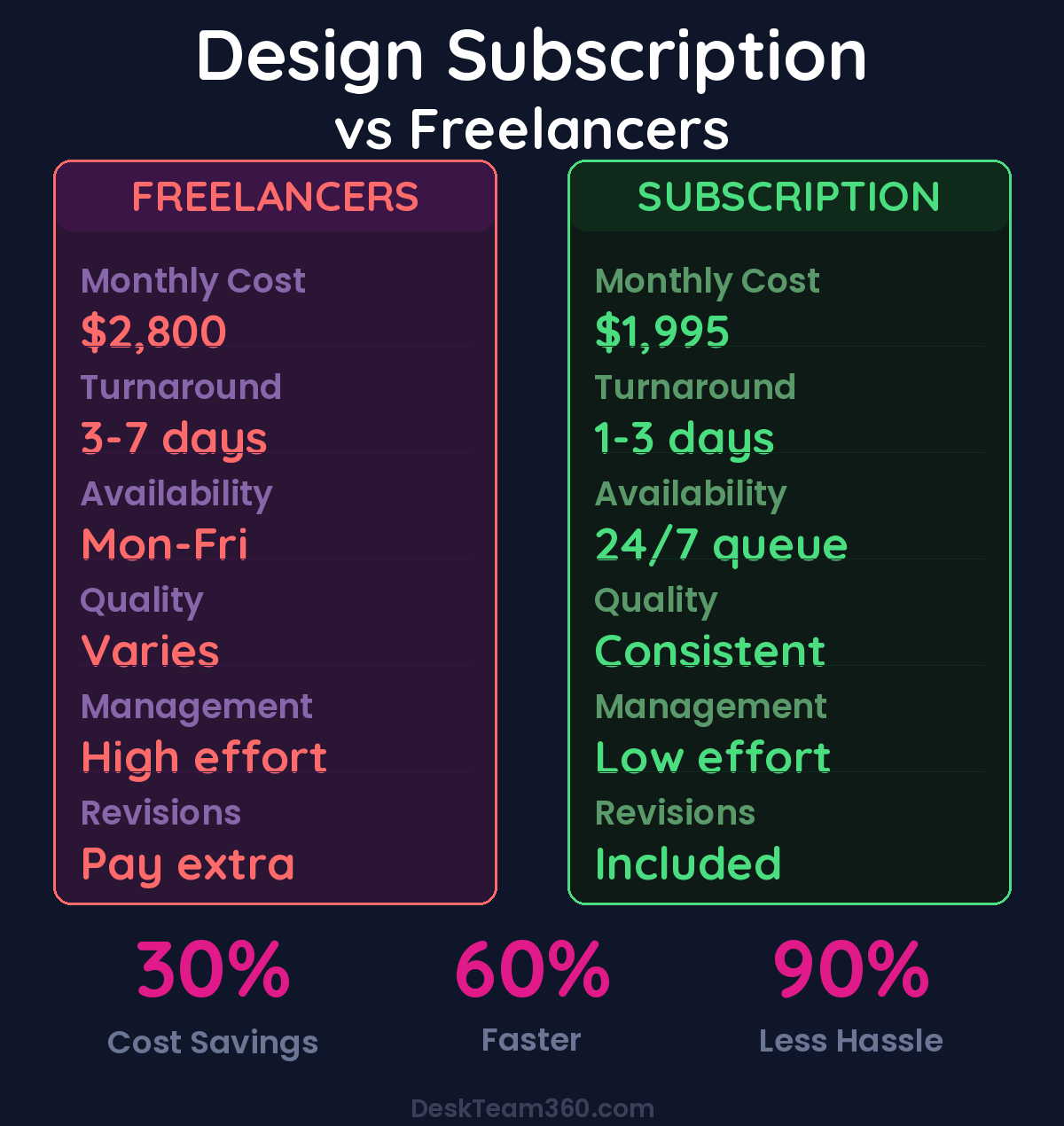
Let’s run actual numbers, because that’s the only way to make this decision.
Freelancers cost $30-150 per hour depending on quality and location. A decent mid-tier designer at $75 an hour doing 30 hours of work per month costs $2,250. Add your time managing them, and you’re at $2,500-3,000 monthly, assuming they don’t disappear.
Agencies charge $100-300 per hour, but you’re paying for account managers and project coordinators who aren’t designing. Simple social media graphics that take two hours to create become $800 projects after markups and management fees.
In-house designers run $70,000-120,000 annually including benefits. That’s $6,000-10,000 per month before you factor in equipment, software licenses, and management overhead. Plus the recruiting costs when they quit.
A good design subscription handles the equivalent of 20-30 freelancer hours per month for $1,500-2,500. The math works if you have consistent volume and don’t need specialized expertise.
Businesses switching from freelancers to subscriptions typically see 40% cost reduction and 60% faster turnarounds within the first quarter.
What to Watch Out For (Red Flags That Kill ROI)
Not every design subscription is worth your money. I’ve tested dozens of them, and here are the warning signs that’ll cost you.
Vague Turnaround Promises
If they say “fast turnaround” instead of “first draft within 48 hours,” run. You need specific commitments, not marketing fluff. Ask about rush options too. Can you get same-day delivery for urgent requests? How much extra does it cost?
Unlimited Everything Claims
Nobody’s giving you unlimited anything. Read the fine print. “Unlimited revisions” usually means unlimited tweaks to the same concept, not unlimited restarts. If your first draft misses the mark completely, starting over often counts as a new request.
Mystery Teams
Some services farm your work out to random contractors and mark up the results. You’re paying for consistency and quality control. Make sure you’re actually getting it. At DeskTeam360, everyone works in our physical office for exactly this reason.
For a deeper dive, see our guide on best outsourced marketing services for small business [2026 guide].
Related reading: DeskTeam360 vs Flocksy: Which Creative Service Is Right for Your Business? [2026].
No Source Files
You should own the source files for everything they create. AI files for logos, PSD files for graphics, video project files for motion work. If they’re only delivering flattened PNGs, you’re locked into their platform forever.
Watch out: Services that require 6-12 month commitments upfront are usually hiding quality issues. The good ones are confident enough to go month-to-month because they know you won’t want to leave.
The Hidden Costs Nobody Talks About
Here’s what the sales pages don’t mention. Every design subscription has invisible costs that add up.
Request management takes time. Writing briefs, providing feedback, and reviewing revisions isn’t free. Factor in 2-3 hours per week of your time or someone on your team’s time. If that person makes $50 an hour, that’s $400-600 monthly in hidden labor costs.
Revision cycles can spiral. Most services give you 3-5 revision rounds, but complex projects often need more. Extra revisions either cost money or delay your timeline. Sometimes both.
Platform learning curves matter. Every service has their own portal, brief template, and communication style. Budget a week to get your team up to speed, longer if you’re migrating from an established workflow.
Scope creep is real. When design capacity feels “unlimited,” teams start requesting everything. Logo variations become full rebrands. Simple graphics become complex illustrations. Clear boundaries prevent subscription costs from doubling when you add video editing, web development, or copywriting to your requests.
How to Calculate If It’s Worth It for Your Business
Stop guessing. Here’s the framework I use with clients.
First, add up your current costs. Freelancer invoices from the last three months. Agency retainers. Your time managing creative projects (be honest, if you’re spending 6 hours a month coordinating with designers, that’s $300-500 of your time depending on your hourly rate).
Second, count your design volume. Social posts, email headers, landing page graphics, presentation slides, print materials, product images. Most businesses are surprised when they actually count. It’s usually 15-30 pieces per month once you include everything.
Third, factor in opportunity costs. What campaigns haven’t you run because design was a bottleneck? What landing pages haven’t you built because you didn’t want to deal with finding a designer? What A/B tests haven’t you run because creative production was too complicated? Understanding how to measure marketing ROI includes measuring what you didn’t do because of operational friction.
If your total current costs are $3,000 monthly and a subscription runs $2,200, you’re saving $800 per month. That’s $9,600 annually. But if removing the design bottleneck lets you launch two additional campaigns per quarter, the ROI gets much bigger.
The Three Questions That Determine Everything
Skip the feature comparisons and sales demos. These three questions will tell you if a design subscription makes sense for your business.
For industry research and benchmarks, check out G2 Reviews.
How many design requests do you actually have per month? Count everything from social graphics to email templates. If it’s less than 10, you’re probably better off with per-project freelancers. If it’s more than 30, you might need multiple subscriptions or in-house capacity.
How much management overhead are you willing to accept? Subscriptions require clear briefs, organized feedback, and consistent communication. If you prefer to wing it and figure things out as you go, freelancers who can handle ambiguous direction might be a better fit.
What’s your risk tolerance for creative consistency? Subscription teams follow established processes and style guides. You get reliable, on-brand work, but maybe not groundbreaking creative concepts. Agencies and senior freelancers might deliver more innovative work, but at higher costs and less predictable timelines.
Pro tip: Start with a month-to-month subscription and track your actual usage. Most businesses either love it immediately or cancel within 60 days. The middle ground doesn’t really exist.
Why I Built DeskTeam360 Instead of Using Existing Services
After testing every major design subscription service in 2019, I decided to build my own. Here’s why the existing options didn’t work for agencies like mine.
Most services only handle design. But agencies need web development, video editing, technical support, and marketing automation too. Juggling five different subscriptions defeats the purpose of simplifying operations.
Quality control was inconsistent. Projects would get assigned to whoever was available, regardless of whether they’d worked on similar projects before. Brand consistency suffered when different designers handled related work.
Communication happened through generic portals instead of integrated project management. When you’re managing 20+ client projects simultaneously, context switching between platforms kills productivity.
Pricing didn’t scale with business growth. Most services charge per subscription regardless of how much work you actually need. Small agencies overpay, large agencies hit capacity limits.
That’s why DeskTeam360 works differently. One team handles everything from design to development to video. Everyone works in the same office for better collaboration. We integrate with your existing project management tools. And pricing scales based on your actual volume, not arbitrary subscription tiers.
The Bottom Line on Design Subscriptions
Design subscriptions work for businesses with consistent volume, clear processes, and realistic expectations. They don’t work for sporadic users, perfectionists, or companies that need cutting-edge creative strategy.
If you’re spending $2,500+ monthly on freelancers and design coordination, a subscription will probably save you money and headaches. If you only need design work occasionally, stick with per-project hiring. If you need same-day turnarounds every week, hire someone in-house.
The decision isn’t about finding the perfect solution, it’s about finding the solution that matches your actual needs and budget. Most businesses I work with know within two weeks whether a subscription fits their workflow. Trust your experience over marketing promises.
And if you want to see what working with an actual team looks like instead of mystery contractors wearing subscription labels, our approach at DeskTeam360 might be worth exploring. We handle design, development, video, and technical support from one office with one point of contact. It’s the service I wished existed when I was managing five different vendors and losing sleep over deadlines.
Free Tool
How Much Is Freelancer Management Really Costing You?
Most agency owners have never done this math. Plug in a few numbers and see your real cost in 2 minutes.
Calculate Your Hidden Costs →