📋 Table of Contents
How One Teacher Built a $150K Education Business Starting With Just a Vision
How One Teacher Built a $150K Education Business Starting With Just a Vision
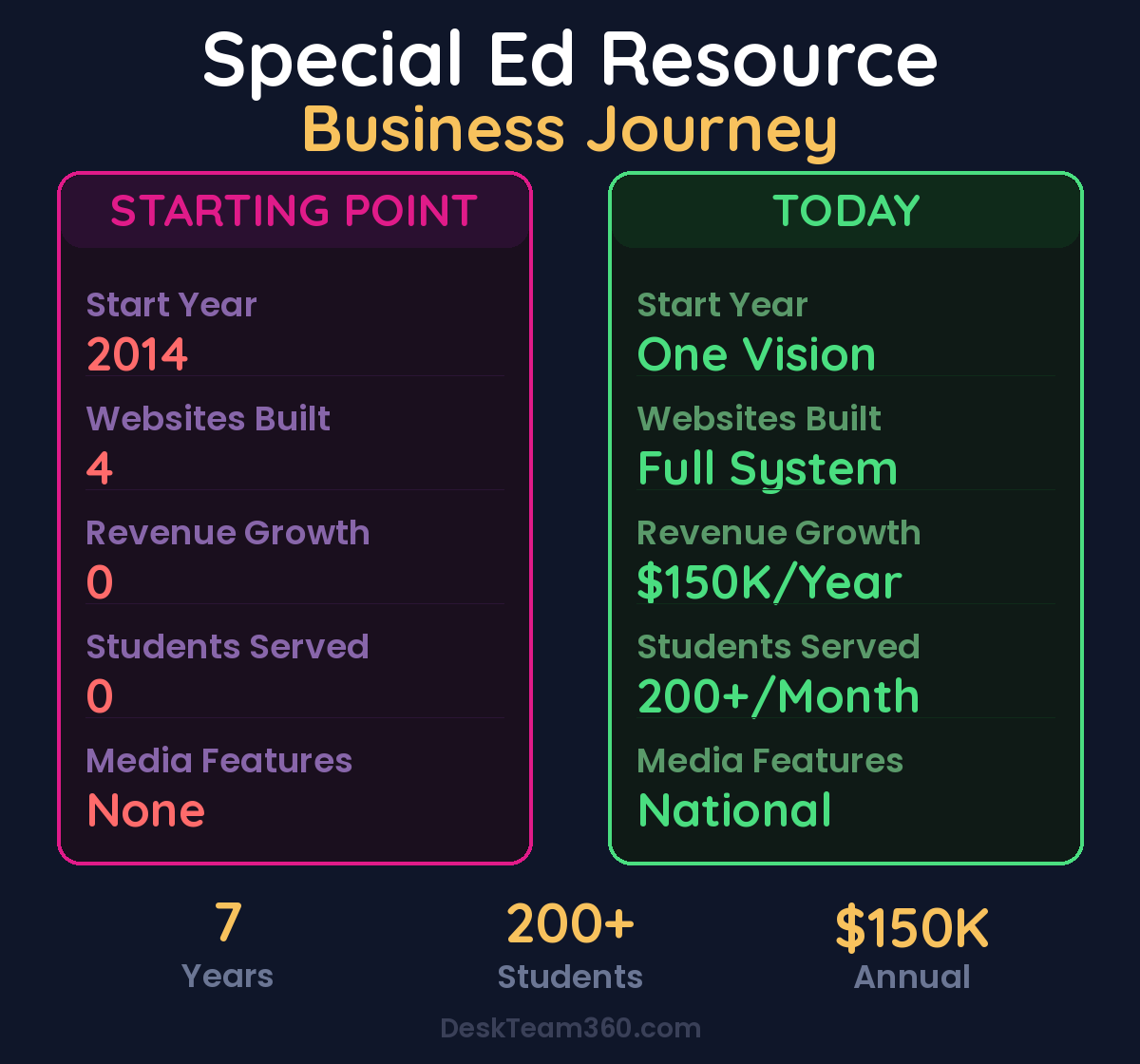
Let’s talk about deskteam360 case study special ed resource. Back in 2014, I got a call from a former Infusionsoft colleague who had a problem. His wife was a teacher with a simple dream: create a resource site for special education teachers. They’d spent months trying to build it themselves on one of those drag-and-drop website builders. It looked terrible and didn’t work.
Fast-forward to today? That same couple now operates SpecialEdResource.com with over 200 monthly recurring paying students across four different websites. They’ve been featured in Good Housekeeping, Top Ten Reviews, and publications worldwide. Their business generates consistent six-figure revenue.
Here’s exactly how we helped them build it, and what you can learn from their journey whether you’re starting an education business or any other online venture.
The Foundation: More Than Just a Pretty Website
When they first reached out, they made the same mistake I see constantly. They thought they needed a “flashy” website that would magically attract customers. Build it and they will come, right? Wrong.
I had to break some hard news: beautiful websites don’t drive business results. Strategic websites do. The difference is everything.
Instead of diving straight into mockups and color schemes, we spent two weeks mapping out their business model. Who exactly needed special education resources? How would teachers discover the site? What would make them pay for premium content instead of using free alternatives?
Those conversations completely changed their approach. We weren’t building a teacher resource site anymore. We were building a comprehensive special education platform that could scale.
The Strategy: Four Websites, One Ecosystem
Most people would have built one site and called it done. That would have been a massive mistake. Here’s why we went with four interconnected websites instead:
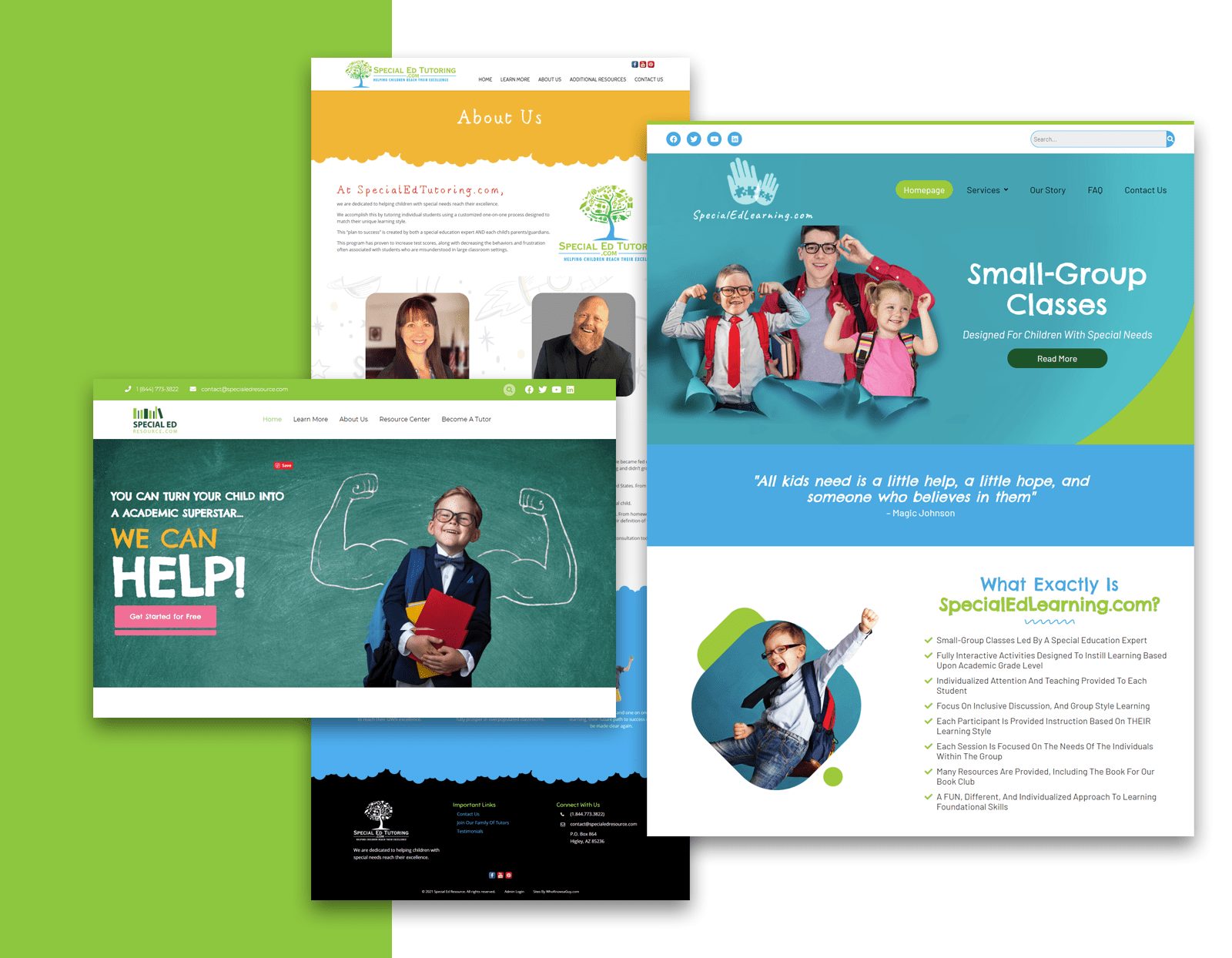
SpecialEdResource.com became the main content hub with free resources, articles, and teacher guides. This drives organic traffic and builds trust. SpecialEdTutoring.com focuses specifically on their tutoring services for parents seeking help for special needs children. SpecialEdLearning.com houses their premium courses and certification programs where the real revenue happens. And they’re launching SpecialEdDirectory as a marketplace connecting parents with qualified special education professionals.
Each site serves a specific audience segment while cross-promoting the others. A teacher reading free content on the main site might need tutoring services for their own child. Parents finding tutoring might want professional development courses. It’s not complicated, just strategic.
This multi-site approach multiplies your organic reach. Instead of competing for one set of keywords, you’re dominating entire topic clusters. Search engines see you as the definitive authority on special education because you’re creating comprehensive coverage across every angle.
The Technical Foundation That Scales
The first site we built in 2014 has been redesigned twice, but the underlying architecture remains solid. That’s intentional. We built for speed, scalability, and search engine optimization from day one.
Page load speeds under two seconds. Mobile-responsive design that actually works on tablets in classrooms. Clean URL structures that search engines love. Integration with their marketing automation system (Keap) so every visitor becomes part of their nurture sequence.
Most importantly, we built it modular. When they wanted to add course functionality, we didn’t rebuild everything. We extended what existed. When they needed better payment processing, we upgraded the system without breaking anything. That saves massive time and money as you grow.
The Content Strategy That Changed Everything
Here’s where most education sites fail miserably. They create content for other educators instead of creating content that gets found by their target audience.
We flipped that script completely. Instead of writing about “pedagogical approaches to special needs instruction,” we wrote about “how to help your autistic child succeed in school.” Same information, totally different angle that parents actually search for.
Pro tip: Your expertise doesn’t mean you should use expert language. The people who need your help most are usually beginners. Write for them, not your peer group. This applies whether you’re in education, consulting, or any other expert service.
We published three types of content consistently: practical guides that solve immediate problems parents face, teacher resources that build professional credibility, and case studies showing real results from their methods. Each piece was optimized for different search terms but all led to the same conclusion: if you need serious help with special education, these people are the experts.
The organic traffic results speak for themselves. They went from zero to thousands of monthly visitors within six months. But traffic alone doesn’t pay bills. We had to convert that attention into revenue.
The Conversion System: From Visitor to Paying Student
This is where the magic happens, and it’s not magic at all. It’s just systematic follow-up that most websites completely ignore.
Every visitor gets tracked through a specific journey. Free resource downloads capture email addresses. Email sequences nurture those leads with helpful content while building trust. Strategic offers introduce paid programs at exactly the right moment when someone is ready to invest in serious help.
The key insight? People don’t buy special education help because they want to learn about special education. They buy it because they’re desperate to help a struggling child or they need professional credentials to advance their career. Our entire funnel spoke to those real motivations instead of generic benefits.
Their conversion rate from email subscriber to paying customer is 15% higher than industry average because every touchpoint addresses real pain points, not theoretical needs.
We also built in upsell mechanisms that feel helpful rather than pushy. Someone who buys a basic course gets offered advanced certification. Parents who complete tutoring get invited to teacher training so they can better support their child. Each step provides genuine value while increasing customer lifetime value.
The Growth Acceleration: Authority and Partnerships
By year three, something interesting started happening. Instead of them chasing media coverage and partnerships, publications and organizations started reaching out to them.
Good Housekeeping featured them as special education experts. Professional education sites started requesting guest articles. Other special education businesses began proposing partnerships and referral arrangements.
This didn’t happen by accident. When you consistently publish high-quality content, optimize for search engines, and build genuine expertise in a specific niche, authority builds naturally. The media mentions and partnerships become inevitable rather than goals you chase.
Watch out: Authority takes time to build but can be destroyed quickly. Every piece of content, every customer interaction, every public statement either builds or undermines your credibility. Stay focused on genuinely helping your audience rather than just promoting yourself.
We cover this in more detail in first call digital agency has increased their quality of work and reduced their wait time on tasks with deskteam360!.
Today, their brand recognition in the special education space opens doors that would have taken decades to unlock through traditional marketing alone. That’s the compound effect of consistently showing up as the helpful expert rather than just another vendor.
The Numbers: What $150K in Annual Revenue Actually Looks Like
Let’s break down how 200+ monthly paying students translates to sustainable business revenue, because the math matters if you’re thinking about building something similar.
Their average customer pays $75 per month across all programs. Basic courses run $49/month, advanced certifications are $99/month, and premium tutoring packages reach $150/month. The weighted average works out to about $75.
200 students × $75 average = $15,000 monthly recurring revenue. That’s $180,000 annually, but the real number settles around $150,000 after accounting for cancellations, refunds, and seasonal fluctuations in the education market.
More importantly, this is predictable revenue. Unlike project-based education businesses that feast or famine based on enrollment cycles, recurring subscription revenue provides stability that lets them invest in content creation, marketing, and business growth. For insights on building predictable revenue streams, check out our guide on subscription business fundamentals.
The Systems That Keep It Running
Here’s what most people miss when they hear success stories like this: the systems that make it sustainable. It’s not just about reaching 200 students. It’s about serving them well enough that they stay, refer others, and buy additional programs.
Their customer support system handles questions within 24 hours. Their content delivery platform ensures courses work flawlessly on any device. Their community forum lets students connect with each other and share successes. Their automated email sequences continue nurturing relationships even after someone becomes a customer.
The business largely runs itself now because we built operational systems from the beginning instead of trying to add them later. That’s the difference between building a job for yourself and building an actual business.
The Team Structure That Scales
They didn’t start with a team. Like most successful online businesses, it began with the founder doing everything. But as revenue grew, they systematically replaced themselves in specific functions.
Content creation was the first hire, a part-time writer who understood special education. Customer support came next, allowing them to focus on strategy instead of answering routine questions. Technical maintenance and updates got outsourced to specialists who could handle those tasks more efficiently.
The key principle? Only hire when the cost of not hiring becomes more expensive than the hire itself. They never hired ahead of revenue, but they also didn’t try to do everything themselves forever. Our article on when to hire your first virtual assistant covers this decision framework in detail.
The Mistakes That Could Have Killed Everything
Success stories always sound smooth and inevitable when you tell them after the fact. The reality was messier. They made several mistakes that could have destroyed the business if we hadn’t caught and corrected them quickly.
Mistake #1: Trying to serve everyone. Their first course was “special education for all teachers.” Generic. Boring. Nobody bought it. We scrapped it and created specific programs: “autism classroom strategies,” “ADHD teaching techniques,” “IEP meeting preparation.” Specific problems get specific solutions and specific customers who pay premium prices.
Mistake #2: Underpricing to compete with free resources. They initially priced courses at $19/month thinking lower prices would increase conversions. Wrong. Low prices signal low value in professional education. When we raised prices to $49-99/month and emphasized certification value, conversions actually improved.
For industry research and benchmarks, check out Clutch.co.
Pro tip: In professional education, your audience expects to invest in quality training. Price your programs based on the value they provide, not based on what free alternatives cost. Teachers and parents will pay premium prices for premium results.
Mistake #3: Neglecting email marketing. For the first year, they focused entirely on driving traffic and creating courses. Their email list barely existed. Once we implemented systematic email collection and nurturing sequences, revenue doubled within six months. The email list is now their most valuable business asset.
Mistake #4: Building everything in-house. They initially wanted to build their own course platform, community forum, and email system. That would have taken two years and cost $50,000 minimum. Instead, we integrated existing tools (Keap for email, Thinkific for courses, Circle for community) and launched in six weeks. Build your core business first, then create custom tools later if needed.
What This Means for Your Business
The special education niche is specific, but the principles apply to any expert service business. Whether you’re a consultant, coach, trainer, or service provider, the same fundamental strategies work.
Start with a clear understanding of who you serve and what specific problem you solve for them. Build a content strategy that demonstrates your expertise while speaking to their actual concerns, not your professional jargon. Create multiple touchpoints and entry points rather than relying on a single website or service offering.
Most importantly, think in systems from day one. Every piece of your business should connect to every other piece. Your content drives traffic. Your traffic captures leads. Your leads convert to customers. Your customers generate referrals and repeat business. When all those pieces work together, growth becomes predictable rather than accidental.
The compound effect is everything in online business. Consistent content creation, systematic follow-up, and reliable service delivery might seem boring compared to viral marketing or breakthrough innovations. But boring consistency is what builds sustainable six-figure businesses that last.
The Next Evolution: Building for the Long Term
Seven years in, they’re not slowing down. The special education market continues growing as awareness and funding increase. Their expertise and brand recognition continue compounding. And they’re building additional revenue streams that leverage everything they’ve already created.
The upcoming directory platform will let them monetize their network of special education professionals. Corporate training programs bring their expertise to school districts and organizations. Certification programs create ongoing professional development revenue.
Each new initiative builds on the foundation we established in 2014. That’s the power of thinking strategically about business architecture from the beginning instead of just solving immediate problems.
If you’re building an expert service business in any niche, the question isn’t whether you need a strategic approach to your online presence. The question is how long you want to wait to get serious about it. Our authority marketing guide walks through the complete framework for establishing expertise in your field.
At DeskTeam360, we’ve helped hundreds of entrepreneurs and professionals build the kind of systematic online business that generates predictable revenue. From content strategy and website development to marketing automation and conversion optimization, we handle the technical implementation so you can focus on serving your customers and growing your expertise.
Ready to build something that lasts? See our plans and let’s get started →