

Best Toptal Alternatives for Web Development: Quality Without the Premium Price
The Toptal Tax Is Real, and It’s Expensive
Looking for the best toptal alternatives? You’re in the right place. Toptal charges a 40-50% markup on developer rates. That’s not a typo. If a developer earns $50/hour through Toptal, you’re paying $75-100/hour for that same talent. For a 6-month project, that premium can cost you an extra $30,000-50,000 over hiring directly or using smarter alternatives.
📋 Table of Contents
I’ve run outsourcing teams for 12+ years across 400+ client projects. Toptal markets itself as “the top 3% of talent,” but here’s what they don’t tell you: most platforms have equally skilled developers. The difference isn’t the quality, it’s the vetting process and the price tag.
You’re paying premium prices for what amounts to a recruitment filter. That filter works, sure, but you can get the same results for 30-60% less cost with the right approach. Here’s exactly how, based on what I’ve seen work across hundreds of development projects.
Why Developers Choose These Platforms Over Toptal
Before we dive into alternatives, understand this: the best developers aren’t desperate to get on Toptal. They’re busy, successful, and often working directly with clients or on platforms with better terms. Toptal’s lengthy application process (4-5 steps, weeks of waiting) filters out great talent who don’t want to jump through hoops.
The best developers gravitate toward platforms with faster onboarding and better profit margins. That’s where you’ll find senior talent who left Toptal or never bothered applying in the first place.
The platforms below consistently deliver developer quality that matches or exceeds Toptal, but without the premium pricing and bureaucratic overhead. I’ve hired from all of them, tracked the results, and can tell you exactly what each one does best.
Free Tool
How Much Is Freelancer Management Really Costing You?
Most agency owners have never done this math. Plug in a few numbers and see your real cost in 2 minutes.
Calculate Your Hidden Costs →
Arc: Developer-Focused Alternative with Better Talent Retention
Arc (formerly CodementorX) is the closest direct alternative to Toptal, but with a crucial difference: they focus on developer experience, not just client experience. Better developer experience means better talent retention, which means you get access to developers who’ve been vetted and are sticking around.
Arc’s screening process is thorough but faster than Toptal’s. Two technical interviews, portfolio review, and reference checks. The whole process takes 1-2 weeks instead of 4-6. Their developer pool skews toward senior engineers with 5+ years of experience, and rates typically run $40-80/hour compared to Toptal’s $75-150/hour range.
The platform handles contracts, payments, and provides project managers for larger engagements. Where Arc really shines is technical specialization. Need a React Native expert? They’ll find one in 48 hours. Looking for someone with specific experience in your industry? Their matching algorithm actually works.
Pro tip: Arc offers both freelance and full-time placement options. If you find a contractor you love, you can convert them to permanent hire with a reasonable placement fee, something Toptal makes much more expensive.
Arc’s weakness is smaller talent pool size. They’re more selective about who they accept, which means fewer options in niche technologies or very specific skill combinations. For mainstream development (web apps, mobile apps, API development), they’re excellent.
Gun.io: Senior Developers Without the Premium Markup
Gun.io focuses exclusively on senior developers with 10+ years of experience. Their rates run $60-120/hour, which sounds expensive until you realize you’re getting truly senior talent that would cost $120-200/hour on Toptal.
What sets Gun.io apart is their vetting process emphasizes real-world problem solving over algorithmic puzzles. They’ll give a developer a business problem similar to what you’re actually trying to solve, not whiteboard coding exercises. The result is developers who can think strategically about your product, not just implement features.
Gun.io works best for complex projects where you need someone who can architect solutions, not just follow specifications. If you’re building something from scratch or refactoring a messy codebase, Gun.io developers often outperform cheaper alternatives because they prevent expensive mistakes upfront.
The downside is limited talent pool and higher selectivity. They reject about 95% of applicants, so finding available developers can take longer. Their sweet spot is 3-6 month engagements where the upfront matching time pays off in project quality.
Related: Outsourced Web Development: Complete Guide for Agencies [2026].
Turing: AI-Enhanced Matching at Scale
Turing takes a different approach: they use AI to match developers based on technical skills, communication style, and time zone compatibility. Their vetting includes coding challenges, technical interviews, and soft skills assessment. Rates typically run $35-75/hour for quality that competitive with platforms charging twice as much.
Where Turing excels is speed and scale. Need 5 developers for different parts of a large project? They can staff that in a week. Need someone in your exact time zone? Their matching algorithm considers that. Need specific experience with your tech stack? They actually test for it rather than relying on resume keywords.
The trade-off with Turing is less hands-on project management. They’ll find great developers but expect you to manage the relationship. For companies with internal project management capability, this works well. For those needing more guidance, Arc or Gun.io provide better support structures.
Gigster: End-to-End Development Teams
Gigster isn’t just about individual developers, they assemble complete project teams: developers, designers, project managers, and QA specialists. Think of it as outsourcing your entire development function rather than just hiring contractors.
This approach works brilliantly for product companies that need to ship features fast without building internal teams. Gigster teams have worked together before, they have established workflows, and they can start contributing immediately instead of spending weeks getting up to speed.
Gigster’s pricing is transparent and project-based rather than hourly. A typical mobile app might cost $50,000-150,000 fully delivered, which includes design, development, testing, and deployment. Compare that to 6 months of Toptal resources at $30,000-50,000 per month, and the math often favors Gigster for complete projects.
Watch out: Gigster works best for greenfield projects with clear requirements. If you need integration with complex existing systems or have frequently changing requirements, individual contractors often provide more flexibility.
Upwork: Hidden Gems Among the Noise
Yes, Upwork. Before you roll your eyes, hear me out. Upwork’s reputation suffers because of the low-end talent, but their top-tier developers often match or exceed Toptal quality at 40-60% lower rates.
The key is filtering correctly. Look for developers with “Top Rated Plus” status, 95%+ job success scores, and rates above $50/hour. Check their portfolio for projects similar to yours. Read client feedback carefully. Interview thoroughly. The vetting burden falls on you, but the savings can be substantial.
Upwork’s advantage is size and diversity. Need a developer with experience in your specific industry? They probably exist on Upwork. Need someone for a 2-week sprint project? Upwork has flexibility that dedicated platforms don’t.
For ongoing development work, building relationships with 2-3 excellent Upwork developers often delivers better results than platform-hopping. Once you find someone good, rates often decrease as the working relationship matures. Our guide on vetting remote developers covers the screening process in detail.
Direct Hiring: The Ultimate Cost Reduction
The cheapest alternative to Toptal isn’t another platform, it’s hiring developers directly. This requires more work upfront but can reduce costs by 50-70% compared to Toptal while giving you access to talent that never touches freelancing platforms.
Direct hiring works through job boards (AngelList, We Work Remotely, Remote OK), developer communities (GitHub, Stack Overflow, Reddit), referrals from existing team members, and LinkedIn outreach to developers at companies you respect.
We covered this in detail in our post about responsive web design best practices: the complete guide.
The process takes longer. Plan 4-6 weeks for sourcing, screening, and onboarding compared to 1-2 weeks with platforms. But for ongoing work or large projects, the time investment pays off. A developer earning $80,000-120,000 salary costs significantly less than equivalent contractor rates, even accounting for benefits and overhead.
For a deeper dive, check out our guide on deskteam360 vs draftss: full team vs budget subscription compared.
Companies hiring developers directly save an average of $85,000 annually per position compared to using premium contractor platforms for the same role.
Direct hiring works best when you have HR infrastructure to handle contracts, payments, and employment law compliance. For companies without that capability, the platform alternatives above often provide better value than building hiring infrastructure from scratch.
Hybrid Approach: Best of Both Worlds
The smartest companies don’t rely on one source. They use a hybrid approach: direct hires for core development team members, platform contractors for specialized projects or temporary capacity increases, and premium platforms like Arc or Gun.io for complex projects requiring immediate expertise.
This approach provides cost optimization, risk mitigation, and access to the widest possible talent pool. Start with direct hiring for predictable, ongoing needs. Use platforms for variable workload and specialized skills. Reserve premium platforms for mission-critical projects where cost is secondary to quality and speed.
Platform Comparison: What Actually Matters
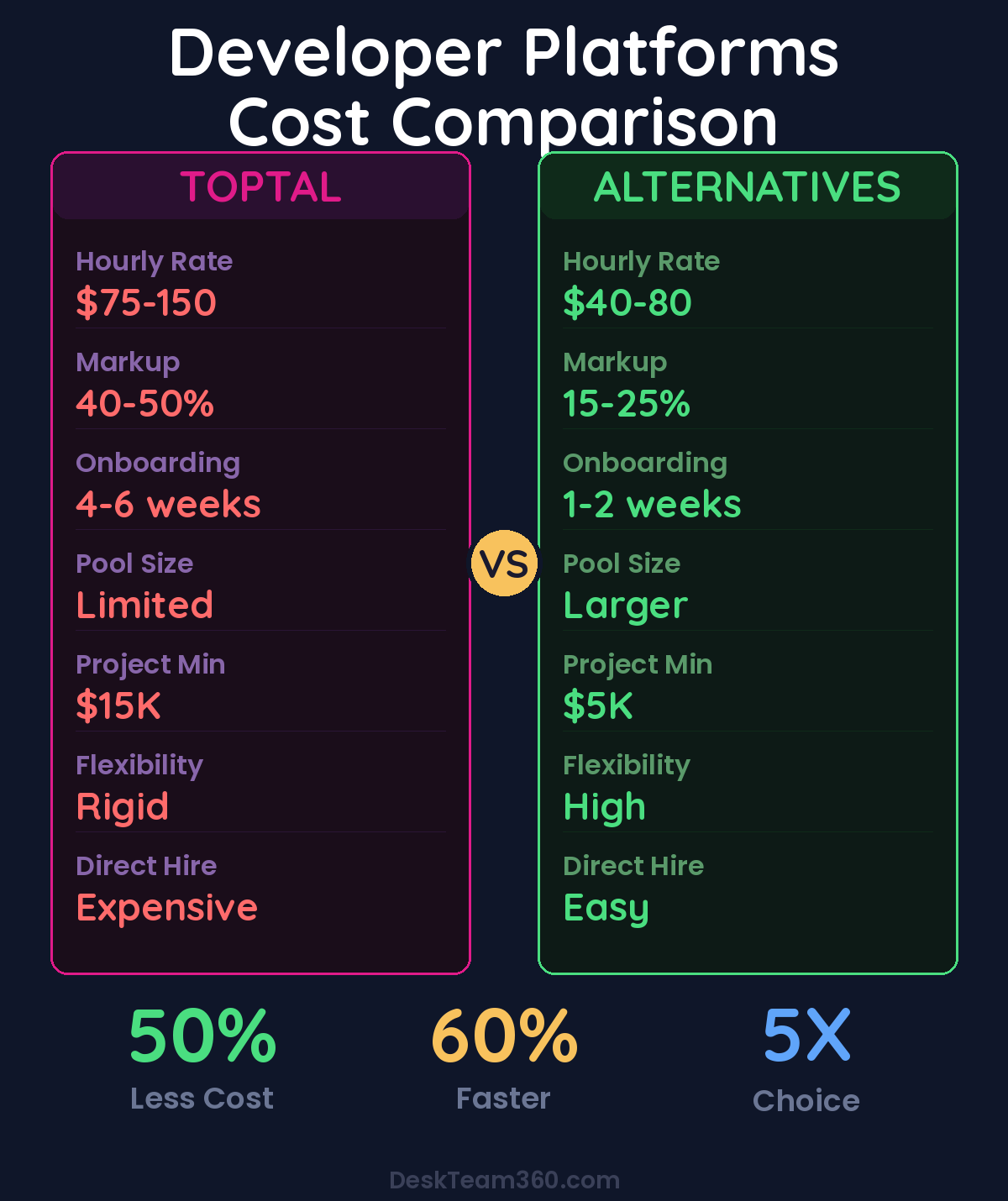
Choosing between these alternatives depends on five factors that matter more than marketing promises.
Project timeline: Need someone this week? Arc and Turing deliver fastest. Have 4-6 weeks? Direct hiring provides best value. Gigster requires 2-3 weeks for team assembly but delivers complete solutions.
Technical complexity: Simple web development? Upwork works fine with proper filtering. Complex architecture or specialized technologies? Gun.io and Arc provide better technical depth.
Project management needs: Want someone to handle everything? Gigster includes full project management. Need individual contributors? Arc provides light PM support. Prefer to manage directly? Turing and Upwork give you full control.
Budget constraints drive platform selection more than quality concerns. The talent quality gap between platforms is smaller than the cost gap. Match platform choice to budget reality, not aspirational spending.
Long-term vs short-term: One-off projects favor platforms for speed. Ongoing development favors direct hiring for cost efficiency. Most companies need both approaches for different situations.
Avoiding the Common Hiring Mistakes
I’ve watched companies waste tens of thousands of dollars making the same mistakes repeatedly. Here’s how to avoid each one.
Hiring based on hourly rate alone. A $40/hour developer who delivers clean code fast often costs less than a $25/hour developer who writes buggy code slowly. Factor in revision time, maintenance costs, and opportunity cost of delays.
For more on this, check out our guide on agency white label services: the complete guide to scaling without hiring.
For industry benchmarks and research, see Capterra.
For industry research and benchmarks, check out G2 Reviews.
Skipping the trial project. Every platform offers trial periods or small test projects. Use them. A week-long test project tells you more about work quality and communication style than any interview.
Not checking references. Platform ratings help, but speaking directly to previous clients reveals information ratings don’t capture. How do they handle changing requirements? Do they communicate proactively? Are they reliable with deadlines?
Underestimating time zone impact. Asynchronous work can function, but real-time collaboration often requires overlapping hours. Factor time zone differences into platform and developer selection, especially for projects requiring frequent communication.
Understanding remote team management prevents many of these issues before they impact project outcomes.
The Real Cost of Development Platforms
Platform fees are just the beginning. Factor in learning curves for new platforms, time spent on contractor search and vetting, project management overhead, revision cycles, and opportunity costs of slower delivery.
A complete cost comparison for a typical 6-month web application project looks like this: Toptal runs $120,000-200,000 all-in including platform fees and PM overhead. Arc costs $80,000-140,000 for equivalent scope and timeline. Gun.io ranges $100,000-160,000 but often delivers faster with fewer revisions. Turing costs $60,000-120,000 with more hands-on management required. Direct hiring costs $50,000-90,000 but requires 4-6 weeks longer for sourcing and onboarding.
The “cheapest” option depends on your internal capabilities and timeline constraints. Companies with strong project management often prefer Turing or direct hiring. Those needing immediate results pay premiums for Arc or Gun.io.
Platform Quality Has Converged
Here’s the truth that platform marketing won’t tell you: developer quality across reputable platforms has largely converged. The talent pool overlaps significantly. The same developers often work on multiple platforms. The vetting processes, while different in detail, produce similar quality outcomes.
The real differences are in pricing models, platform features, and support quality. Choose based on those factors rather than assuming one platform has dramatically better talent than others.
That said, platform quality does matter for project management, dispute resolution, and payment processing. The alternatives above all provide professional-grade infrastructure. Toptal’s premium comes from brand marketing more than operational superiority.
Start With Your Budget and Timeline
The best Toptal alternative is the one that fits your actual constraints, not theoretical ideals. If budget is tight and timeline is flexible, start with direct hiring supplemented by carefully vetted Upwork contractors. If you need immediate results and cost is secondary, Arc or Gun.io deliver fastest time-to-value.
Most successful companies use 2-3 different sources depending on project requirements. Build relationships with developers and platforms that work well. Don’t platform-hop endlessly searching for perfect solutions that don’t exist.
For comprehensive development team management, including international hiring, compliance, and ongoing project oversight, our approach at DeskTeam360 combines the best elements of direct hiring with platform benefits. We handle the sourcing, vetting, and management complexity while you get predictable costs and reliable delivery.
Free 5-Minute Video
See How DeskTeam360 Works in Under 5 Minutes
Watch the short video and see exactly how we handle design, development, and marketing implementation — so you don't have to.
Watch the Video →