


How to Create an Email Drip Campaign (With Templates and Examples)
Why Most Email Campaigns Die in Spam Folders
Figuring out how to create an email drip campaign doesn’t have to be complicated. You write the perfect welcome email. Spend hours crafting the subject line. Hit send to 2,000 subscribers and get 47 opens. By email three, you’re down to single digits. By email five, you’re talking to yourself.
📋 Table of Contents
I’ve watched hundreds of businesses torch their email lists with campaigns that read like they were written by a robot having a breakdown. Generic subject lines that scream “mass email.” Copy that sounds like a corporation lawyer approved every word. Zero personality, zero value, zero results.
Here’s the thing that drives me crazy: email drip campaigns work. When done right, they turn strangers into customers, trial users into paid accounts, and one-time buyers into repeat customers. I’ve built campaigns that generate $50,000+ in revenue per month on autopilot. The playbook isn’t complicated, most people just skip the steps that actually matter.
What an Email Drip Campaign Actually Is
An email drip campaign is a series of pre-written emails that get sent automatically based on triggers like signups, purchases, or time delays. Think of it as hiring a salesperson who works 24/7, never takes vacation, and follows your script perfectly every time.
The “drip” part means emails are spaced out over time. Not dumping everything on day one. A welcome email today, a case study next week, a soft pitch after that. You’re building a relationship, not hitting someone over the head with a sales bat.
Pro tip: The best drip campaigns feel like getting useful emails from a smart friend who happens to run a business. If your emails sound like press releases, you’re doing it wrong.
Free Tool
How Much Is Freelancer Management Really Costing You?
Most agency owners have never done this math. Plug in a few numbers and see your real cost in 2 minutes.
Calculate Your Hidden Costs →
The Five Types of Email Drip Campaigns That Actually Convert
Not all drip campaigns are created equal. Some exist to nurture, some to onboard, some to sell. Understanding which type you need determines everything from timing to tone to call-to-action placement.
Welcome Series: First Impressions That Stick
Someone just joined your list. They’re paying attention right now, which they might not be next week. Your welcome series has one job: prove you’re worth the inbox real estate.
A solid welcome series runs 3-5 emails over two weeks. Email one arrives immediately and sets expectations about what they’ll receive and how often. Email two delivers your best free resource (the thing that got them to sign up). Email three shares your origin story or company mission. Email four showcases social proof with customer stories. And email five makes a soft offer or introduces your main product.
Onboarding Series: Getting Users to Actually Use Your Product
Product signups mean nothing if people don’t activate. Your onboarding series exists to bridge the gap between “I signed up” and “I’m getting value.” This is especially critical for SaaS products where feature adoption determines retention.
Start with quick wins. Day one should be the simplest possible first step. Day three, the second-most-important feature. Day seven, advanced tips once they’re hooked. The key is progressive complexity based on actual user behavior, not arbitrary timelines.
Behavior-triggered beats time-triggered every time. Send the “advanced features” email when someone completes basic setup, not because it’s been a week. Your ESP should support this; if it doesn’t, find a better one.
Educational Nurture: Building Authority Before Selling
These campaigns exist to establish expertise and keep you top-of-mind during long sales cycles. B2B services, high-ticket items, anything where the buying decision takes months, not minutes.
The content mix matters here: 60% pure education with zero sales pitch, 30% case studies and social proof, 10% soft product mentions. You’re playing the long game, building trust that pays off when they’re ready to buy.
Re-engagement: Winning Back Inactive Subscribers
That subscriber who hasn’t opened an email in six months? Don’t delete them yet. A targeted re-engagement campaign can bring 15-20% of inactive subscribers back to life. The ones who don’t respond? Then you can safely remove them.
Re-engagement campaigns work because they acknowledge the silence directly. “We noticed you haven’t been opening our emails” hits different than pretending nothing happened. Offer an easy way to update preferences or unsubscribe gracefully. The ones who stay want to be there.
Post-Purchase: Turning Buyers Into Repeat Customers
The sale isn’t the end, it’s the beginning. Post-purchase campaigns reduce buyer’s remorse, increase product adoption, and set up future sales. Every business should have these, but most don’t.
Start with order confirmation and shipping updates (basic table stakes). Then move to usage tips, complementary product suggestions, and requests for reviews or referrals. The goal is deepening the relationship while their purchase experience is still fresh.
The Email Drip Campaign Blueprint
Every successful drip campaign follows the same basic structure, regardless of type or industry. Here’s the framework I use for every campaign we build at DeskTeam360.
Step 1: Define Your Goal and Trigger Event
What specific action do you want recipients to take by the end of the campaign? Book a demo? Upgrade to paid? Purchase a specific product? Make a referral? If you can’t answer this in one sentence, the campaign will fail.
The trigger event determines when the campaign starts. Newsletter signup? Product trial? Abandoned cart? First purchase? The more specific your trigger, the more relevant your messaging can be.
Related reading: 15 Benefits of Outsourcing Marketing (With Real Examples).
Step 2: Map Your Customer Journey
Before writing a single word, understand the mental journey from trigger to goal. What questions do they have? What objections need addressing? What information do they need to make a decision? Plot this out chronologically. Most campaigns fail because they skip straight to selling without addressing the underlying concerns.
Watch out: Don’t assume everyone enters your campaign with the same level of product knowledge. Some subscribers are ice cold, others are evaluation-ready. Your messaging needs to work for both, or you need separate campaigns.
Step 3: Plan Your Email Sequence
How many emails do you need? What’s the optimal timing between them? This varies by industry and campaign type, but there are proven patterns.
Welcome series: 3-5 emails over 2-3 weeks. Onboarding: 5-7 emails over 30-45 days. Educational nurture: 6-8 emails over 6-12 weeks. Re-engagement: 3-4 emails over 2 weeks. Post-purchase: 4-6 emails over 30-60 days.
Start conservative. It’s easier to add emails to a working campaign than to salvage one that overwhelmed people from day one.
Step 4: Write Your Email Copy
This is where most campaigns live or die. Your subject lines determine open rates. Your first sentence determines whether they keep reading. Your call-to-action determines whether they take action.
Subject lines should be specific and curiosity-driven. “Your order has shipped” is functional but boring. “Your order shipped (plus a surprise inside)” creates anticipation. Personal trumps clever every time.
Email body copy should feel conversational, not corporate. Write like you’re emailing one person, because you are. Use short paragraphs. Ask questions. Tell stories. If you wouldn’t say it to someone’s face, don’t put it in an email.
Step 5: Design for Mobile (Because Everyone Checks Email on Their Phone)
70%+ of emails get opened on mobile devices, yet most email designs still prioritize desktop. Your emails need to look great and be usable on a 6-inch screen.
Single-column layouts work best. Large, tappable buttons for calls-to-action. Text that’s readable without zooming. Images that load fast and don’t require WiFi. When in doubt, simpler is better.
Email Drip Campaign Templates That Convert
Here are three proven templates you can adapt for your business. I’ve used variations of these across dozens of industries with consistent results.
Template 1: The Authority-Building Welcome Series
Email 1 (immediate): Welcome and expectation setting. “You’re in. Here’s what happens next.” Include your best free resource and set delivery expectations.
Email 2 (day 2): Your origin story. Why you started this business, what problem you’re solving, what makes you different. People buy from people, not companies.
Email 3 (day 5): Social proof showcase. Customer success story, testimonial, or case study. Let someone else say you’re good instead of saying it yourself.
Email 4 (day 8): Educational content. Your best blog post, whitepaper, or how-to guide. Pure value, no sales pitch.
Email 5 (day 12): Soft introduction to your main product or service. How it solves the problem they signed up to learn about. Include pricing and a clear next step.
Template 2: The Feature-Adoption Onboarding Series
Email 1 (immediate): Confirm signup and guide to the most important first action. One specific task, not a tour of everything.
Email 2 (day 3): Follow up on first action. Did they complete it? If yes, what’s next. If no, why not and how to fix it.
Email 3 (day 7): Introduce the second-most-important feature. Show specific use cases and benefits.
Email 4 (day 14): Advanced tips for power users. Templates, shortcuts, or integrations that save time.
Email 5 (day 21): Upgrade path or expansion opportunity. More storage, premium features, additional seats.
Email 6 (day 30): Success story from similar customer. How they use the product, results achieved, lessons learned.
Template 3: The Value-First Nurture Series
Email 1 (immediate): Welcome and deliver promised lead magnet. Set expectations for ongoing emails.
Email 2 (week 2): Industry insight or trend analysis. Position yourself as someone who understands the market.
Email 3 (week 4): How-to content addressing a common problem. Step-by-step solution they can implement immediately.
Email 4 (week 6): Behind-the-scenes content. Your process, tools you use, lessons learned from mistakes.
Email 5 (week 8): Customer spotlight or case study. Real results, specific numbers, quotable testimonials.
Email 6 (week 10): Resource roundup. Best tools, articles, or books in your industry. Pure value, no agenda.
Email 7 (week 12): Soft pitch for your service. How you help businesses like theirs, process overview, easy way to learn more.
Technical Setup: Getting Your Drip Campaign Live
Great copy won’t save you if the technical setup is broken. Deliverability, segmentation, and tracking determine whether your campaign succeeds or gets buried in spam folders.
Choose an Email Service Provider That Doesn’t Suck
Your ESP determines deliverability, automation capabilities, and reporting quality. ConvertKit excels for content creators and course sellers. Mailchimp is user-friendly but limited on automation. ActiveCampaign offers the most advanced automation features. Klaviyo dominates for ecommerce. Choose based on your specific needs, not marketing hype.
Whatever you choose, verify it supports behavior triggers, proper segmentation, and A/B testing. If you can’t trigger emails based on website actions or purchase behavior, you’re stuck with basic time-based sequences.
Segmentation Determines Relevance
Sending the same campaign to everyone guarantees mediocre results. Sales prospects need different messaging than support customers. Enterprise buyers respond to different content than solopreneurs.
Start with basic segmentation: how they joined your list, their industry, company size, or product interest. Advanced segmentation adds behavior tracking, engagement level, and lifecycle stage. The goal is relevant messaging, not complicated segments for their own sake.
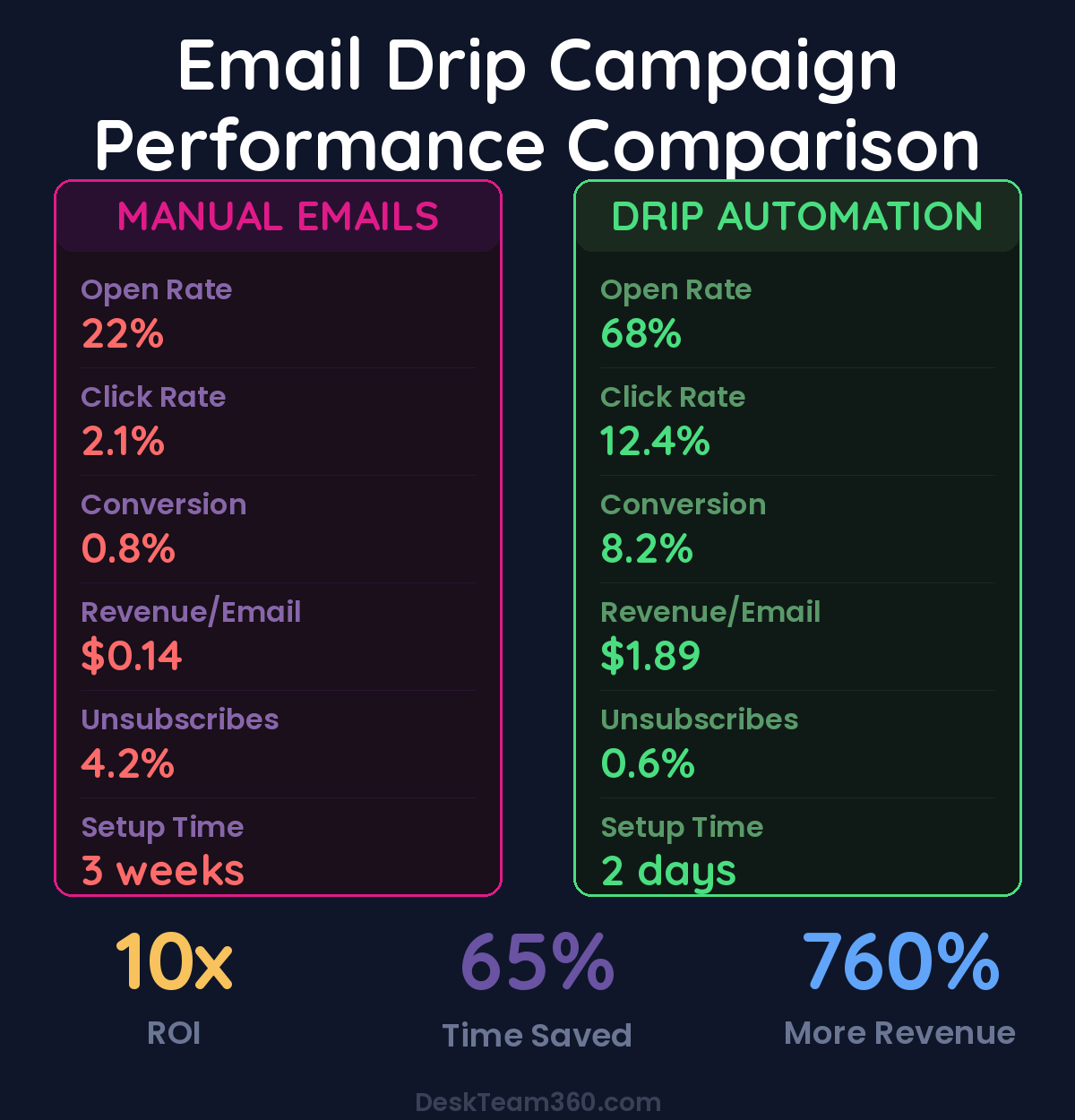
Segmented email campaigns generate 760% more revenue than broadcast emails. Yet 70% of businesses still send the same message to everyone.
Track the Right Metrics
Open rates are vanity metrics. Click-through rates matter more. Conversion rates matter most. Track what drives business results, not what looks impressive on reports.
For each campaign, monitor: email deliverability rate (above 95%), open rate by email in sequence, click-through rate by email, conversion rate to your goal action, and unsubscribe rate (under 2% per campaign). Revenue per email sent is the ultimate scorecard.
Common Drip Campaign Mistakes That Kill Results
I’ve audited hundreds of email campaigns, and the same mistakes appear repeatedly. Here’s how to avoid the big ones.
Writing emails in batches instead of as a connected story. Each email should flow naturally from the previous one. If you can rearrange the order without losing coherence, your sequence isn’t connected enough.
We break this down further in digital marketing for home services: the complete playbook.
For industry research and benchmarks, check out HubSpot Marketing.
Making every email about you. Features, benefits, your company story, your product updates. Flip the ratio. 80% about them, their challenges, their goals. 20% about how you help.
Weak or missing calls-to-action. Every email needs a clear next step, even if it’s just “reply and let me know what you think.” Emails without CTAs are just newsletters in disguise.
Watch out: Don’t bury your CTA at the bottom of a 500-word email. Lead with value, make your ask, then provide supporting details. Most people decide whether to click within the first 50 words.
Ignoring mobile optimization. If your emails look terrible on phones, you’ve lost 70% of your audience before they finish reading. Test every email on multiple devices before sending.
Set-and-forget mentality. Your first campaign won’t be perfect. Monitor performance, A/B test subject lines and copy, update based on customer feedback. The best campaigns are constantly evolving.
Advanced Strategies for Email Campaign Optimization
Once your basic campaign is performing, these advanced tactics can double or triple your results.
Behavioral Triggers Beat Time Triggers
Instead of “send email 3 after 5 days,” trigger emails based on actual behavior. Downloaded your guide? Send the implementation checklist. Visited pricing page? Send case studies and testimonials. Abandoned cart? Send discount code and scarcity messaging.
This requires integration between your ESP and website analytics, but the relevance improvement is dramatic. Behavior-triggered emails see 50%+ higher engagement than time-based sequences.
Dynamic Content Based on Subscriber Data
Show different content blocks based on subscriber attributes. Enterprise customers see ROI calculations and security features. Small businesses see ease-of-use and quick setup benefits. Same email, personalized sections.
Most ESPs support basic dynamic content through merge tags and conditional logic. Use it for more than first names. Industry, company size, and product interest create much more relevant experiences.
Re-engagement Sequences for Non-Openers
Someone didn’t open email 2? Send them a different version of the same message with a new subject line. Still no response after email 3? Branch them into a separate re-engagement sequence with different messaging and timing.
This prevents active subscribers from getting buried in sequences designed for inactive ones. Engagement levels determine email frequency and content intensity.
Measuring Success: KPIs That Actually Matter
Vanity metrics feel good but don’t pay bills. Focus on metrics that directly impact revenue and customer lifetime value.
Campaign-level metrics include overall conversion rate (goal completions divided by campaign entries), revenue per campaign subscriber, average time from entry to conversion, and cost per conversion including content creation time.
Email-level metrics include click-to-open rate (clicks divided by opens, not total sends), forward rate and social shares, reply rate for conversational emails, and conversion rate by traffic source and subscriber segment.
Monthly optimization reviews should cover: top-performing subject lines and copy elements, highest-converting calls-to-action, optimal send timing by audience segment, and subscriber feedback themes. Use this data to improve future campaigns and optimize existing ones.
Building Your First Email Drip Campaign
Start with a welcome series if you don’t have one. It’s the highest-leverage campaign for most businesses and the easiest to create content for. Focus on the framework: clear goal, relevant trigger, mapped customer journey, connected email sequence.
Write your first draft, test it on a small segment, measure results, and iterate based on data. Perfect campaigns don’t exist, but campaigns that improve every month compound into serious business drivers.
If you need help setting up email marketing systems that actually convert, that’s exactly what we do at DeskTeam360. We handle the strategy, copywriting, technical setup, and ongoing optimization so you can focus on running your business while your emails work 24/7 to grow it.
Free 5-Minute Video
See How DeskTeam360 Works in Under 5 Minutes
Watch the short video and see exactly how we handle design, development, and marketing implementation — so you don't have to.
Watch the Video →