


How to Do Keyword Research for SEO: Step-by-Step Guide
Knowing how to do keyword research can be the difference between growth and spinning your wheels.
📋 Table of Contents
Why Most Businesses Waste Thousands on Content Nobody Searches For
I’m going to be blunt: if you’re creating content without doing keyword research first, you’re gambling. You might get lucky and rank for something valuable. But more likely, you’re writing blog posts and building pages that nobody is searching for.
I’ve been running agencies for 12+ years, and I see this pattern everywhere. A business invests $10K in content creation, publishes 50 blog posts, and gets almost zero organic traffic. The reason is always the same, they never checked whether anyone was actually searching for the topics they wrote about.
Keyword research is how you make sure every piece of content you create has a real audience waiting for it. It’s not glamorous work, it’s detective work. But it’s the most important work you can do before you write a single word.
Here’s exactly how to do it, the free tools, the paid tools worth investing in, and the strategic thinking that ties it all together.
Search Intent Is Everything (And Most People Get It Wrong)
Keywords aren’t just words, they’re windows into what people actually want. Before you chase any keyword, you need to understand the intent behind it. Get this wrong and you’ll create content that ranks but never converts.
The Four Types of Search Intent
Informational intent: The searcher wants to learn something. “What is SEO,” “how to change a tire,” “best practices for email marketing.” They’re not ready to buy, they want answers. These build authority but rarely drive sales directly.
Navigational intent: The searcher is looking for a specific website or brand. “Facebook login,” “HubSpot pricing,” “DeskTeam360 blog.” They know where they want to go. Limited value unless it’s your brand they’re searching for.
Commercial investigation: The searcher is comparing options before a purchase. “Best CRM for small business,” “Mailchimp vs ConvertKit,” “top web design services.” They’re getting close to buying but haven’t decided yet. These are gold mines for positioning your solution.
Transactional intent: The searcher is ready to buy or take action. “Buy running shoes online,” “hire web designer,” “sign up for HubSpot.” These are the highest-value keywords because they indicate purchase readiness.
Don’t chase volume blindly. Chase intent that aligns with your business goals. I’d rather rank for 10 transactional keywords than 100 informational ones.
Free 5-Minute Video
See How DeskTeam360 Works in Under 5 Minutes
Watch the short video and see exactly how we handle design, development, and marketing implementation — so you don't have to.
Watch the Video →
Free Keyword Research Tools That Actually Work
You don’t need expensive tools to start doing effective keyword research. Here are the free options that deliver real results.
Google Search (The Tool Everyone Overlooks)
Google gives you keyword ideas for free, you just need to know where to look. I use this method before any paid tool because it shows you what people actually search for, not what keyword tools think they search for.
Autocomplete suggestions: Start typing a keyword in Google’s search bar and note the suggestions that appear. These are real searches that real people make frequently. Google doesn’t suggest random phrases, it suggests what gets searched most.
People Also Ask boxes: After searching, look for the “People Also Ask” section. Each question is a keyword opportunity. Click on one, and more appear. You can mine dozens of long-tail keywords this way in five minutes.
Related searches: Scroll to the bottom of the search results page for “Related searches.” These are semantically related keywords that Google associates with your query. They’re usually less competitive than your original search.
Google Search Console (Your Secret Weapon)
If you already have a website, Google Search Console shows you exactly what keywords you’re ranking for and how much traffic they drive. This is free data directly from Google about your specific website.
Look for keywords where you rank on page 2 (positions 11-20). These are prime candidates for optimization because you’re close to page 1. Sometimes a simple content update or better internal linking is all you need to jump to page 1.
If you haven’t set this up yet, our guide on setting up Google Analytics walks you through the same process for Search Console.
AnswerThePublic (For Question-Based Content)
AnswerThePublic visualizes questions and phrases that people search for around any seed keyword. Type in “web design” and you’ll get hundreds of question-based keywords organized by who, what, when, where, why, and how.
This is especially valuable for blog content because people search for questions, not just product names. “How much does web design cost” gets more searches than “web design pricing.”
Pro tip: Export your last six months of customer questions from support tickets, sales calls, and chat logs. Turn the most common questions into keyword research targets. Your customers are literally telling you what to create content about.
Related reading: Digital Marketing for Construction Companies: The Complete Guide.
Paid Tools Worth the Investment
When you’re serious about SEO, paid tools give you significantly more data, accuracy, and competitive intelligence. Here’s where to put your money.
Ahrefs (Best Overall for Serious SEO)
Ahrefs is expensive at $99/month, but it’s the gold standard for keyword research. The keyword database is massive, the difficulty scores actually correlate with ranking difficulty, and the competitive analysis features are unmatched.
What makes Ahrefs worth it: accurate search volume data (not ranges), keyword difficulty scores that I trust, click data that shows how many clicks a keyword actually generates, competitor analysis that reveals exactly what keywords your competitors rank for, and content gap analysis that finds keywords competitors rank for that you don’t.
SEMrush (Best All-in-One Platform)
SEMrush covers keyword research, competitor analysis, site auditing, and more. If you want one tool that handles SEO, PPC research, and content marketing, SEMrush is the all-in-one choice. Slightly less accurate than Ahrefs for keyword data but broader feature set.
Moz Keyword Explorer (Best for Beginners)
Moz’s tool is more beginner-friendly with clear difficulty scores and “Priority” metrics that factor in volume, difficulty, and CTR opportunity. Good for teams newer to SEO who want guidance built into the tool.
The Step-by-Step Keyword Research Process
Enough theory. Here’s the actual playbook I use for every client project.
Step 1: Start With Seed Keywords
Seed keywords are the broad terms that describe your business, products, or services. For a web design agency, seed keywords might be: web design, website development, landing page, graphic design, WordPress.
Don’t overthink this, list 10-15 broad terms related to what you do. These aren’t the keywords you’ll target directly, they’re the starting point for finding better, more specific opportunities.
Step 2: Expand With Modifiers and Tools
Take each seed keyword and run it through your chosen tools. Also add modifiers to generate long-tail variations:
Question modifiers: how to, what is, why, when, where, best way to
Commercial modifiers: best, top, review, comparison, vs, alternative
Local modifiers: near me, in [city], [city] + service
Intent modifiers: buy, hire, cost, pricing, free, cheap, affordable
“Web design” becomes “how much does web design cost,” “best web design for small business,” “hire web designer near me,” and dozens more. Each variation targets a different stage of the buyer journey.
Step 3: Evaluate Volume, Difficulty, and Intent
For every keyword you’ve generated, evaluate three factors:
Search volume: How many people search for this monthly? Higher isn’t always better, but zero volume means zero opportunity. I typically look for keywords with at least 100-500 searches per month for smaller businesses.
Keyword difficulty: How hard will it be to rank on page 1? New websites should target keywords with difficulty scores under 30. Established sites can go after more competitive terms in the 40-60 range.
Search intent: Does this keyword match the type of content you can create? If the intent is informational, you need a blog post or guide. If it’s transactional, you need a service or product page.
The intent-content match is critical. Ranking for an informational keyword with a sales page doesn’t convert visitors. Match your content format to what the searcher actually wants, not what you want to sell them.
Related: Marketing Implementation for Online Service Providers: A Practical Guide.
Step 4: Analyze the Competition
Before committing to a keyword, Google it and study the results. Who currently ranks on page 1? What type of content ranks (blog posts, product pages, videos, tools)? What’s the quality level, can you create something significantly better?
If page 1 is dominated by massive authority sites with comprehensive content, that keyword might be too competitive right now. Look for keywords where the existing results are thin, outdated, or low quality. That’s where you can win.
Step 5: Build Your Keyword Map
Organize your keywords into a spreadsheet that maps each keyword to a specific page on your website:
Primary keyword (the main keyword each page targets), secondary keywords (related terms to include naturally), content type (blog post, service page, landing page, guide), search intent (informational, commercial, transactional), and priority based on volume, difficulty, and business relevance.
This keyword map becomes your content strategy roadmap. Every piece of content you create should be tied to a specific keyword opportunity.
Long-Tail Keywords (Where the Real Money Is)
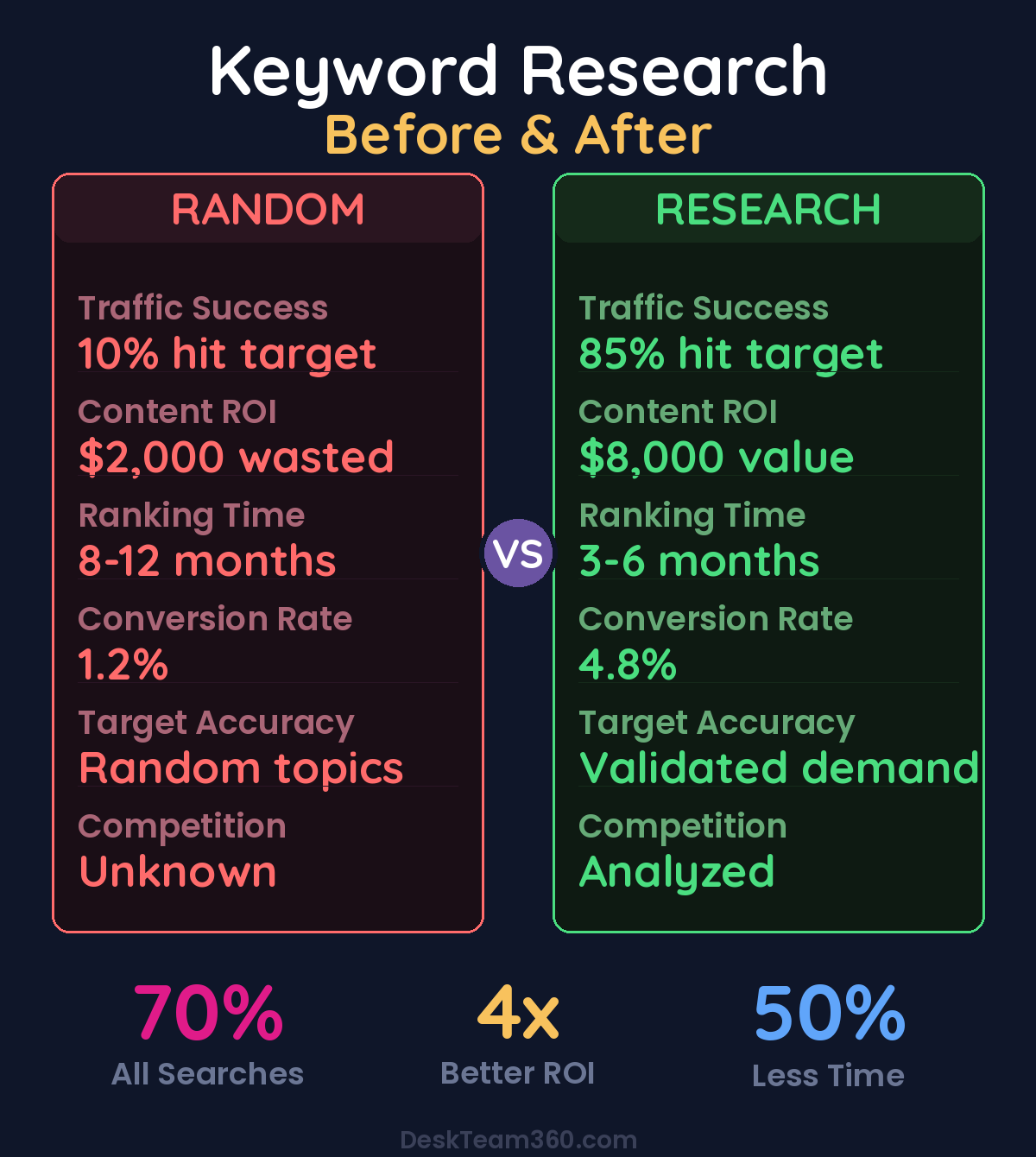
Long-tail keywords are longer, more specific search phrases. They have lower search volume individually but collectively drive the majority of all Google searches. And they’re dramatically easier to rank for.
Someone searching “shoes” could want anything. Someone searching “women’s waterproof hiking boots size 8” knows exactly what they want and is ready to buy. The specificity of long-tail keywords means higher intent and better conversion rates.
I’ve seen clients go from zero organic traffic to 50,000+ monthly visitors by systematically targeting long-tail keywords that their competitors ignored. The cumulative effect is massive.
Long-tail keywords (3+ words) account for 70% of all searches but are targeted by only 30% of websites. That’s a massive opportunity gap.
For industry research and benchmarks, check out Moz SEO Learning Center.
Finding long-tail opportunities: use “People Also Ask” and related searches in Google, filter your keyword tool results by word count (3+ words), check your Search Console data for long-tail queries you already appear for, and browse forums, Reddit, and Quora for how real people phrase their questions.
Competitive Keyword Analysis
One of the most powerful keyword research techniques is analyzing what your competitors rank for. Why start from scratch when you can learn from what’s already working?
Here’s my process: identify 3-5 direct competitors in your space, run their domains through Ahrefs, SEMrush, or Ubersuggest, export their top-ranking keywords, filter for keywords relevant to your business with achievable difficulty, and identify content gaps where they rank for keywords you haven’t targeted yet.
This is especially valuable for businesses entering a competitive market. Your competitors have already done years of content testing and iteration. Learn from their wins and create better versions of what’s working for them.
You can also reverse-engineer their content strategy. What topics do they cover most? What keywords drive their most traffic? What content formats work best in your industry? Use our guide on creating a content calendar to systematize this competitive intelligence into your own strategy.
Keyword Research Mistakes That Kill Results
I see the same mistakes repeatedly, even from experienced marketers.
Targeting only high-volume keywords. You’ll never rank for “marketing” with a new website. Start with achievable long-tail terms and build authority over time. I’d rather rank #3 for a 500-volume keyword than #50 for a 10,000-volume keyword.
Ignoring search intent. Creating informational content to target commercial keywords (or vice versa) is a guaranteed way to get traffic that never converts. Match your content to the intent.
Not updating research regularly. Search trends change constantly. New competitors enter the market. Products evolve. Revisit your keyword research quarterly to catch new opportunities and shifting volumes.
Watch out: Targeting keywords with no business relevance just because they have high volume is vanity SEO. Focus on keywords that attract your actual target customers, not random traffic that doesn’t convert.
Keyword stuffing. Writing content that unnaturally repeats your keyword is a relic of 2010 SEO. Write for humans first, optimize for search engines second. Google is smart enough to understand context and synonyms.
Prioritizing Keywords for Maximum Impact
You can’t target every keyword at once, especially with limited resources. Here’s my prioritization framework:
Quick wins (do first): Keywords where you already rank on page 2, keywords with low difficulty and decent volume, keywords with clear transactional or commercial intent that align with your offerings.
Strategic investments (do next): Higher-difficulty keywords that align with core business offerings, keywords requiring comprehensive guide content that establishes authority, keywords that help you own a specific topic cluster in your niche.
Long-term plays (do later): Highly competitive head terms that require significant domain authority, broad informational keywords with massive volume but unclear business value, keywords requiring resource-intensive content like tools or calculators.
From Research to Revenue
Keyword research isn’t a one-time project, it’s an ongoing discipline that should inform every page you build, every blog post you write, and every content decision you make. Do the research, create the content, measure the results, and iterate.
The businesses that win at SEO aren’t the ones with the biggest budgets. They’re the ones that consistently publish high-quality content targeting keywords they’ve validated through research. They understand their audience’s search behavior and create content that matches both intent and quality expectations.
This systematic approach to keyword research has helped our 400+ clients generate millions in organic traffic value. It’s not magic, it’s method. And if you need help turning that keyword research into professionally designed content, landing pages, and website updates, our team handles the implementation while you focus on strategy. Check out our plans here or see how we help with SEO implementation and management.
Free Tool
How Much Is Freelancer Management Really Costing You?
Most agency owners have never done this math. Plug in a few numbers and see your real cost in 2 minutes.
Calculate Your Hidden Costs →