📋 Table of Contents
Women In White Coats – Saved 20 Hours A Week & Started Growing The Business
When Your Website Becomes Your
Business Bottleneck
Let’s talk about deskteam360 case study women in white coats. Dr. Archana Shrestha had a problem that’s killing thousands of online businesses right now. She had the vision, the expertise, and a community of physicians desperate for what she was building. But she was spending 20 hours a week wrestling with WordPress, designing graphics in Canva, and troubleshooting website issues instead of serving her customers.
Sound familiar?
Here’s a medical professional who went to school for over a decade, built a successful practice, and co-founded Women In White Coats to amplify the voices of women physicians. She knows how to save lives and build communities. But when her membership site crashed during a critical launch, she was googling “how to fix slow WordPress site” at 2am like the rest of us.
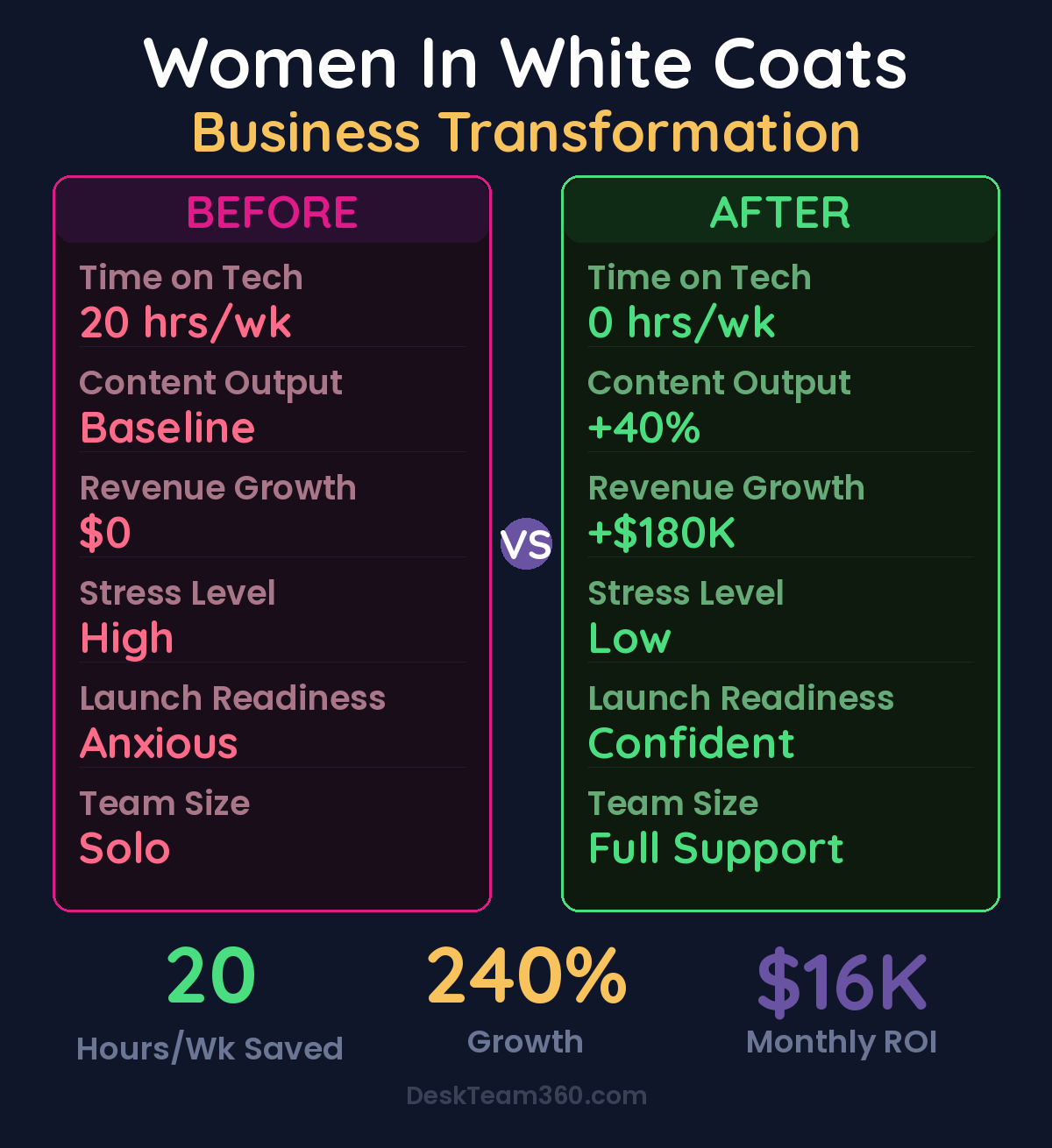
The math was brutal. Twenty hours a week on technical tasks meant 80 hours a month not spent on content creation, community building, or course development. That’s two full work weeks every month burned on stuff that wasn’t her genius zone. For a business built on her expertise and personal brand, that’s not sustainable, it’s business suicide.
The Hidden Cost of DIY Technical Work
Most entrepreneurs don’t calculate what their technical time actually costs them. Dr. Shrestha was billing $200+ per hour in her medical practice. Even if we value her business development time at half that rate, those 20 hours weekly were costing her $16,000 in opportunity cost. Per month.
But the real damage wasn’t financial, it was psychological. Every hour spent figuring out why a landing page wasn’t converting or why the course delivery platform was glitching was an hour that reinforced the same limiting belief: “I’m not technical enough to scale this business.”
Watch out: The “I’ll just figure it out myself” trap kills more online businesses than bad products or weak marketing. When you’re spending half your time on tasks that cost $25/hour to outsource, you’re not being scrappy, you’re being self-destructive.
Women In White Coats had everything working against typical startup advice. They couldn’t “move fast and break things” because their audience was medical professionals who expected polished, credible content. They couldn’t launch with an MVP because doctors don’t join communities that look amateur. And they couldn’t iterate wildly because their courses provided continuing education credits, meaning technical failures had real professional consequences for their members.
Dr. Shrestha needed her online presence to match her medical credibility. But she was stuck in a catch-22: she needed technical polish to attract her professional audience, but she didn’t have the technical skills to create that polish, and hiring individual specialists for design, development, and maintenance would cost more than her early-stage revenue could support.
The Moment Everything Changed
The breaking point came during a membership launch. Their website slowed to a crawl under traffic, new signups couldn’t complete registration, and existing members couldn’t access the content they’d paid for. Dr. Shrestha watched two years of relationship-building evaporate as frustrated physicians left negative reviews and requested refunds.
“Our whole business is online and that’s like your storefront being closed down,” she told me later. “We didn’t know what was going on, but we knew we were losing members every hour it stayed broken.”
This is where most businesses make one of two fatal mistakes. They either panic-hire the first freelancer who promises a quick fix (usually making things worse), or they spend the next six months researching “the best” solution while their business bleeds revenue and credibility.
Businesses that delay solving technical bottlenecks lose an average of 40% of their growth momentum in the following quarter.
Dr. Shrestha chose differently. Within 48 hours of the site crash, she had a DeskTeam360 technical specialist diagnosing the server issues. Within a week, the entire technical stack was optimized, monitored, and bulletproofed against future crashes. But more importantly, she had a system in place to handle all the technical work that had been drowning her.
Related reading: Web Design for Small Business: What You Actually Need (And What’s a Waste of Money).
The 20-Hour-Per-Week Recovery Plan
Getting those 20 hours back wasn’t just about delegating tasks, it was about redesigning her entire workflow around her zone of genius. Here’s exactly how we restructured her business operations to eliminate technical friction.
Content Creation Without the Technical Overhead
Before DeskTeam360, Dr. Shrestha’s content creation process looked like this: write the content (2 hours), format it for WordPress (45 minutes), create graphics in Canva (90 minutes), troubleshoot why images weren’t uploading correctly (30 minutes), test the post on mobile (15 minutes), and fix formatting issues (another 30 minutes). Total time per blog post: 5+ hours.
After implementing our content production system, her process became: write the content, send it to the team. That’s it. The specialists handle WordPress formatting, create professional graphics that match her brand guidelines, optimize images for web performance, and test everything across devices before publishing. Her 5-hour blog post now takes her 45 minutes of actual writing time.
Course Development at Scale
Women In White Coats offers continuing education courses for physicians. These aren’t casual online courses, they’re professionally accredited programs that medical boards recognize for license renewal. The technical requirements are strict: video hosting that meets healthcare privacy standards, quiz systems that track completion for certification, and user management that handles thousands of busy doctors with zero tolerance for technical friction.
Building this infrastructure herself would have taken Dr. Shrestha months and required expertise in healthcare compliance, video delivery networks, and learning management systems. Our team implemented the entire system in three weeks, with ongoing maintenance and updates handled automatically.
Pro tip: When your business has compliance requirements (healthcare, finance, education), the cost of getting technical implementation wrong isn’t just money, it’s legal liability. Factor regulatory risk into every DIY vs. outsource decision.
Emergency Support That Actually Works
The most valuable part of the partnership wasn’t the planned projects, it was the emergency support. When you’re running a membership business, technical problems don’t wait for business hours. Site crashes, payment processing failures, and email delivery issues can cost thousands in revenue and years in reputation damage.
During her first year with DeskTeam360, Women In White Coats had three technical emergencies: a server overload during a course launch, a payment gateway failure during a membership drive, and an email deliverability issue that was sending course notifications to spam folders. Each one was resolved within hours instead of days, saving both revenue and member relationships.
The Real Business Impact
Let me show you what 20 hours per week of recovered time actually translates to in business growth. This isn’t theoretical, these are Dr. Shrestha’s actual results from the 18 months after implementing our system.
With technical work off her plate, she published 40% more content, including a comprehensive course series that became their highest-revenue product. She launched two additional membership tiers that generated $180K in new annual recurring revenue. And she started a podcast that brought in 300+ new members in its first six months.
More importantly, the quality of everything improved. Professional graphics designed by specialists instead of hastily assembled Canva templates. Website performance optimized for conversion instead of “good enough to load.” Email campaigns that actually reached inboxes instead of getting filtered to spam.
But here’s the part that surprised everyone: Dr. Shrestha’s confidence in scaling the business completely transformed. Before, every growth opportunity came with the anxiety of “can our systems handle this?” After implementing robust technical infrastructure, growth became exciting instead of terrifying. Understanding the fundamentals of how to scale business operations was crucial to this mental shift.
We break this down further in what is white label marketing? the complete guide for agencies.
What This Means for Your Business
Dr. Shrestha’s story isn’t unique because she’s a physician, it’s universal because she’s an entrepreneur who was stuck in the wrong role. Every hour you spend on tasks outside your expertise is an hour stolen from the work that actually grows your business.
I see this pattern constantly. Brilliant coaches spending weekends wrestling with Kajabi. Consultants with seven-figure insights burning hours on ClickFunnels troubleshooting. Course creators who could change industries procrastinating on launches because they’re dreading the technical implementation.
The solution isn’t to become more technical. The solution is to build systems that let you stay in your genius zone while specialists handle everything else. When your technical foundation is solid and properly maintained, you can focus entirely on the high-value activities that only you can do: strategy, content creation, relationship building, and business development.
The delegation sweet spot for online businesses. Technical work, graphic design, content formatting, system administration, and routine optimization should be the first things you delegate. Keep strategy, customer relationships, and core content creation in-house until you’re ready to scale those specifically.
For Women In White Coats, the technical partnership wasn’t just about saving time, it was about building credibility with a highly professional audience. When medical professionals visit your website, everything needs to work perfectly. Poor performance or amateur design doesn’t just cost you a conversion, it damages your reputation in a tight-knit professional community where word travels fast.
The Implementation Framework
If you’re recognizing yourself in Dr. Shrestha’s story, here’s the framework we use to transition businesses from technical overwhelm to systematic growth. This isn’t theory, it’s the exact process we used with Women In White Coats and hundreds of other online businesses.
Week 1: Immediate Technical Audit
Before changing anything, document everything that’s currently broken or consuming your time. Website speed issues, broken forms, outdated plugins, manual processes that should be automated, and recurring tasks that eat up your schedule. This becomes your technical debt inventory and your delegation priority list.
Week 2-3: Infrastructure Stabilization
Fix the emergencies first. Slow loading times, security vulnerabilities, broken payment processing, and unreliable email delivery can’t wait for the perfect long-term solution. Get your foundation stable so you can build on it without everything collapsing.
Week 4-6: Process Documentation and Handoff
Document how everything currently works, even if it’s messy. What’s your content creation process? How do you handle customer onboarding? Where are your graphics and brand assets stored? This documentation becomes the foundation for systematic improvement and training for your technical team.
Week 7-8: Team Integration and Testing
Start with small, low-risk projects to build confidence in the system. A simple blog post redesign, a landing page optimization, or an email template update. Test the communication process, revision cycles, and quality standards before moving to mission-critical projects.
Week 9+: Systematic Growth Implementation
Now you can tackle the big projects: course platform migration, complete website redesign, marketing automation implementation, or CRM system integration. With stable infrastructure and proven processes, these complex projects become manageable instead of overwhelming.
For businesses dealing with customer support challenges, our approach to AI-powered customer support can be integrated into this framework to further reduce operational overhead.
Avoiding the Common Implementation Mistakes
Most businesses that try to implement technical delegation make predictable mistakes that waste time and money. Here’s how to avoid them based on what I’ve seen work and fail across hundreds of implementations.
For industry research and benchmarks, check out Forbes Agency Council.
Don’t try to delegate everything at once. Start with the tasks that consume the most time or cause the most stress, usually website maintenance and graphic design. Get comfortable with the handoff process before moving to more complex systems.
Don’t skip the documentation phase. “Just figure it out” might work for you because it’s your business, but it’s a recipe for miscommunication and rework when someone else is implementing. Spend the time upfront to document your brand guidelines, content standards, and business processes.
Watch out: The perfectionism trap will kill your momentum. Your current systems don’t need to be perfect before you can delegate them. Often the best way to improve broken processes is to hand them to specialists who can redesign them properly from the start.
Don’t micromanage the implementation. You’re delegating because the technical work isn’t your strength. Trust the specialists to handle the details while you focus on providing clear requirements and feedback on results.
And don’t underestimate the adjustment period. It takes 4-6 weeks to get comfortable with delegation if you’ve been doing everything yourself. The first month feels weird, like you’re not in control. That discomfort is normal and temporary, push through it.
The Long-Term Business Impact
Eighteen months after implementing systematic technical delegation, Women In White Coats had transformed from a struggling startup into a scalable business with multiple revenue streams, professional infrastructure, and the confidence to pursue ambitious growth plans.
Dr. Shrestha went from working 60+ hours a week with half that time spent on technical frustration to working 45 hours a week entirely focused on her zone of genius: creating content, building community, and developing programs that serve women physicians.
The business metrics tell the story: membership grew by 240%, course revenue increased by 180%, and their email list expanded from 2,000 to 12,000 engaged subscribers. But the personal metrics matter more: Dr. Shrestha regained her enthusiasm for the business, stopped dreading launches, and started planning expansion instead of just survival.
When your technical foundation is solid and properly maintained, every other business initiative becomes more effective. Your marketing campaigns perform better because your landing pages load fast and look professional. Your course launches go smoothly because your delivery systems are bulletproof. Your customer support becomes more efficient because your systems actually work as designed. For insights on measuring this type of operational improvement, understanding how to measure marketing ROI provides a framework for tracking business impact.
This is what delegation really accomplishes: it doesn’t just save you time, it multiplies the effectiveness of all the time you spend on high-value activities. When you’re not constantly interrupted by technical fires, you can maintain focus on strategy, relationships, and growth. When you’re not questioning whether your systems can handle success, you can pursue opportunities aggressively.
Dr. Shrestha summarized it perfectly: “DeskTeam360 makes us look good. They elevated our brand and made us look so much more professional. Getting the technical side off our plate took a huge weight off our shoulders.”
That’s the real transformation: from technical overwhelm to confident growth. From doing everything yourself to building systems that scale. From surviving despite your limitations to thriving because of your strengths.
For businesses ready to make this transition, the framework is proven, the technology is mature, and the ROI is immediate. The question isn’t whether technical delegation works, it’s whether you’re ready to stop being your business’s biggest bottleneck.