
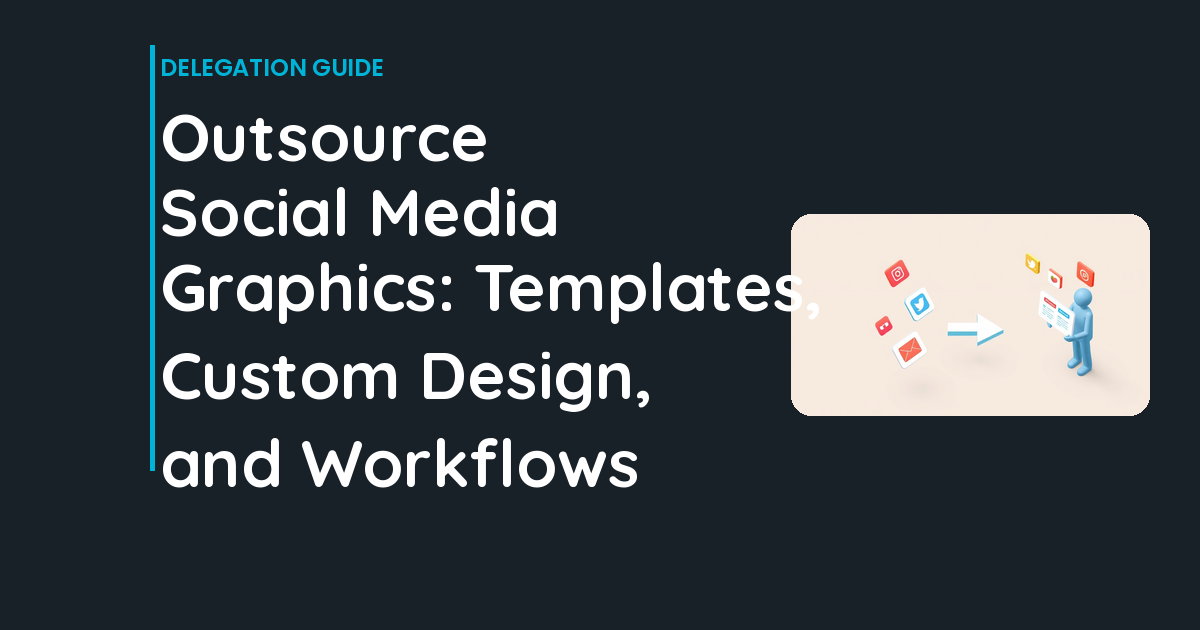
Outsource Social Media Graphics: Templates, Custom Design, and Workflows
Why DIY Social Media Graphics Are Killing Your Business
When you outsource social media graphics, you’re making a strategic move. It’s midnight. You’re hunched over Canva trying to make a decent Instagram post for tomorrow morning. Your eyes are burning. Your design skills peaked in middle school PowerPoint presentations. And you’re thinking, “There has to be a better way.”
📋 Table of Contents
There is. I’ve been outsourcing marketing tasks for 12+ years across 400+ client projects, and social media graphics are the easiest win you can get. Here’s exactly how to stop wasting your time on amateur-hour designs and build a system that produces professional graphics at scale.
The Real Volume Problem Nobody Talks About
Let me break down the math that every business owner pretends doesn’t exist. A serious social media presence requires posting consistently across multiple platforms. Instagram needs 3-5 feed posts plus 5-10 stories per week. LinkedIn wants 3-5 posts. Facebook, same. Add Twitter, Pinterest, and TikTok if you’re feeling ambitious.
That’s easily 25-40 unique graphics per week. Every single week. Forever.
Each platform has different dimensions. Instagram Stories are vertical 1080×1920. LinkedIn posts are 1200×627. Pinterest pins are 1000×1500. You can’t just resize one design and call it a day, it looks terrible and performs worse.
The average business needs 1,500+ social media graphics per year to maintain a professional presence across platforms.
If you’re spending even 30 minutes per graphic in Canva, that’s 750 hours annually. At $100/hour (what your time is actually worth), you’re burning $75,000 in opportunity cost on graphics that probably look like they were made in Canva.
I’m not here to make you feel bad about your design skills. I’m here to show you how to fix this systematically.
Free 5-Minute Video
See How DeskTeam360 Works in Under 5 Minutes
Watch the short video and see exactly how we handle design, development, and marketing implementation — so you don't have to.
Watch the Video →
Templates vs Custom Design: The 80/20 Rule
Here’s the framework that changed everything for our clients: 80% of your social media graphics should use templates, 20% should be custom designed. This isn’t a compromise, it’s strategic efficiency.
The Template System That Actually Works
Templates aren’t about being lazy, they’re about creating a repeatable system that maintains brand consistency while allowing fast production. When I say templates, I mean a library of master designs where you swap content without touching the layout.
Your template library needs to cover these content types: quote graphics with 2-3 layout variations, educational tips or how-to posts, promotional announcements and sales, customer testimonials and reviews, blog post promotions, carousel slides for multi-part content, and stories templates for behind-the-scenes content.
The magic happens when your template system is platform-specific. Your Instagram quote template feels native to Instagram. Your LinkedIn thought leadership template matches what performs on LinkedIn. You’re not forcing square pegs into round holes.
Pro tip: Invest 2-3 weeks getting your template library perfect before you outsource anything. A solid template system is the difference between a designer producing 5 graphics per day versus 25 graphics per day. The upfront investment pays dividends forever.
When to Go Custom
The remaining 20% of your graphics need fresh, custom design. Campaign launches, major announcements, holiday and seasonal content, complex infographics, event promotions, and anything that needs to stand out from your regular content flow.
Custom work takes 3-5x longer than template work, which is why you limit it. But when you need to make an impact, custom design is worth every minute.
Building Your Graphics Outsourcing System
Enough theory. Here’s the step-by-step process I use with every client.
Step 1: Document Your Brand (Before You Outsource Anything)
Most people skip this step and then wonder why their outsourced graphics look generic. Your designer isn’t a mind reader. They need a brand kit that covers every design decision.
Document your primary colors with exact hex codes, secondary colors for variety, fonts with specific weights (don’t just say “use Arial”), logo variations for different backgrounds, photography style examples, graphic style preferences, and your brand voice and tone.
If you don’t have this documented yet, stop here and create it. Our guide on creating brand style guides walks you through the entire process. You can’t outsource effectively without clear brand standards.
Step 2: Build Your Content Pillar System
Random content gets random results. Define 4-5 content pillars that all your social media revolves around. For a service business, that might be educational content teaching your expertise, behind-the-scenes content showing your process, client results and case studies, industry commentary with your takes on trends, and promotional content with offers and CTAs.
Each pillar gets its own template set. When you brief your designer, you’re not saying “make this pretty,” you’re saying “this is an educational post, use template set B, swap in this headline and data.”
Step 3: Batch Everything (This Is Where Most People Fail)
Here’s what doesn’t work: requesting graphics one at a time as you need them. Your designer spends all their time context-switching instead of being productive. You spend all your time writing briefs instead of running your business.
Here’s what works: monthly batching. Spend week one planning your entire month’s content calendar. Topics, copy, images, templates. Week two, submit everything to your design team in one massive batch. Week three, review and revisions. Week four, schedule everything and forget about graphics until next month.
Batching turns graphic design from a daily interruption into a monthly process. The efficiency gains are massive.
Step 4: Create Your Quality Control Checklist
No graphic goes live without passing this checklist. Brand colors used correctly, fonts match brand standards exactly, logo properly positioned, text is readable with proper contrast, no spelling or grammar errors, correct dimensions for target platform, all text stays within safe zones, and image quality is high resolution.
Print this checklist and use it. Every time. Quality control is what separates professional outsourcing from amateur hour.
Where to Actually Outsource Social Media Graphics
You’ve got four real options. Here’s the honest breakdown of each.
Freelance Designers
Freelancers charge $25-75 per graphic or $20-50/hour. They’re fine for light social media needs, maybe 10-15 graphics per month. But as your volume increases, freelancers become expensive and hard to manage.
You’re coordinating schedules, explaining your brand repeatedly to new designers, and hoping they’re available when you need them. The overhead kills the cost savings.
For a deeper dive, see our guide on how much does it cost to outsource marketing in 2026? (real numbers).
Design Agencies
Agencies bring strategic thinking alongside design execution, but you’re paying $1,000-3,000 per month for that strategy. If you need graphics for a major campaign launch, agencies are worth it. For routine social media templates? You’re overpaying for strategy when you need production.
Design Subscription Services
This is where the smart money is. A design subscription like DeskTeam360 charges $399-999 per month for unlimited graphics. Need 30 Instagram posts this month? Same price as 5 posts. Templates, custom designs, carousels, stories, all included.
More importantly, one team learns your brand inside and out. Your social media graphics match your website graphics match your email graphics because the same designers produce everything. Brand consistency happens automatically.
The subscription model solves the volume problem. Instead of rationing graphic design because each piece costs money, you can produce as much as you need. This changes your whole approach to social media from “what’s the minimum I can get away with” to “how can I maximize my presence.”
AI Design Tools
I’ll be blunt: AI design tools like Midjourney or DALL-E can’t produce usable social media graphics yet. They’re getting better at pretty pictures, but they fail spectacularly at readable text, precise layouts, and brand consistency. Maybe in 2-3 years, but not today.
Platform-Specific Design Rules
Every platform has its own visual language. Your graphics should feel native to each platform, not like the same design awkwardly resized.
Instagram: Mobile-First Design
Most Instagram browsing happens on phones. Your text needs to be readable at actual phone size, not desktop size. Bold fonts, high contrast, simple layouts. Carousel posts consistently get higher engagement than single images, so invest in multi-slide designs.
Your Instagram grid is your portfolio. Maintain a consistent aesthetic that looks good when someone views your profile. Random fonts and colors make you look amateur.
LinkedIn: Professional but Not Boring
LinkedIn rewards educational content and data-driven insights. Document-style carousels perform exceptionally well. Think “presentation slide” more than “Instagram post.”
Include your branding subtly. A giant logo watermark screams “corporate spam.” Your brand should be recognizable without being obnoxious.
Pinterest: Vertical and Text-Heavy
Pinterest is a search engine, not a social media platform. Vertical format is mandatory, 1000×1500 minimum. Text overlays with clear, bold fonts perform best because people are searching for solutions.
Use keyword-rich text directly on the image. Pinterest users save content for later, so make it clear what value they’re saving.
The ROI Math That Changes Everything
Let’s run the actual numbers because this is where the business case becomes obvious.
DIY approach: 30-45 minutes per graphic in Canva, 25 graphics needed per week, 20 hours weekly time investment, 80 hours monthly. If your time is worth $75/hour (and it should be), you’re burning $6,000 monthly on graphics that look like they were made in Canva.
Outsourced approach: 5 minutes briefing per graphic, 2 hours monthly for reviews and feedback, design service cost of $500-800 monthly. Total monthly investment: $500-800 plus 2 hours of your time.
For industry research and benchmarks, check out Clutch.co.
Outsourcing saves 78 hours per month while producing professional graphics that actually convert.
Those 78 hours can go toward business development, strategy, or actually serving customers. You know, the things that only you can do.

Measuring Performance to Improve Results
Don’t just produce graphics, track which ones perform and feed that data back to your design team. Monitor engagement rates to see which designs get the most likes and comments. Track save rates on Instagram because saves indicate high-value content. Measure click-through rates to see which graphics drive website traffic. Watch follower growth to identify content types that attract new audience.
Share monthly performance data with your design team. Tell them exactly which graphic styles drove the best results. The feedback loop is what separates good content from great content.
For broader content strategy, our content marketing ROI guide covers how to connect social media performance to actual business results.
Common Outsourcing Mistakes That Kill Results
I’ve watched companies blow their social media outsourcing in predictable ways. Here’s how to avoid each pitfall.
Skipping the brand kit documentation. Your designer guesses what you want and probably guesses wrong. Spend time upfront documenting everything, or spend months fixing inconsistent graphics.
Requesting graphics one at a time. This turns your designer into a customer service rep instead of a production machine. Batch requests monthly for maximum efficiency.
No quality control process. Graphics go live with typos, wrong dimensions, or off-brand elements. Create a checklist and use it religiously.
Watch out: Don’t judge your outsourced graphics against your current DIY attempts. Judge them against your competitors’ best content. The goal isn’t just better than what you’re doing now, it’s better than what’s working in your industry.
Changing your brand constantly. Every time you tweak colors or fonts, your designer has to relearn your brand. Lock in your brand standards and stick with them for at least 6 months.
Scale Your Social Media the Right Way
Social media graphics don’t have to be a bottleneck in your marketing. With a solid template system, clear brand standards, and the right outsourcing partner, you can produce professional content at scale without burning out on Canva.
At DeskTeam360, we handle social media graphics alongside websites, email campaigns, ads, and everything else your brand needs. One team, one brand standard, unlimited graphics. For more on building a comprehensive outsourced marketing system, check out our guide on content creation outsourcing.
Stop spending your evenings on design software. Let professionals handle the graphics while you focus on what actually grows your business.
Free Tool
How Much Is Freelancer Management Really Costing You?
Most agency owners have never done this math. Plug in a few numbers and see your real cost in 2 minutes.
Calculate Your Hidden Costs →