📋 Table of Contents
Saved 10 Hours A Week | Saved Thousands Of Dollars A Month | Increased Donations
Your Nonprofit Staff Shouldn’t Be Building Websites
Let’s talk about save time outsourcing and why it matters for your business. I just watched a nonprofit program director spend three hours trying to update a single blog post. She’s brilliant at designing programs to prevent child abuse, but she was googling “how to center an image in WordPress” while $100,000 in grant applications sat unopened on her desk.
This happens at every nonprofit I’ve worked with. Social workers building websites. Program managers figuring out CSS. Executive directors troubleshooting plugins at midnight because the site crashed and donors can’t access the giving page.
It’s completely backwards, and it’s costing you way more than you think.
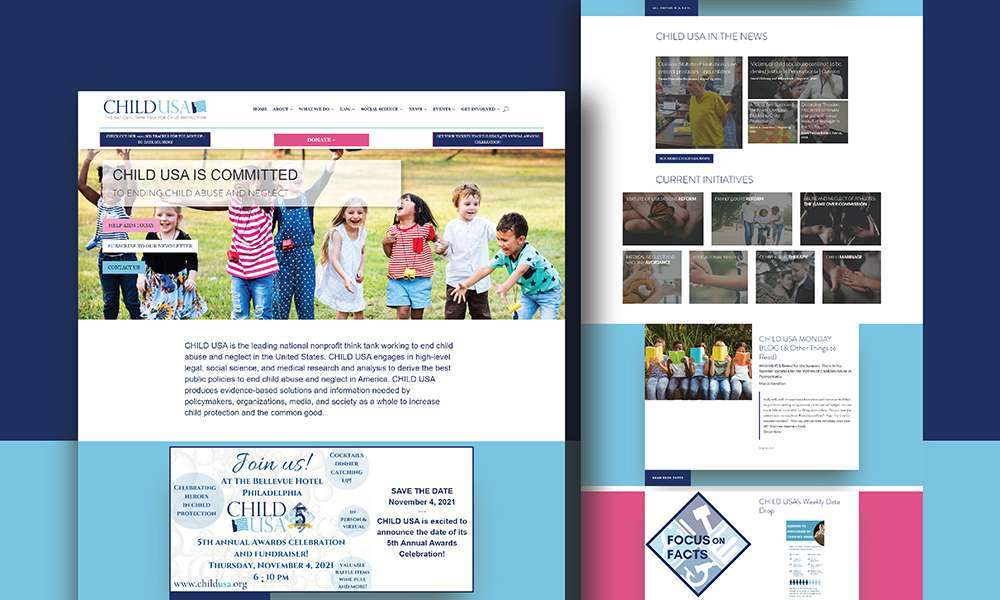
Let me tell you about Child USA, a nonprofit committed to ending child abuse and neglect. Their story illustrates exactly what happens when you stop forcing mission-critical staff to become accidental web developers and actually let them focus on their expertise.
The Hidden Cost of DIY Website Management
Before we dive into Child USA’s transformation, let’s address the elephant in the room. Most nonprofits treat website work like it’s free because staff time doesn’t show up on an invoice. But your program director makes $65,000 a year, your development coordinator makes $55,000, and your executive director makes $85,000. When they’re spending 10 hours a week on website tasks, you’re paying $25-40 per hour for amateur web work.
Here’s what Jillian Ruck, Child USA’s team lead, told me about their situation before making a change: “I would have to assign different staff members to different areas to oversee different parts of the site. Because our site is so large and our staff members are not web or tech people, it would take a lot of time to work on and oversee, and it took a lot of time away from the important things we were working on.”
The real cost isn’t just time, it’s opportunity cost. While your team struggles with technical issues, applications go unwritten. Donor relationships get neglected. Program quality suffers. And ironically, the website still doesn’t look professional because good intentions can’t substitute for technical expertise.
Jillian put it perfectly: “We’d be googling how to do certain things on the site because again none of us were super experienced in this, and while Google can get you far enough, it’s not an amazing site that we were happy to share out to the world.”
The Child USA Transformation
Child USA partnered with DeskTeam360 in March 2021 to completely overhaul how they handled website management. Instead of staff members becoming part-time web developers, they focused on what they do best while delegating all technical work to specialists.
The change wasn’t gradual. It was immediate and dramatic.
“Our blog page was not great, the content was great, but it wasn’t super user-friendly so I wanted to revamp it and standardize it,” Jillian explained. “The team came back and said, hey if you do this it would be great and you wouldn’t be creating a new page every time and you’d have these posts and you would have graphic images instead of just text. I said that looks great, let’s go for it, and your team was able to do it. Once I approved it, it was finished in a day and a half.”
That’s the difference between amateur hour and professional execution. What would have taken their staff weeks of googling and experimenting got done in 36 hours.
Professional web teams don’t just execute, they strategize. Child USA didn’t just get their requests completed, they got recommendations for improvements they hadn’t even considered.
But the bigger transformation happened when DeskTeam360 proactively suggested a complete homepage redesign. Jillian recalls: “In all honesty, I never asked for the home page to be redesigned. Your team came to me and said hey we think your site could look better, here’s a couple of design options, what do you think. I looked at it and I was amazed. Wow, it has all the elements we want to showcase but it looks way better and sleeker, and showed off even better the work that we are doing.”
The Numbers Tell the Real Story
Let’s break down exactly what Child USA saved by making this shift, because the math is compelling for any nonprofit dealing with similar challenges.
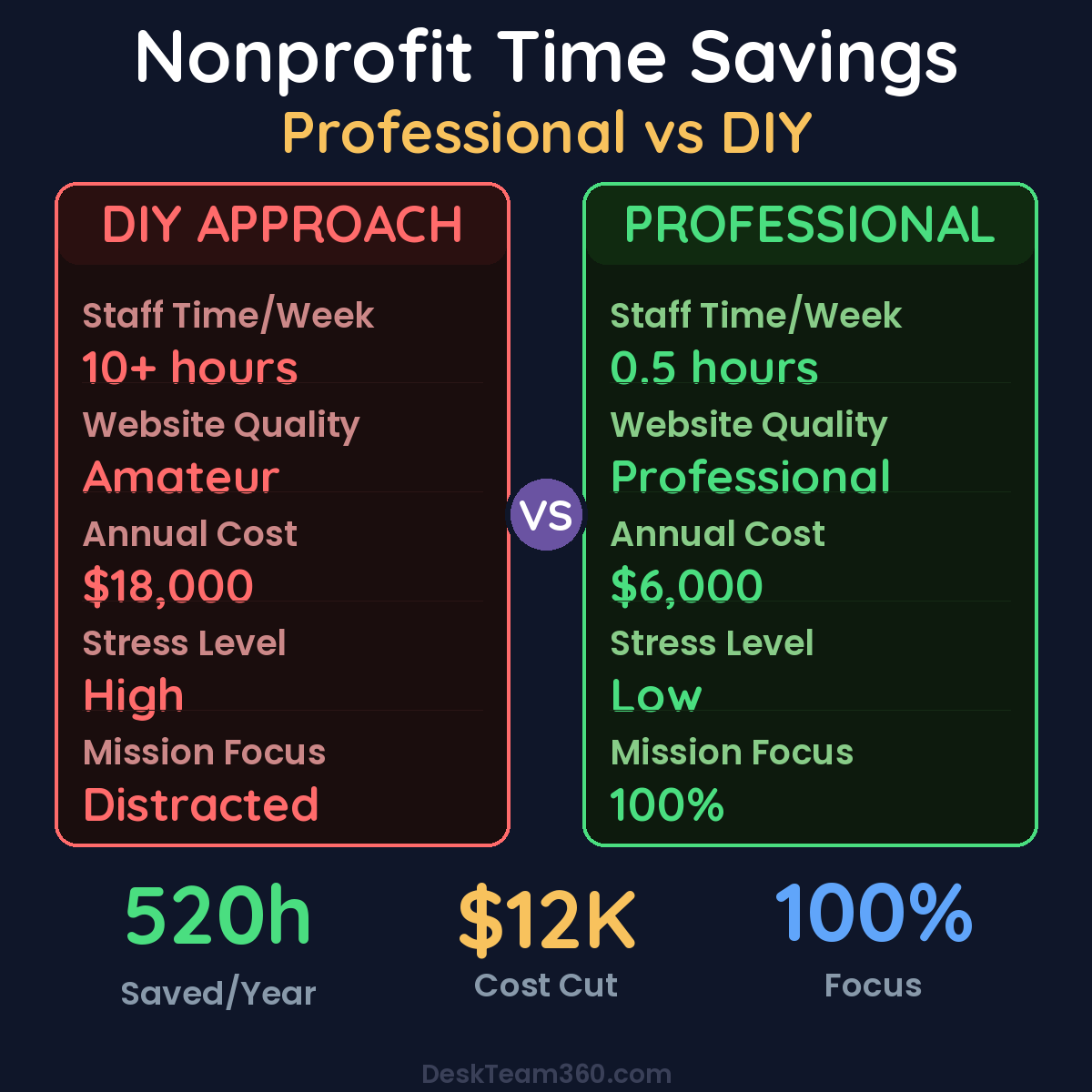
Before the change, Jillian was spending about 10 hours per week on website-related tasks. At her hourly rate (calculated from nonprofit salary standards), that’s $350 per week or roughly $18,000 annually in opportunity cost. Multiply that across the team members who were also pulled into website work, and you’re looking at serious money.
“Over a year’s time, you guys are saving us a month’s worth of time,” Jillian told me. “I was spending about 10 hours a week and now I don’t do that. I approve things and I send it in to your team and it just gets done.”
But the financial impact goes beyond just time savings. “You are saving us thousands of dollars,” she continued. “With the time we save, she can do more fundraising to make even more money.”
Child USA gained 520 hours annually to focus on their core mission while maintaining a professional web presence.
That’s time for grant applications, donor meetings, program development, and actual mission work. When you’re in the business of preventing child abuse, every hour matters.
Beyond Time Savings: The Stress Factor
The quantifiable savings are impressive, but there’s an unquantifiable benefit that Jillian described beautifully: “Before we were like pulling out our hair trying to get these website and technical things to work, and after DeskTeam360 it felt like we were sitting on a beach drinking cocktails and all worries are gone. It’s off our plate. You just have that much more time to go enjoy yourself. That is the feeling for myself and my staff.”
I see this stress pattern constantly. Nonprofit staff take on website responsibilities because somebody has to do it, but they lack the expertise to do it efficiently. They spend hours on tasks that would take a professional minutes. They worry about breaking something. They stress about whether the site looks professional enough for major donors.
Watch out: The “we’ll figure it out” approach to website management creates ongoing stress and anxiety for your team. That emotional cost compounds over time and affects job satisfaction and retention.
Jillian’s team experienced immediate relief: “All of our staff are feeling this way. My team has done nothing but rave about DeskTeam360. They say everyone has been really great to work with, that they love that they can just send in the ticket and it just gets done and they don’t have to worry about it.”
The Professional Standard That Drives Results
Here’s what really clicked for Child USA: their website is their primary fundraising and awareness tool. As Jillian put it, “Our website is the main way of telling people what we do, so it’s really important to invest to make it professional and user-friendly for people who visit it.”
When your website looks amateur, potential donors question your professionalism. When it’s hard to navigate, visitors leave without learning about your mission. When it’s not optimized for donations, you miss revenue opportunities.
Child USA saw immediate improvements in public perception. “Now it looks great and professional and people actually comment now about how great it looks,” Jillian reported. That social proof matters enormously for nonprofits that depend on public trust and support.
The professional standard also enabled bigger thinking: “The biggest win is the fact that we can work on projects that we never would have had the time for. I can go to the team and say I want this part of our site to work better, and I have no idea what that would look like, but your team does.”
Pro tip: When you work with professionals, they bring strategic thinking to your website that goes beyond just executing tasks. They see opportunities for improvement that your staff might miss.
Building Systems That Scale
One aspect of Child USA’s approach that other nonprofits should copy is their systematic approach to delegation. They didn’t just outsource occasional projects, they built a repeating system for ongoing website maintenance and content creation.
“We have DeskTeam360 create every new page and blog post as content is created,” Jillian explained. “You guys really make it look good and professional so our staff can focus on content creation.”
This system approach creates predictable workflows. Staff know they can focus on writing compelling content about their programs and impact, while the technical implementation and design polish happen automatically. It’s the difference between ad-hoc crisis management and strategic operations.
Jillian described how this affected her role as a supervisor: “As a supervisor, you really want to support your staff and give them the resources and time to do what they need to do. And this felt like me being able to say hey team, I hear you, you need more time, and here’s a system that will do that for you.”
The Specialization Principle for Nonprofits
What Child USA discovered is something that for-profit companies figured out decades ago: specialization drives efficiency. You wouldn’t ask your accounting firm to design your programs, so why ask your program staff to build your website?
The most successful nonprofits I work with treat website management like any other professional service. They understand that good web presence requires ongoing attention from people who do this work full-time, not as a side project between their real responsibilities.
This approach scales beyond just websites. The principle applies to social media management, graphic design, email marketing, and other specialized tasks that nonprofits often try to handle internally.
Child USA’s team understood this intuitively. When technical challenges came up, they didn’t try to figure it out themselves. “Things that I don’t even know if it’s possible on a site, and I’m able to ask your team and they know how to do it, which has been so great,” Jillian noted.
Quality Control Without Micromanagement
One concern I hear from nonprofit leaders is losing control over their message and brand when they delegate website work. Child USA’s experience shows how to maintain quality control without micromanaging the process.
They established clear guidelines upfront. “Because we work on children’s issues, we had to say that we only want pictures of happy children and we only had to say that once, so that was really nice,” Jillian explained. Professional teams understand that nonprofits have unique requirements and build systems to accommodate them.
The key is finding a team that takes time to understand your organization’s mission and constraints. “The time you guys took to learn about our organization and to let us know if we do something and I didn’t like it to let us know and we’ll adjust it,” Jillian reflected. “You really just took the time to learn about us and what we like and what we don’t like.”
This is different from working with freelancers or agencies that treat you like a transaction. When you build a relationship with a team that understands your sector and your specific mission, the quality of work improves dramatically.
For industry research and benchmarks, check out Clutch.co.
For a deeper dive, see our guide on 15 benefits of outsourcing marketing (with real examples).
Small Wins That Build Momentum
Child USA’s transformation didn’t happen overnight. It started with small, systematic changes that built confidence and momentum. “The first small win was to set a reminder to send you guys this one thing each week and just have it get done,” Jillian recalled. “Just saves so much time, and don’t have to worry about forgetting to do it and just take it off their plate.”
That’s the pattern I recommend for any nonprofit considering this shift. Start with one recurring task that’s taking staff time away from mission work. Get that working smoothly, then expand to other areas. Understanding effective delegation principles can help you structure this transition properly.
The momentum builds quickly. Once staff experience the relief of having technical tasks handled professionally, they start identifying other areas where delegation could help. “This is going to elevate our public view to the next level,” Jillian predicted as they expanded their partnership.
Success builds on success. When your team sees immediate improvements from professional website management, they become advocates for strategic delegation in other areas.
The Trust Factor
Perhaps the most important element of Child USA’s success was finding a team they could trust. “I was referred to you, and then talking with Cher I could tell that you guys really care about what you do, and that really helped to build the trust,” Jillian explained.
For nonprofits, trust isn’t just about technical competence, it’s about understanding the mission and treating it with appropriate seriousness. Child USA needed a team that understood they weren’t just building a website, they were creating a platform to prevent child abuse and protect vulnerable children.
“You guys really take pride in your work and want to be an excellent product,” Jillian concluded. That attitude difference shows up in every interaction and every deliverable.
What This Means for Your Nonprofit
Child USA’s story isn’t unique. It’s the predictable result of applying professional standards to mission-critical functions. Every nonprofit struggling with website management, social media, or other technical tasks can achieve similar results by making strategic delegation decisions.
The question isn’t whether you can afford to delegate these functions. The question is whether you can afford not to. When your program director is building web pages instead of designing interventions, when your development coordinator is troubleshooting plugins instead of cultivating donors, when your executive director is fighting with WordPress instead of leading strategy, you’re already paying the cost.
You’re just not getting the results.
At DeskTeam360, we work with nonprofits across all mission areas to create professional web presence without the internal technical overhead. From ongoing website maintenance to strategic redesigns to accessibility compliance, we handle the technical side so your staff can focus on changing the world.
The Child USA approach works because it recognizes a simple truth: your mission is too important to be derailed by technical distractions. When you free your team to do what they do best, everyone wins.
Your staff, your donors, your beneficiaries, and ultimately the communities you serve.